
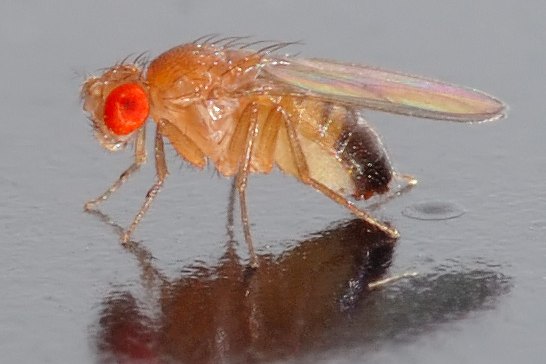
The fly never had to be taught how to eat. A simulated fruit fly, wired from a real insect’s brain map and placed in a physics engine, fed on its own. Scientists at Eon built it, and they say it reached 91% accuracy on behaviors including that feeding step, with no AI training data behind it.
The work was led by senior scientist Philip Shu and his collaborators. They took the connectome of the fruit fly Drosophila melanogaster, mapped by FlyWire, and added a simplified neuron model. The resulting brain holds over 125,000 neurons and 50 million synaptic connections. It drives a fly body simulated in MuJoCo, a physics package.
Brain plus body
Earlier efforts had gone one of two ways. Some modeled brains with no bodies; others animated bodies with no brains. Here the loop is closed: neural activity turns into physical action inside the simulated world.
There is no machine learning in the usual sense. The behavior comes from the wiring itself.
Michael Andrgg, a key figure on the project, listed what the model needs to work:
- the graph of connections between neurons
- the weights of those connections, set by the number of synapses
- a map separating excitatory from inhibitory neurons
- a “leaky-integrate-and-fire” model that governs when neurons fire
He read the result as a point about architecture. “This shows how much information is captured by the architecture itself, rather than the neuron model, which is great for the feasibility of full emulation,” Andrgg said.
Next up, a mouse
Eon says its goal is the largest connectome and the highest-fidelity brain emulation ever produced. A mouse brain comes first, with human-scale emulation as the longer target. The numbers are steep: a mouse brain has roughly 70 million neurons, about 560 times the fly’s count.
Andrgg does not see the jump as a change in kind. “If a fly brain can now close the sensorimotor loop in simulation, the question for the mouse becomes one of scale, not of kind,” he said.
In the meantime the team is working to merge its connectome data with functional recordings. Advances in expansion microscopy should let them map connections in finer detail, and they plan to collect calcium and voltage imaging to watch neural activity in living tissue.
The startuphub report adds that a working brain simulation could help explain brain function and lead to treatments for neurological disorders, and it raises questions about consciousness.




