
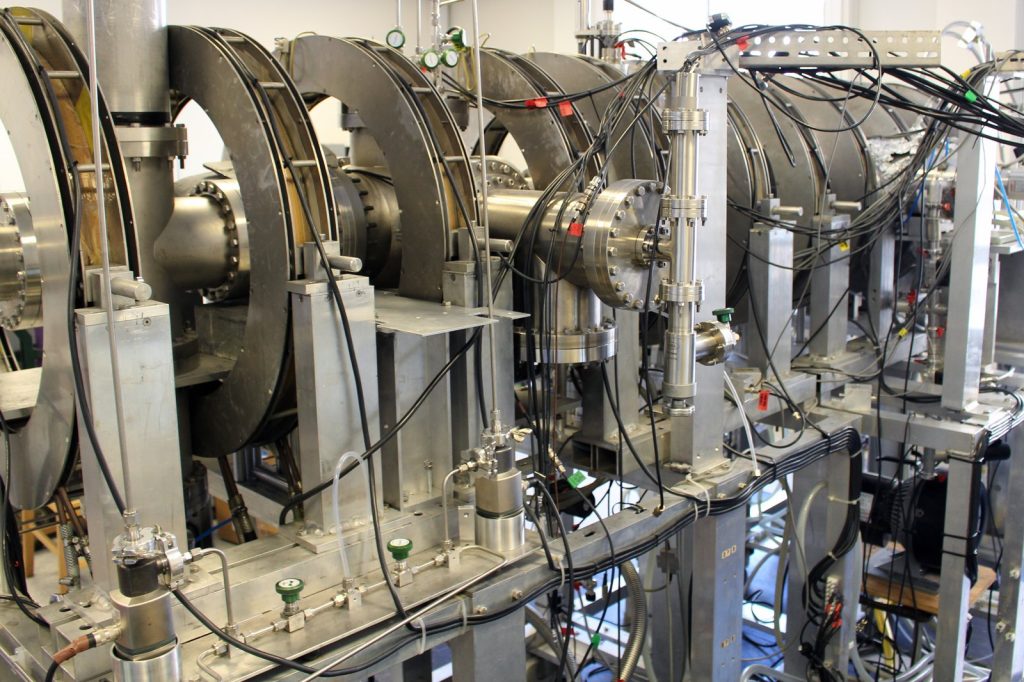
In an unprecedented breakthrough, a team of physicists has successfully observed quantum diffraction in positronium, marking the first time this has been achieved with an exotic matter-antimatter atom. This discovery, reported by the Tokyo University of Science in Nature Communications, demonstrates that positronium, a short-lived atom composed of an electron and its antimatter counterpart, the positron, behaves as a unified quantum object, rather than as two separate particles. The researchers created a high-quality beam of positronium and directed it through an ultra-thin graphene sheet, detecting a distinct diffraction pattern as a result.
This pattern suggests that the electron and positron within positronium act as a single wave, a finding that could have far-reaching implications for the study of antimatter and the fundamental laws of physics. The implications of this discovery could pave the way for precision experiments with antimatter, including testing gravity’s effects on antimatter and delicate material surface studies.
This research could open new avenues for exploration and discovery, particularly in the realm of antimatter physics. Given the unique properties of positronium, this observation represents a significant step forward in our understanding of the behavior of matter and antimatter. The ability to create a high-quality beam of positronium and detect its diffraction pattern is a testament to the advancements being made in this field, and highlights the exciting possibilities that lie ahead in the study of quantum mechanics and antimatter.
As researchers delve deeper into the properties of positronium and other exotic atoms, we can anticipate further breakthroughs and discoveries. These findings could provide insights into some of the most intriguing mysteries in physics, such as the nature of gravity and the behavior of matter at the quantum level.
With the ability to study antimatter in greater detail than ever before, scientists may gain a deeper understanding of the fundamental forces of nature, and how they shape the behavior of particles and objects across all scales, from the smallest subatomic particles to the vast cosmos. As we move forward, it will be fascinating to see how this research evolves and what new discoveries and breakthroughs emerge from the study of positronium and other exotic atoms. These discoveries could redefine our understanding of the universe and the laws of physics that govern it.
Additional Information
Physicists Observe Short-Lived Positronium Atom Acting as a Single Wave Physicists at Tokyo University Build Positronium Beam to Observe Diffraction #PhysicistsObserve #AntimatterAtomBehaving #Wave #Tech #News




