
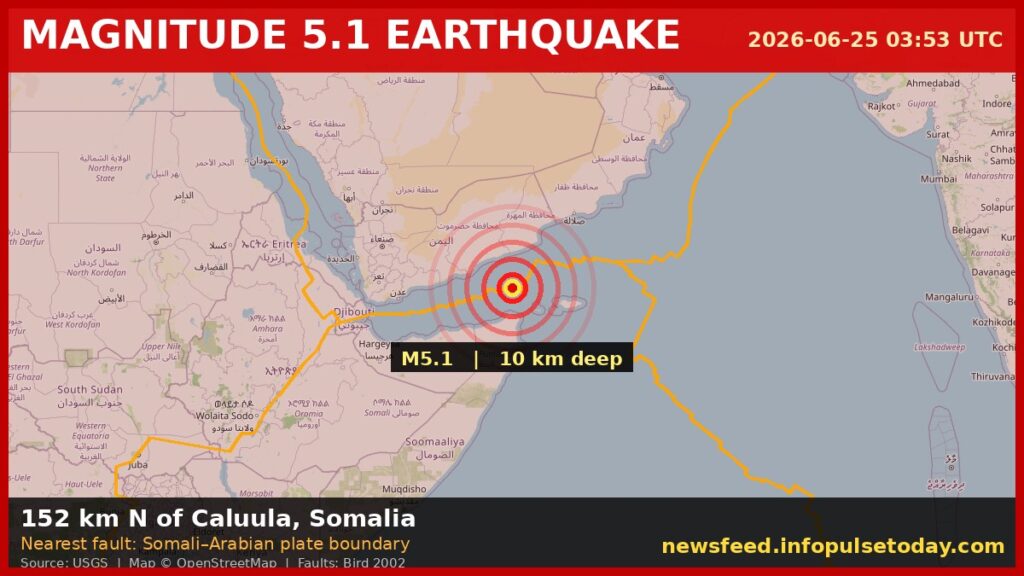
The shallow depth of Thursday morning’s earthquake in the Gulf of Aden is the detail that tells seismologists the most about what happened. The U.S. Geological Survey placed the event at 10 kilometres down. That is very shallow.
For an earthquake of magnitude 5.1, depth determines how the ground behaves. Shallow quakes, defined by the USGS as those less than 70 kilometres deep, release their energy closer to the surface.
The same magnitude at 50 kilometres depth would spread that energy through more rock before it reached people and buildings. At 10 kilometres, the shaking is sharper. It is more concentrated.
That is why a moderate earthquake — and 5.1 is considered moderate — can still cause minor to moderate damage near the epicentre. The energy has nowhere to go but up.
The epicentre was 152 kilometres north of Caluula, Somalia, in a part of the Gulf of Aden that has seen this before. The USGS records show at least 28 earthquakes of magnitude 5.0 or greater within about 300 kilometres of that spot over the past two decades. The largest was a magnitude 6.6 in 2006.
This is a seismically active area. The tectonic plates that meet under the Gulf of Aden are pulling apart, and that stretching produces frequent, sometimes strong, earthquakes. The quake hit at 03:53 UTC on Thursday, June 25.
No tsunami warning was issued. That is standard for a magnitude 5.1 event, especially one that occurred in open water.
Tsunami warnings typically require a larger earthquake, usually above magnitude 7.0, and a specific kind of vertical fault movement. The USGS did not see that here. What seismologists watch for now is aftershocks.
The report notes that aftershocks are common following an earthquake of this size and may continue for days or weeks. The shallow depth means those aftershocks, if they occur, could also produce noticeable shaking.
Aftershocks tend to be smaller than the main shock, but they can still rattle already weakened structures. The USGS continues to monitor the area through its global network. Further updates may come as more data becomes available.
For people in the region, the immediate concern is that the ground could shake again. The USGS advises preparedness for further shaking. That is the standard public safety message for any earthquake of this size.
The moderate magnitude means widespread destruction is not expected. But shallow earthquakes are unpredictable in their local effects.
A building on poor soil near the epicentre could suffer more damage than the same building on solid rock farther away. The USGS does not provide that level of detail in its initial reports. It provides the raw numbers: location, depth, magnitude, time.
The depth of 10 kilometres is the key number in this story. It is the reason this moderate earthquake gets attention.
Deep earthquakes of the same magnitude often go unnoticed by people at the surface. This one was shallow enough to be felt. It was shallow enough to potentially cause damage.
And it was shallow enough that the USGS will keep watching the data streams from its global network for days, looking for the pattern of aftershocks that typically follows an event like this. The next few days will tell whether this was the main event or just the beginning of a sequence.




