
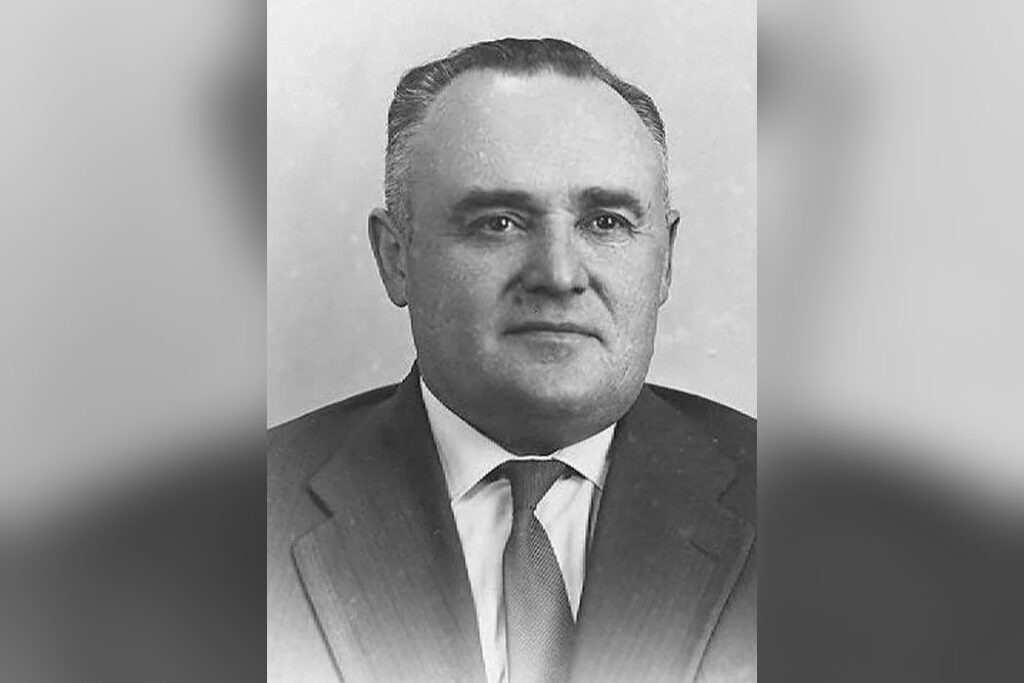
Here is the strangest shift in the whole space race: the man winning it for the Soviet Union could not be named. Sputnik, Vostok, Soyuz were trumpeted worldwide, but Sergei Korolev, the chief designer behind all three, lived and worked as a state secret, his identity unprintable until his death. The world learned his name only in January 1966, when the obituaries appeared. The trend underneath every Soviet first from Sputnik onward runs through one hidden, improbable career.
Korolev was born in Zhytomyr, Ukraine, on 12 January 1907 by the standard account, though a later biographer dates the birth to 30 December 1906; his parents’ marriage was unhappy, his father Pavel was declared dead to the boy and in fact lived until 1929. A teacher’s son obsessed with aircraft, he designed a glider at 17, studied at the Kiev Polytechnic Institute and then in Moscow, and moved from flying to rocket propulsion while it was still theory. In 1931 he co-founded GIRD, the Group for Investigation of Reactive Motion, with Friedrich Tsander and others; it flew the first Soviet liquid-fuel rockets before the military absorbed it in 1933. Then came the purge. His propulsion colleague Valentin Glushko was arrested on 23 March 1938 and, to lighten his own charges, denounced Korolev, who was seized that 7 June and sentenced to ten years of forced labour. In custody he was beaten until his teeth were gone, his knee was ruined and his heart damaged; he passed through four months of Gulag camp before the imprisoned aircraft designer Andrei Tupolev pulled him into a prison engineering bureau. The two rocket men never reconciled, a grudge with later consequences. He was freed in 1944, his conviction set aside.
What’s changing next in the record is the speed of the comeback. In November 1944, still nominally a prisoner, he was handed three days to propose a Soviet answer to the German V2; his sketch flew a quarter of the V2’s range, 75 kilometers, but it kept him in the game. Sent to Germany after the war to assess what the American “Paperclip” operation had left behind, he rose to chief engineer of the new missile institute NII-88, producing the R1, known in the West by its NATO codename Scud. In 1953 he committed to an intercontinental missile of 7000 kilometers range, and on 21 August 1957 the R-7 flew from a new site near Baikonur. Nicknamed “Semyorka”, it was the finest space launcher of its day, and when a science payload fell behind schedule Korolev’s shop built a “minimum satellite” instead: Sputnik 1, orbited on 4 October 1957, its “beep-beep” startling the world. Sputnik 2 followed on 3 November with the dog Laika, then came the first lunar probe, the first photograph of the Moon’s far side, the first probes toward Venus and Mars. For the human step he converted a spy satellite design, swapping its cameras for an ejection seat, and on 12 April 1961 an upgraded R-7 sent Yuri Gagarin into orbit.
The Moon beat him. President John F. Kennedy’s 15 May 1961 pledge turned the race into a national program the USSR had not matched, and Korolev’s answer, the 100-meter N-1 launcher paired with a modular craft he called Soyuz, stalled in politics and grudges. Refusing to work with Glushko, now the empire’s engine chief, he hired aircraft-engine man Nikolai Kuznetsov, whose small motors forced a first stage of 35 engines, 42 across the rocket; the N-1 won approval only in 1964, three years into the American lunar sprint. His health, battered by the camps and the workload, broke in 1965, and he died on the operating table during cancer surgery on 14 January 1966. Luna 9’s soft landing followed two weeks later, the last Soviet first for years. The N-1 flew four times, failed four times, and was cancelled in August 1974, by Glushko, who inherited the bureau. Twice married, Korolev left a daughter, Natasha, and his wife Nina, an Order of Lenin, and his name on a Martian crater, a far-side lunar crater and an asteroid.
Watch this space, though, because the quiet punchline is durability. The R-7’s descendants, flying as Soyuz, have logged more than 1700 launches, the most of any launcher family, from Baikonur, Plesetsk and Europe’s spaceport in French Guiana alike, and both the rocket and the crewed spacecraft still had room to evolve decades after their designer died. The secretive state that hid Korolev is gone. His 1957 hardware is still on the pad.
Sources
- ESA – Sergei Korolev: Father of the Soviet Union’s success in space
- Who was Sergei Korolev? | BBC Sky at Night Magazine




