
“The space shuttle heat shield would come back essentially partially broken and would require many months of refurbishment in order to fly again.” That was Elon Musk’s summary of the problem Starship is trying to avoid, quoted by Ars Technica in August 2025. It also points to a long line of answers to the same question: how do you bring a crew home through plasma?
Apollo: a shield that burned away
Apollo’s answer was ablation. The command module carried a coating that charred and wore off during entry, taking heat with it. That material was Avcoat, silica fibers with an epoxy-novalic resin, packed into a fiberglass-phenolic honeycomb. It brought nine crews home from the Moon between December 1968 and December 1972, according to AmericaSpace. Astronaut John Young recalled a “brilliant white plasma flow shimmering across the outside of the spacecraft.”
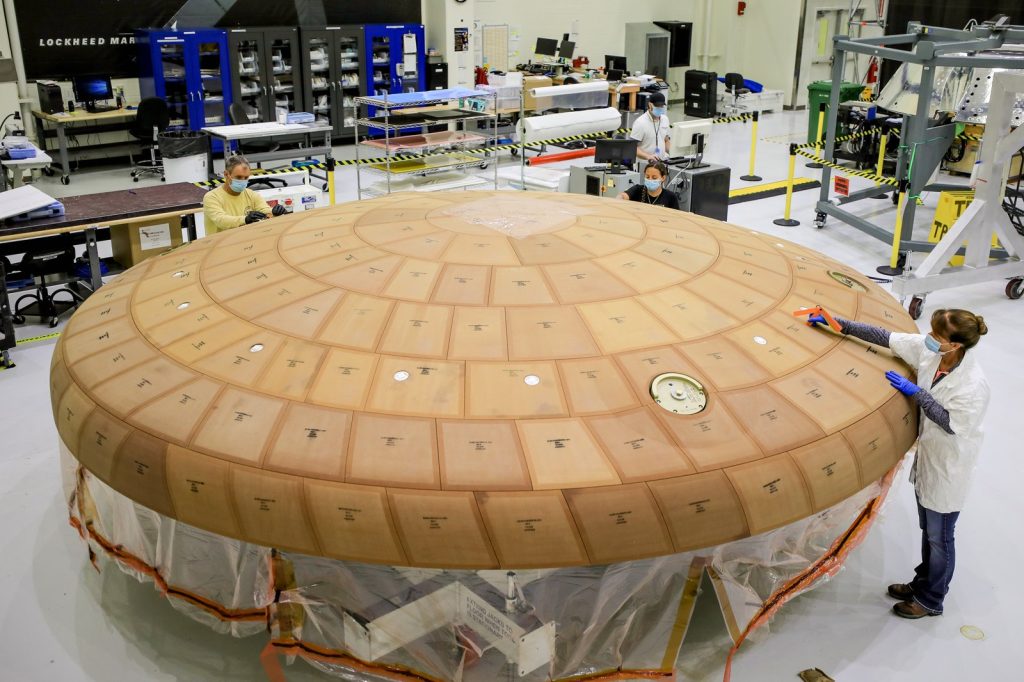
The idea proved durable. When NASA picked a shield for Orion in April 2009, it chose Avcoat again, calling it “the more robust, reliable and mature system.” For the Artemis-2 crew module, technicians applied 186 blocks of it. The shield has to handle temperatures approaching 2,800 degrees Celsius at lunar-return speeds of 24,500 mph.
Shuttle: ceramic tiles
The shuttle designers wanted something reusable. Ablatives were close to a last resort, in the words of NASA historian Dennis R. Jenkins, after a bad experience on the X-15A-2. Lockheed’s ceramic silica insulation won out instead. An early version, LI-1500, was 89 percent porous and survived repeated cycles to 2,500 degrees Fahrenheit.
The material was brittle, so it could not cover a whole vehicle. It went on as small tiles, generally 6-by-6-inch squares, with gaps of about 0.01 inch between them. Each was bonded to a felt pad, and the pad to the skin of the orbiter. Reinforced carbon-carbon protected the nose cap and wing leading edges above 2,700 degrees Fahrenheit. Black tiles covered the underside up to 2,300 degrees, white tiles up to 1,200.
The tiles nearly delayed the program. By mid-1979 NASA found they lacked the strength to survive the loads of even a single mission. Columbia reached Kennedy Space Center with just over 24,000 tiles installed and 6,000 to go. Proof testing at 125 percent of maximum flight stress failed 13 percent of them. Technicians then spent 20 months testing and installing 30,759 tiles, working three shifts a day, six days a week. They managed an average of 1.3 tiles per person per week.
The cost carried through the shuttle’s 30-year service. Ars Technica reported that tile damage was routine and repairs were made in the hangar between missions.
Starship: tiles on stainless steel
SpaceX kept the tile idea and changed the structure beneath it. Starship’s primary structure is stainless steel, chosen partly for its high melting point. On return from space, the ship sees temperatures up to 2,600 degrees Fahrenheit, hot enough to melt aluminum. Early Starships flew with roughly 18,000 hexagonal ceramic tiles, each about the size of a dinner plate.
Musk said in 2019 that the hexagon shape leaves “no straight path for hot gas to accelerate through the gaps.” Space.com reported his stated goal at the time: “Zero refurbishment.”
Reuse is still unproven. In 2025, according to Ars Technica, SpaceX was testing new tile designs, metallic insulators and sections with “active cooling,” and had added a backup layer under the tiles. Musk conceded that the ship had come back through the atmosphere for a soft landing several times but “shed many heat shield tiles” doing it. “There are 100 different variables that we could tweak with the heat shield tiles,” he said, and the only way to learn which to change was to fly repeatedly and inspect the ship after landing.
Sources
- The Shuttle's Thermal Protection System (TPS), by Dennis R. Jenkins (NASA History Office)
- NASA Completes Orion Heat Shield Milestone for Crewed Artemis-2 Mission (AmericaSpace)
- SpaceX's Hexagon Tiles for Starship Heat Shield Pass Fiery Test (Space.com)
- With Starship, SpaceX encounters an obstacle that haunted NASA's space shuttles (Ars Technica, Stephen Clark)




