
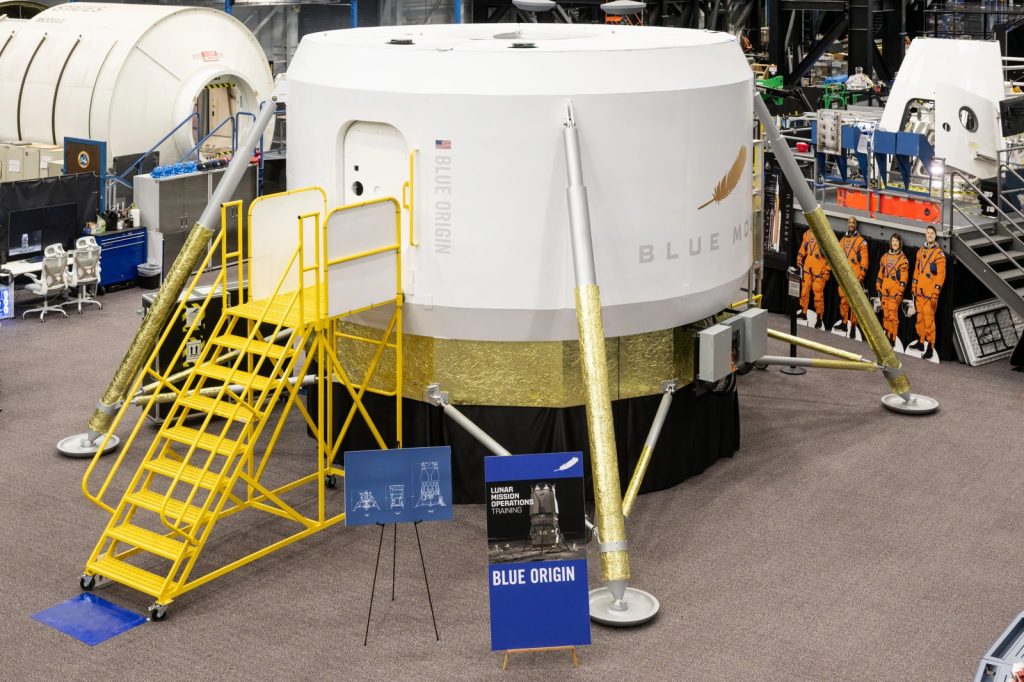
The race to dominate the next era of American spaceflight is playing out not in orbit but in government procurement offices, where two private companies are vying for NASA and Pentagon contracts that will decide who builds the lunar landers and who launches the nation’s most sensitive military satellites. SpaceX, founded by Elon Musk, and Blue Origin, founded by Jeff Bezos, are locked in a rivalry that has reshaped the business of space exploration even as both companies rely on federal dollars to fund their most ambitious projects.
At stake is the architecture of the Artemis program, NASA’s effort to return American astronauts to the lunar surface, as well as the future of national security launches overseen by the U.S. Space Force and the Pentagon.
Lunar Lander Contracts Drive Rivalry
The opening salvo in this corporate contest came in April 2021, when NASA awarded SpaceX a $2.9 billion contract to develop the Human Landing System for the Artemis program. The broader stakes of that program are clear: returning American astronauts to the lunar surface by 2025. Blue Origin did not accept the decision quietly. In August 2021, the company filed a lawsuit challenging the award, a legal gambit that forced a temporary halt in work on the lander.
A federal court dismissed the lawsuit in November 2021, clearing the way for SpaceX to proceed. By 2023, NASA awarded Blue Origin a $3.4 billion contract for a second lunar lander, effectively creating a two-provider architecture for the Artemis program.
The agency now has two competing lunar landers under development. NASA’s procurement choices carry consequences that extend far beyond the balance sheets of the two companies. The agency was created in 1958 during the Space Race to replace an earlier aeronautics committee and give American space activity a civilian, peaceful focus.
It has directed most U.S. crewed and uncrewed spaceflight efforts, from the early Mercury and Gemini flights through the Apollo lunar landings, the Skylab station, the Space Shuttle, and the International Space Station. Today, NASA leads the multinational Artemis program alongside partners in Europe, Japan, Canada, and elsewhere, while also running robotic science missions and maintaining deep space communications networks.
By selecting two competing landers, the agency ensures that if one vendor encounters technical or financial trouble, the other can still carry American astronauts to the Moon—a redundancy that mirrors the Cold War approach of relying on multiple contractors for critical space hardware.
Pentagon and Space Force Contracts at Stake
The competition extends well beyond lunar exploration. Both companies are vying for U.S. Space Force launch contracts that carry national security significance. SpaceX won a $316 million contract in 2020 for national security missions, giving the company a proven track record for delivering military payloads to orbit.
Amazon’s Kuiper satellite constellation, by contrast, has not yet launched any government payloads. The Pentagon’s Defense Innovation Unit has partnered with both companies for satellite-based communications, signaling that the Department of Defense is keeping its options open for future contracts.
NASA works closely with the U.S. Space Force and other federal bodies on launch and research matters. The agency’s procurement decisions shape which companies build lunar landers and carry national security payloads. For now, the strategic advantage remains with SpaceX, which has demonstrated reliable launch capabilities for both NASA and the military.
But the broader stakes of the Artemis program—which aims to reestablish an American presence on the Moon and eventually pave the way for crewed missions to Mars—mean that the competition is far from settled. Blue Origin’s newly funded lunar lander and its continued partnerships with the Pentagon suggest that the rivalry will persist, with both companies pushing the boundaries of what is possible in American spaceflight.
The outcome will determine not only which company controls the next generation of launch infrastructure but also how the United States projects power and presence in the space domain for decades to come.




