
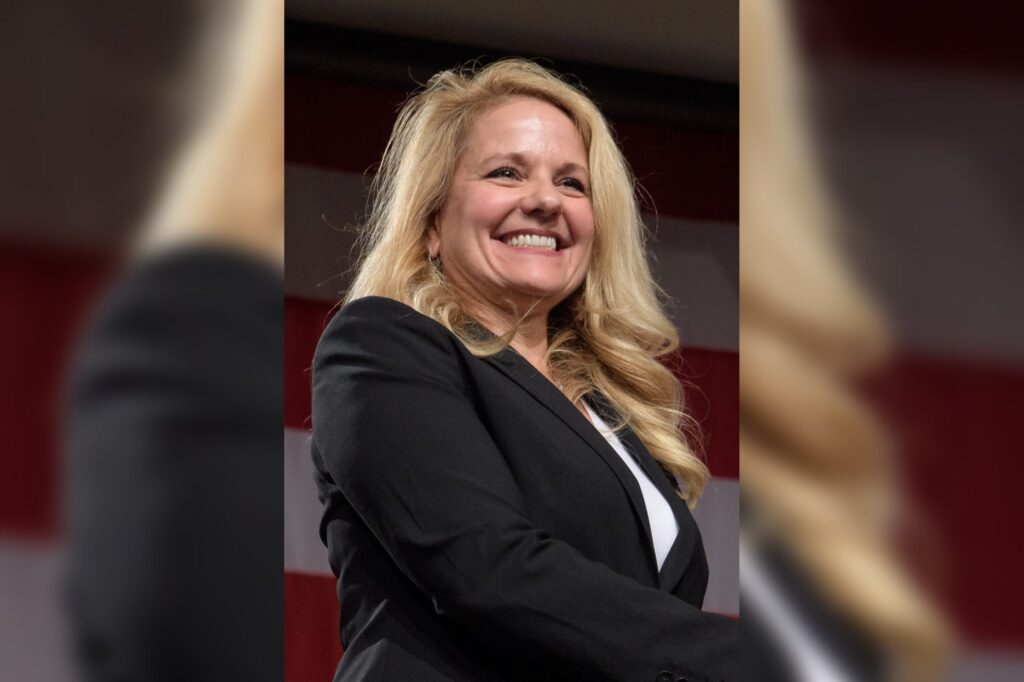
The Operator Beside Musk
Gwynne Shotwell runs the daily machinery of SpaceX: president and chief operating officer since December 2008, second on the org chart behind only founder Elon Musk, running operations, growth and strategy across a staff of roughly 22,000. By the middle of 2026 her role had outgrown even that description. When SpaceX went public on June 12, 2026, she worked the bell at Nasdaq in New York while Musk beamed in by video from Texas, and Fortune’s account put the offering at 555.6 million shares priced at $135, raising $75 billion, a sum Fortune branded the biggest IPO ever. The ticker, per Tribune India’s coverage of the deal, is SPCX, on a $1.77 trillion valuation. Her 2025 pay, as Fortune tallied it, came to $85.8 million, dominated by option awards over a $1.08 million base, and she sits among the top five holders of Class A stock.
From Thermal Analysis to the Second Seat
Her path to that seat was technical. Northwestern University gave her a mechanical engineering bachelor’s and an applied mathematics master’s, spent about ten years at The Aerospace Corporation’s El Segundo research center from 1988 on military space work, mainly thermal analysis, then led business development in Microcosm’s space systems division from 1998. She joined SpaceX in September 2002, recruited by Musk as its 11th employee, to build the commercial side of a company that had never launched anything. The compiled record credits her with the first NASA Commercial Resupply Services negotiation, with a Falcon launch book that grew past 50 missions, a manifest reported near $5 billion in value, and with reusability milestones that included the first orbital first-stage landings plus the debut re-flight of a used commercial cargo craft. The crewed milestone came on May 30, 2020, when a private firm orbited astronauts for the first time.
A Million AI Satellites
The March 2026 TIME profile found her at the Starbase, Texas factory, eighteen Starship hulls, from bare steel barrels to stacked ready-ships, spread across a million-square-foot floor, aiming at NASA’s Artemis IV moon landing. “It’s a hard problem and the whole architecture is complex, but we’re gunning for 2028,” she said. But her most striking reveal was elsewhere: SpaceX had just asked the Federal Communications Commission to license up to a million AI satellites, a constellation of data centers in space linked by laser and processed as a single distributed brain. “We just recently gave a request for FCC licensing for up to a million AI satellites,” she said. “I’m surprised that didn’t get more news. I don’t know if we’ll get to a million, but it’s much easier to ask at the beginning and then march toward that goal.” The pitch leaned on energy efficiency, since terrestrial data centers gulp power and coolant water while orbiting hardware runs on constant sun and the cold of space. Her endpoint is manufacturing on the moon itself: “I would be disappointed if we didn’t have a settlement on the moon and [are] building a manufacturing facility on the moon within 10 years. Hopefully half that.”
The Moon Moves Up the Queue
The calendar is less patient than the vision. NASA picked SpaceX in 2021 to build the Artemis human landing system on a $2.9 billion contract, with Blue Origin taking a second, $3.4 billion award in 2023 for a later landing. In February 2026 the Aerospace Safety Advisory Panel questioned whether Starship, a 171-foot lander needing an onboard elevator against the Apollo module’s 23-foot ladder-and-legs design, is the right ship at all, and NASA responded by shuffling schedules and possibly providers. Musk, in a February 8 post, reordered the destination list: “SpaceX has already shifted focus to building a self-growing city on the Moon, as we can potentially achieve that in less than 10 years,” he wrote, “whereas Mars would take 20+ years.” William Gerstenmaier, vice president of build and flight reliability, remembered the company’s founding obsessions: “the first discussion was about how we go to Mars; it wasn’t about how you fill out your time card.”
The Public-Company Test
The backdrop is a company that merged with Musk’s AI firm xAI in February 2026 and now runs Starlink past the 10 million customer mark, with a constellation slated to grow from 9,400 satellites toward 20,000. Shotwell backed the merger without hesitation. “These are Elon companies,” she said. “Elon makes these kinds of decisions, and as soon as we started talking about [the merger] I was incredibly supportive, especially as I was seeing more and more AI being used at the company. It made perfect sense. It’s a force multiplier.” On the listing itself she was coy: “I’m not supposed to talk about the IPO in any way,” What comes next is the part her career never included, running the world’s most aggressively ambitious aerospace firm under quarterly scrutiny, from a company town, Starbase, that voted itself into existence 212 to 6 in May 2025.
Sources
- Gwynne Shotwell – President and Chief Operating Officer, SpaceX | The Executive Review
- SpaceX's Gwynne Shotwell Aims to Put AI on the Moon




