
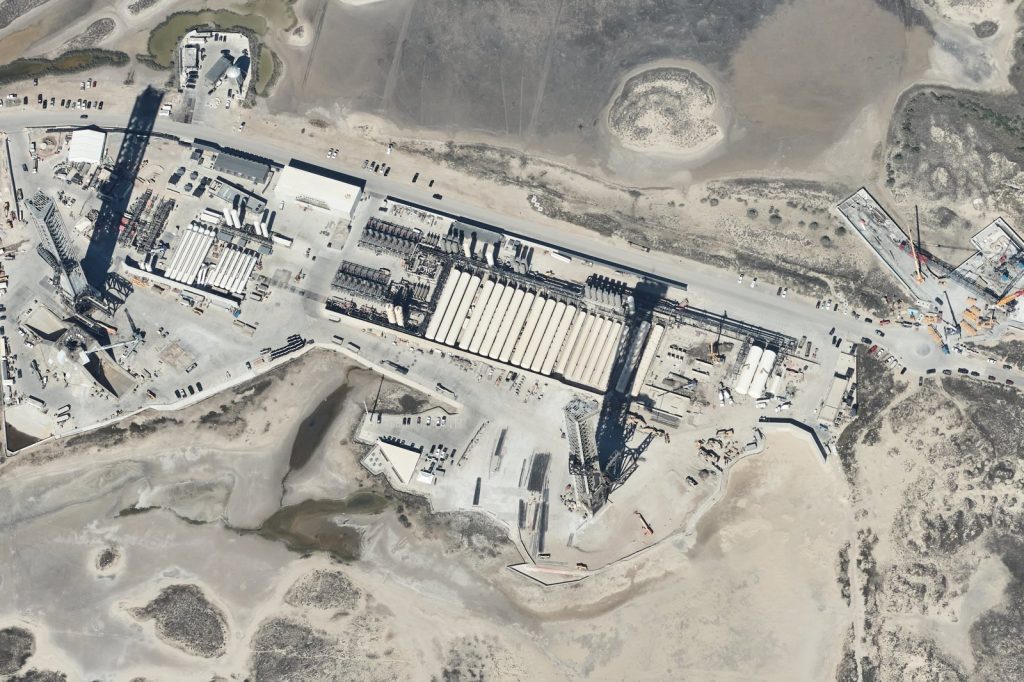
STARBASE, Texas, July 27 — The figure that matters: 475 feet. That is the height of Mechazilla, the launch tower at SpaceX’s Starbase facility, and the centerpiece of the company’s plan to catch not only its Super Heavy booster but also the Starship upper stage using a pair of mechanical arms informally called chopsticks. By the numbers, the catch system has already proved itself on Super Heavy.
Since Flight 5 on October 13, 2024, the 230-foot-tall booster has been successfully caught four times. The chopsticks clamp onto the vehicle’s hardpoints — structural interfaces near the nose and mid-body — and lower it onto the launch mount.
No landing legs needed. That saves weight and speeds up turnaround. Investors will note the economics: a reusable rocket that lands itself back on the pad, ready to fly again in hours, not weeks.
The Mechanism
Mechazilla is equipped with a quick-disconnect arm for propellant loading and a catch-arm system. The chopsticks are actuated by hydraulics and can rotate and translate to align with incoming vehicles. To catch Starship, the upper stage would execute a boost-back burn after stage separation to return to the launch site, then a reentry burn to slow from orbital velocity.
It would then descend aerodynamically using its four grid fins. As Starship nears the tower, it performs a landing burn with its six Raptor engines, reducing speed to near zero.
The chopsticks clamp onto the hardpoints and actively damp oscillations during capture, guided by onboard cameras and telemetry. That is the plan. The execution is harder than it sounds.
The Challenge
Starship is 165 feet tall — shorter than Super Heavy but with a very different center of mass and aerodynamic profile. The source notes that this presents new control challenges. The catch system eliminates landing legs, which saves weight and enables rapid reuse, but the vehicle must be in a nominal state after reentry for a catch attempt to be viable.
SpaceX has not publicly released a minimum requirement for a successful catch. If Starship is off-nominal, it would divert to an ocean splashdown.
In earlier projections, SpaceX estimated a catch attempt could occur as early as Flight 14, then slated for late February 2025. That timeline has come and gone without public confirmation of a Starship catch. The company has not announced a new target publicly.
What’s Next
What is clear is the technological trajectory. The chopstick catch has been derisked on Super Heavy. The next step — catching a 165-foot orbital vehicle with different flight dynamics — is the kind of engineering frontier that defines SpaceX.
The bottom line: the catch system is fundamental to the company’s vision of rapid, full-stack reuse. Investors will watch for the next flight data from Starbase, and for any indication that Starship’s control systems are ready for the precision approach required.
One thing is certain. When the catch attempt does come — whether on Flight 14 or a later mission — it will be a pivotal moment in the history of reusable launch.




