
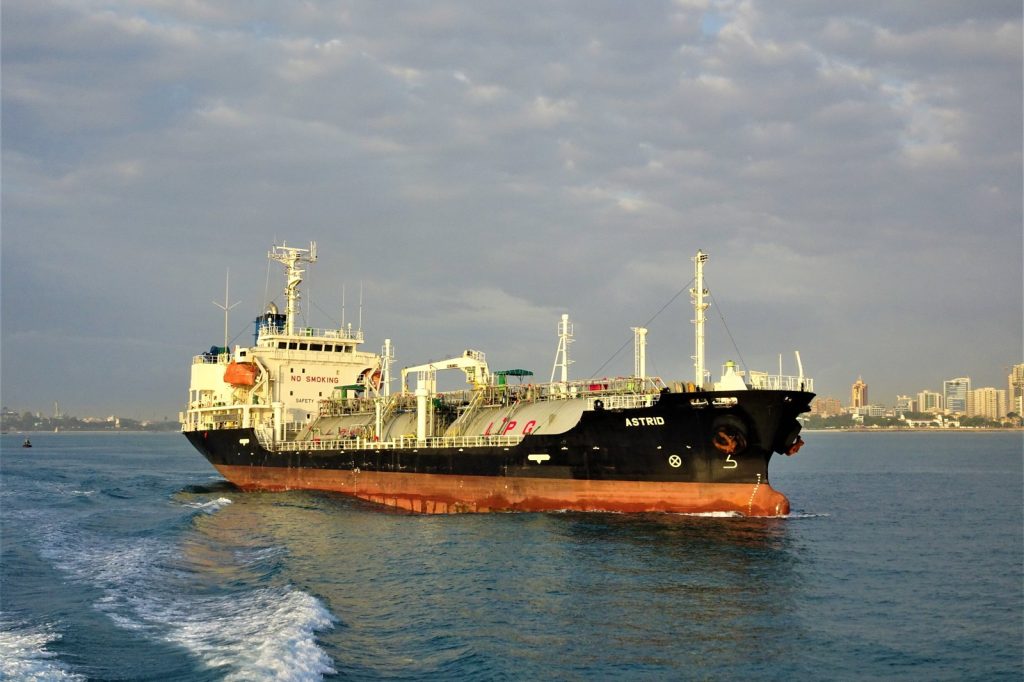
Twenty point nine million barrels of oil moved through the Strait of Hormuz each day in the first half of 2025, according to the US Energy Information Administration. That flow, 14.7 million barrels of crude plus 6.1 million barrels of refined products, was roughly a fifth of the world’s petroleum liquids consumption and about a quarter of all seaborne oil trade. The strait is the only sea route out of the Persian Gulf, connecting it to the Gulf of Oman and the Arabian Sea.
Most of that oil heads east. In the first half of 2025, 89% of the crude and condensate moving through Hormuz went to Asian markets. China, India, Japan and South Korea together took 74%. In 2024 the United States imported about 0.5 million barrels a day through the strait, equal to 7% of its crude oil imports and 2% of its petroleum consumption.
The exporters are concentrated. Saudi Arabia, Iraq, the United Arab Emirates, Iran, Kuwait, Qatar and Bahrain all ship oil through this passage, according to the International Energy Agency.
A Shifting Market
The trading patterns behind those flows have changed dramatically. From 2001 to 2022, crude oil exports from Persian Gulf countries to the United States fell 72%, from 2,660 to 740 thousand barrels per day. Exports to the European Union fell 37%, from 2,330 to 1,460 thousand barrels per day. China moved the opposite way: its Persian Gulf oil imports grew 800%, from 630 to about 5,800 thousand barrels per day.
By 2022, the United States and the European Union took just 4.1% and 8.1% of the Gulf’s crude oil exports, while China imported more than 30%. Persian Gulf oil accounted for 12% of total US crude imports, 15% of the EU’s, and 55% of China’s. China was the world’s largest crude oil importer, holding a 23% share of global imports that year.
The Persian Gulf itself remains an energy powerhouse. It holds 1,564 billion barrels of proven crude oil reserves, a 55% share of the world total. In 2022 its countries produced 31% of the world’s oil and accounted for 42% of global crude oil exports. The region also holds 39% of the world’s proven natural gas reserves.
Limited Workarounds
The International Energy Agency put crude oil moving through the strait at nearly 15 million barrels a day in 2025, about 34% of global crude oil trade. Only two significant pipelines can move Gulf oil around the strait. Saudi Arabia’s East-West line has a design capacity of 5 million barrels a day, or 7 million with temporary conversion, though Yanbu’s export terminals can handle about 4.5 to 5 million. The United Arab Emirates’ Habshan-Fujairah pipeline has a nameplate capacity of 1.5 million barrels a day and a maximum of roughly 1.8 million. Together, the two routes could carry about 4.7 million barrels a day, less than a quarter of the 20.9 million barrels that crossed Hormuz in the first half of 2025.
Spare capacity on the bypass lines stood at about 2.6 million barrels a day, according to the EIA. That leaves most Gulf exports without a practical overland alternative.
Econovis, in a separate analysis, found that Iran’s ability to use the strait as a bargaining lever has weakened because oil demand has shifted toward China. A disruption would hit China’s economy harder than that of the United States or Europe, the analysis concluded, so it cannot be used to persuade Washington to lift sanctions.
Sources
- Hormuz Strait Tension | Econovis
- Strait of Hormuz Oil & LNG: How Much Flows Now vs Before the War | hormuz.now




