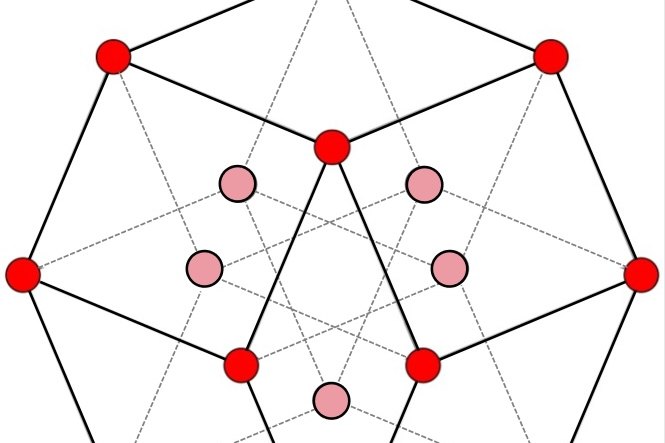
Take a square, pull it into the third dimension and you have a cube. Pull the cube into a fourth spatial dimension and you have a tesseract, the object mathematicians call the four-dimensional hypercube. The idea extends to any dimension you like, but the tesseract is the one that keeps drawing attention, partly because it can almost, but never quite, be pictured.
Building up dimension by dimension
The construction is a march. Start with a point, which has no extent. Sweep it along a straight path and you trace a line segment. Sweep that segment sideways, perpendicular to itself, and it traces out a square. Lift the square perpendicular to its own plane and you get a cube. Sweep the whole cube along a fourth direction, perpendicular to each of its three axes at once, and the swept volume is a tesseract.
Each sweep doubles the corners: one for a point, 2 for a segment, 4 for a square, 8 for a cube and 16 for the tesseract. Keep going and the 5D penteract carries 32 vertices while the 6D hexeract has 64.
What the object contains
The full inventory reads like a riddle: 16 vertices, 32 edges, 24 square faces and 8 cells, with every cell being an ordinary cube. Those eight cubic cells are the genuinely strange entry. A cube’s boundary is six flat squares that tile around it in three dimensions without overlap; a tesseract’s boundary is eight full cubes wrapping it in four dimensions the same way. No viewer stuck inside three dimensions can see all eight at once, yet the bookkeeping stays perfectly consistent.
One compact formula generates the whole table: the count of k-dimensional pieces in an n-cube equals two raised to n minus k, times the number of ways to choose k items from n. It hands you the hexeract’s parts without effort, 64 vertices, 192 edges, 240 faces and 160 cells, plus 60 four-dimensional and 12 five-dimensional boundary pieces, and it works just as well for a cube in 10 or 100 dimensions.
Where the name comes from
The word dates to 1888 and the British mathematician Charles Howard Hinton, who coined it in A New Era of Thought. Hinton also minted the pair of direction words ana and kata, from Greek, for the two ways to move along a fourth axis, the analogues of left and right or up and down. In an 1880 essay titled What is the Fourth Dimension?, he proposed reading three-dimensional motion as cross-sections sliced from a fixed four-dimensional arrangement, an intuition that anticipates the world lines of relativity.
Drawing the undrawable
Nobody can see a tesseract directly, just as a sketch on paper never fully shows a cube. The standard workaround is a perspective projection, which yields the familiar cube within a cube: the near end renders as a large outer cube, the far end as a smaller one nested inside, and eight edges bridge corresponding corners between them, leaving six truncated pyramids in the gaps. Unfolding works too. A cardboard cube opens flat into a cross of six squares; a tesseract opens into a three-dimensional cross of eight cubes, in 261 distinct ways against the 11 nets available to an ordinary cube. Salvador Dali made the most famous unfolding the cross in his 1954 painting Crucifixion, also known as Corpus Hypercubus.
Why anyone cares
Hypercube shapes turn up well outside pure geometry. Binary codes sit naturally on their vertices, since every corner of an n-cube can carry its own string of n zeros and ones; the same structure suits optimization problems and the design of parallel computing networks, where each corner links to exactly n neighbors and routing stays efficient as dimensions climb. And the unit hypercube, one unit on a side, always has volume exactly 1, no matter the dimension, which makes it a dependable building block. Spheres behave oddly as dimensions grow, their volume sliding toward zero, but the cube family stays predictable at any scale.
Sources
- What Is a Hypercube? From Cubes to Tesseracts – ScienceInsights
- Tesseract | Brilliant Math & Science Wiki