
Launching a kilogram into low Earth orbit cost about $3,225 from the United States in 2025. From Europe it cost $9,897. That gap, found by researchers Alessio Terzi and Francesco Nicoli, is the main result of a study published online in Economics Letters on August 5, 2026.
The figures are averages weighted by payload, in 2024 dollars. The study put India at $13,302 per kilogram, Russia at $6,682, China at $5,809 and Japan at $5,287. U.S. costs came in at less than one-third of Europe’s.
The numbers rest on a database of launches from 1960 to 2025. Its Mendeley dataset lists 6,740 launches across 16 geographic entities. A related PNAS Nexus study describes 4,405 launches over the same broad period, and the public summaries do not explain why the counts differ.
What the number measures
Think of it like shipping freight. The price on the invoice depends on where the box is going, how it is handled and when it has to arrive. Cost per kilogram flattens all that into one figure.
The authors use a unit flyaway cost, which covers recurring manufacturing, engineering support, tooling and quality control. It leaves out the full cost of developing a rocket in the first place. It is also not the price a satellite operator is quoted, since customers pay for orbit, integration, schedule, mission assurance and contract terms.
India shows why rankings can mislead. Its $13,302 figure looks high for a country known for cheap space programs. Terzi and Nicoli blame launcher size: smaller rockets spread fixed costs over less payload mass, so the cost per kilogram rises even when the launch itself is fairly inexpensive. A small dedicated launcher can also offer schedule control or direct insertion into orbit, which can justify a higher price.
How the U.S. pulled ahead
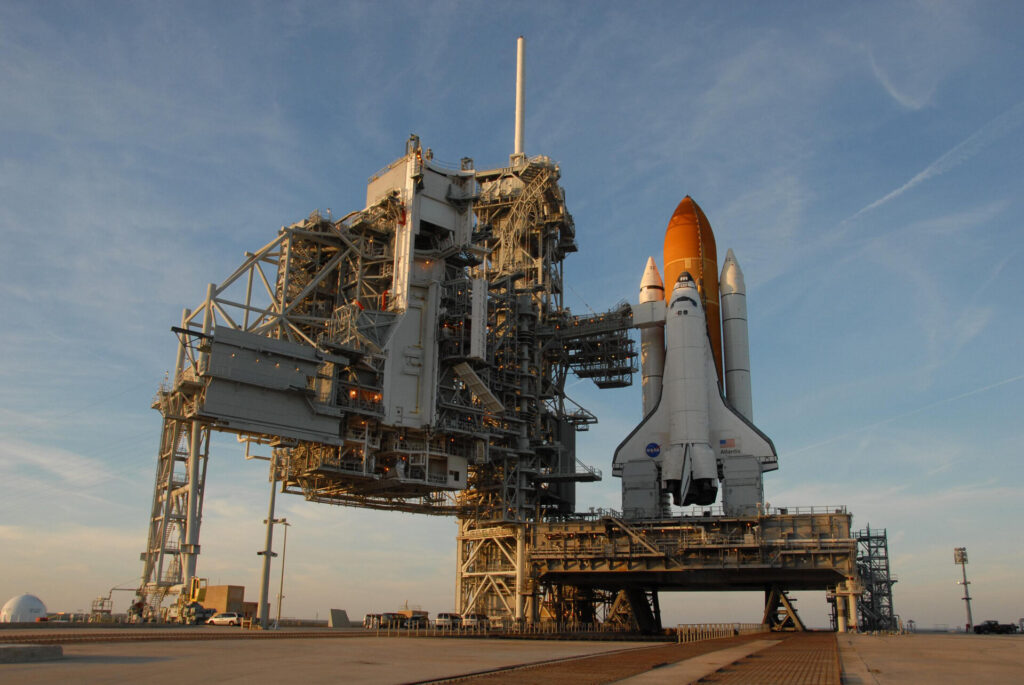
The U.S. lead is recent. American and Russian cumulative payload tracked each other through the early 2000s. The 2003 Columbia disaster interrupted Space Shuttle flights, and the Shuttle’s retirement in 2011 left the United States without a domestic replacement for several capabilities.
Then Falcon 9 took off, literally. Booster recovery became routine and SpaceX started deploying Starlink at scale. Reuse alone does not lower costs, the study notes, because a recoverable rocket that flies rarely still carries heavy fixed costs. Falcon 9 flies often, uses standardized hardware and serves government, commercial, crew and its own constellation missions. That steady demand is what makes reuse pay.
Government money helped early on. NASA picked SpaceX under its Commercial Orbital Transportation Services program in 2006. NASA’s program history records $396 million in NASA investment, alongside about $454 million financed by SpaceX, and NASA later bought cargo flights to the International Space Station.
Europe and the United States had broadly similar average costs around 2012 and 2013. After that, U.S. costs dropped sharply while European costs stayed comparatively flat through much of the decade. By 2025 Europe’s payload-weighted average was more than three times the U.S. figure.
The payload share tells the same story. The U.S. share of yearly global payload fell below 20% around 2012, then climbed past 82% in 2024 and stayed near there in 2025. Separate research from the same academic network estimates SpaceX carried roughly 75% of global payload to orbit in 2025. That is a share of mass, not of launches, because a few heavy missions move far more than many small ones.
Europe’s response
Europe still has ways to reach orbit. Ariane 6 is operational, Vega-C is flying again, and both launch from the Guiana Space Centre. Ariane 5 retired in July 2023 and Ariane 6 flew for the first time on July 9, 2024. On June 17, 2026, an Ariane 6 launched 36 Amazon Leo satellites using the more powerful P160C boosters and set a payload-weight record for the European rocket. The European Space Agency’s page listed the next Ariane 6 mission, carrying the MTG-I2 weather satellite, for August 27, 2026.
The European Commission’s Vision for the European Space Economy treats autonomous access to space as part of Europe’s freedom of action. It backs pooling public launch demand, wider use of European launchers and investment in infrastructure.
Terzi and Nicoli say that foreign dependence could become bargaining power in a dispute. They describe that as a possible risk, not evidence that the United States has used launch dependence for coercion.




