
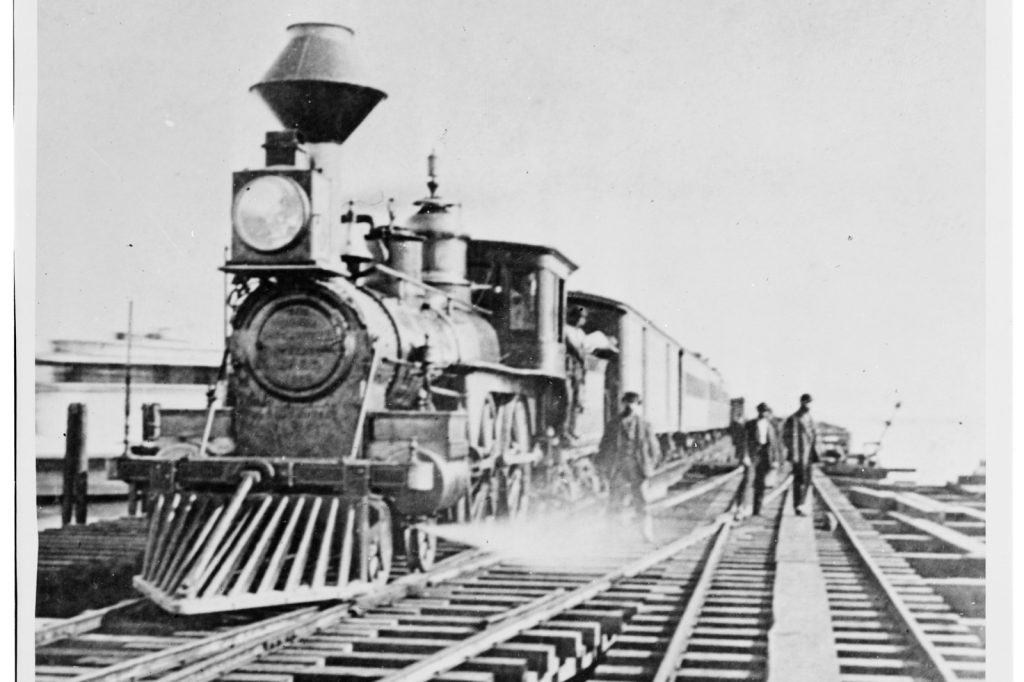
Promontory, 1869. The meeting of the two rail crews cut a coast-to-coast trip from months to days. Towns followed the track.
Under the hood, the technical reality was a link built by two companies working toward each other. The Pacific Railway Act of 1862 authorised a rail connection spanning the continent. The Central Pacific Railroad started from Sacramento, California, led by Leland Stanford, Collis Huntington, Charles Crocker and Mark Hopkins. The Union Pacific Railroad, under Dr. Thomas Durant, began building from the Missouri River near the Iowa-Nebraska border.
Each mile of completed track brought the companies land grants and government bonds. The public money financed a hard build. Native American attacks threatened the crews as they advanced through tribal territories. Construction teams faced mountains and rivers. Most of the Central Pacific’s workers were Chinese immigrants, thousands of them, who had come to the United States in search of better opportunities. The Union Pacific drew its labour from Irish immigrants and Civil War veterans.
A national market
Before the line, travellers faced months by wagon, stagecoach, or a sea route around Cape Horn or over the Isthmus of Panama. The railroad cut the trip to under a week. Cost of a coast-to-coast journey dropped by 85%, making travel affordable and open to more Americans. It carried freight valued in the millions of dollars every year, moving western resources east and into international trade.
The transcontinental line created one national market for trade goods. American industry and agriculture expanded rapidly on that connection. Mining, logging and agriculture all grew because resources could be hauled to eastern markets. Remote regions linked to urban centres, and local economies developed around the line. The railroad became a lifeline for goods and people, attracting businesses, entrepreneurs and settlers along the route. It also made possible the rise of mail-order catalogue businesses, letting Americans order goods from distant sellers.
From 1871 to 1900, workers added 170,000 miles of track, connecting the eastern states with the Pacific Coast. That build-out did more than move goods. It shaped where Americans lived.
The towns and the costs
Work camps along the line became temporary towns. Many evolved into permanent settlements. The Union Pacific alone can trace about 7,000 cities and towns back to depots and water stops on its line. The railroad brought previously isolated regions closer together, allowing greater westward settlement and migration.
The expansion had a hard edge. Thousands of trees were cut down. Towns encroached on wild areas, and wildlife was displaced. The railroad also sped up buffalo hunting. Buffalo, which many Native American tribes relied on, fell sharply as hunting pressure increased.
The completion set off racial tensions in California, where white workers blamed Chinese labourers for economic instability. Prejudice and fear led to the Chinese Exclusion Act of 1882, which restricted Chinese immigration and barred Chinese immigrants from becoming U.S. citizens.
The construction also marked a shift in government-financed capitalism. The Central Pacific’s Big Four used government assistance, staking little of their own capital while the public covered most of the bill.




