
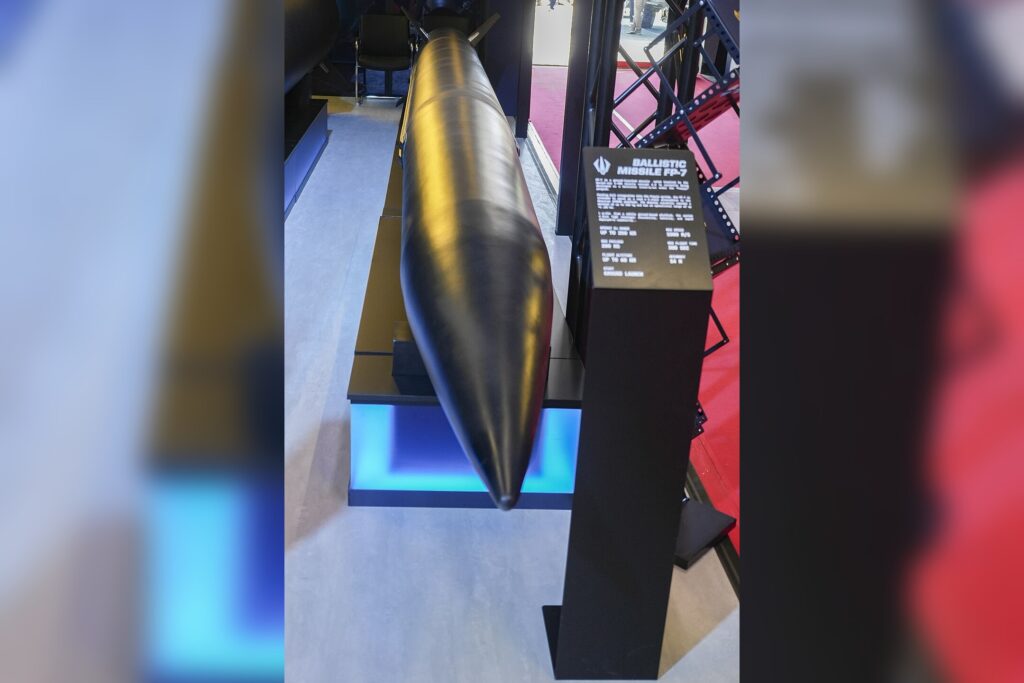
Kyiv, October 2 — Ukraine used the FP-7 ballistic missile in combat for the first time, according to confirmed military reports from Ukrainian defense sources and independent battlefield assessments. The FP-7 is a solid-fuel, road-mobile short-range ballistic missile developed by Ukraine’s state-owned defense conglomerate Ukroboronprom, specifically the Luch Design Bureau. Initial development began in the early 2010s, with the first successful flight tests conducted in 2018.
The missile has a reported range of up to 280 kilometers and carries a payload of approximately 480 kilograms. It is capable of delivering high-explosive or submunitions warheads.
Its deployment marks a significant advancement in Ukraine’s indigenous long-range precision strike capacity, reducing reliance on foreign-supplied systems such as the U.S.-provided ATACMS or European Storm Shadow missiles. Ukrainian officials have stated that the missile’s development was accelerated following the 2022 Russian full-scale invasion. Production was scaled up at facilities in Dnipro and Kyiv to meet wartime demands.
The FP-7 was first publicly unveiled in 2021 during Ukraine’s Independence Day military parade in Kyiv, where it was displayed alongside other domestically produced systems like the Hrim-2 and Vilkha missiles. The combat use of the FP-7 was confirmed through geolocated video footage showing launch signatures and impact sites consistent with the missile’s flight profile.
This verification was carried out by open-source intelligence analysts, including those from the Conflict Armament Research (CAR) group and Bellingcat. No official casualty figures or specific target details have been released by Ukrainian military authorities, in line with operational security protocols. The missile’s employment underscores Ukraine’s growing ability to strike deep into occupied territories and logistical hubs, particularly in southern and eastern frontlines where Russian supply lines and command nodes are located.
Analysts note that the FP-7’s solid-fuel design allows for quicker launch preparation compared to liquid-fueled alternatives, enhancing survivability and responsiveness in contested environments. The system is believed to be guided by a combination of inertial navigation and satellite-based correction, though Ukraine has not disclosed full technical specifications to prevent countermeasures. The FP-7’s combat debut adds to Ukraine’s expanding arsenal of domestically produced strike systems, which now includes artillery drones, loitering munitions, and upgraded Soviet-era platforms.
Its use reflects a broader strategic shift toward self-reliance in defense manufacturing, supported by international partners who have provided technical assistance, components, and funding for Ukraine’s defense industrial base since 2022. The missile is not exported and remains exclusively in service with the Ukrainian Armed Forces.
As the conflict continues, observers will watch for further deployments of the FP-7 and its impact on frontline dynamics.




