
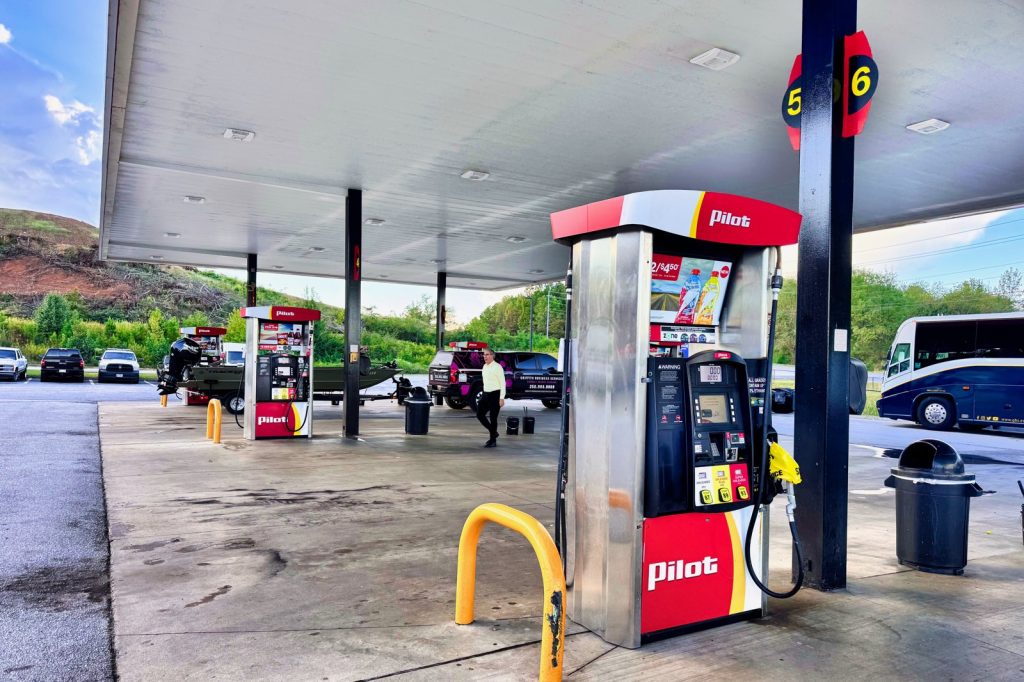
Washington, September twenty-one — The diesel pump has become a recession gauge for rural America. A gallon of the fuel averaged six dollars and twenty-eight cents nationwide on September fourteen of this year, an all-time peak, and the scholars who study energy markets see no bend in that curve ahead. Morgan Bazilian and Jamie Webster of the Colorado School of Mines, writing in The Conversation, trace the squeeze to a war closing the Hormuz chokepoint stacked on top of two slower pressures that have been building for a decade.
The arithmetic of the run-up is stark. Compared with a three-dollar-seventy-five-cent monthly average a year earlier, mid-September pump prices stood sixty-seven percent higher. Before the fighting started — back in January, when Washington and Jerusalem had not yet struck Tehran in late February — a gallon cost three dollars and fifty-two cents. Since the war’s opening days, the price has climbed more than seventy-eight percent.
A Refinery Base That Kept Shrinking
Why can’t supply respond? Partly because the refining base underneath it never stopped thinning. Federal rules phased in from two thousand six forced sulfur out of diesel; locomotive and marine fuels followed under the same regime in twenty fourteen. Complying meant multi-year retrofits costing billions, adding five to nine cents per gallon, and yielding a fuel holding marginally less energy per unit of volume. Just a single new plant — Galveston, Texas — has come online in five decades, and its forty-five thousand daily barrels cover under zero point two percent of national demand. Two more plants closed in twenty twenty-five for weak economics, and since twenty twenty a dozen-plus have pivoted to renewable diesel, chasing biofuel subsidies at the cost of halving or worse their conventional output.
What remains is running hot. Refinery crude inputs hit roughly seventeen point five million daily barrels by late August at nearly ninety-eight percent of capacity, the strongest utilization since twenty eighteen, and distillate output still lagged the prior year. Stocks across the supply chain slid to about one hundred three million barrels, the thinnest for that point on the calendar since nineteen fifty-one.
The World Wants the Same Barrels
Exports, meanwhile, set a record in August as buyers everywhere scrambled to replace Russian barrels. Moscow — historically the number two diesel exporter behind Washington — halted diesel shipments on July ninth to reserve fuel for its war effort, then stretched that ban through year-end after Ukrainian drones hit its refineries. Gulf refiners, the other pillar of world supply, have trimmed runs because the Iran conflict keeps disrupting their operations. On September fifteen, Senate Majority Leader John Thune floated an American export ban to keep more product at home.
Refiners are cashing in. By late August the crack spread on a barrel of diesel passed one hundred dollars for the first time on record — hard evidence that demand is outrunning not just distillate supply but crude itself.
Who Pays
Trucking burns most American diesel; railroads, farms, builders, and shipping follow. A September analysis from Congress’s Joint Economic Committee pegged the added cost of planting major crops this year versus last at more than one point four billion dollars, a sixty-three percent jump landing hardest on Illinois, Iowa, and Minnesota. Because virtually everything retailed rides a truck at some stage, the spike seeps into wider inflation.
Winter brings one more blow. Heating oil, chemically a near cousin of diesel, warms much of the Northeast, and the Energy Information Administration projects national distillate stocks dipping under one hundred million barrels this month and holding there through most of twenty twenty-seven — territory unseen since twenty twenty-one. Winter heating-oil quotes are already thirty percent higher or worse.
Crude above one hundred dollars a barrel grabs headlines, but the deeper stress sits in distillate. With plants maxed out — an Illinois Mobil outage on September thirteenth showed how fast output drops when anything slips — even a sudden peace with Iran would not quickly refill the pipeline. Falling inventories, the authors conclude, mean high prices with no near-term exit.
Sources
- Iran War Pushes Diesel to Record High Prices, With No Relief on the Horizon – Morning Ag Clips
- US diesel prices hit record $6.23 per gallon




