
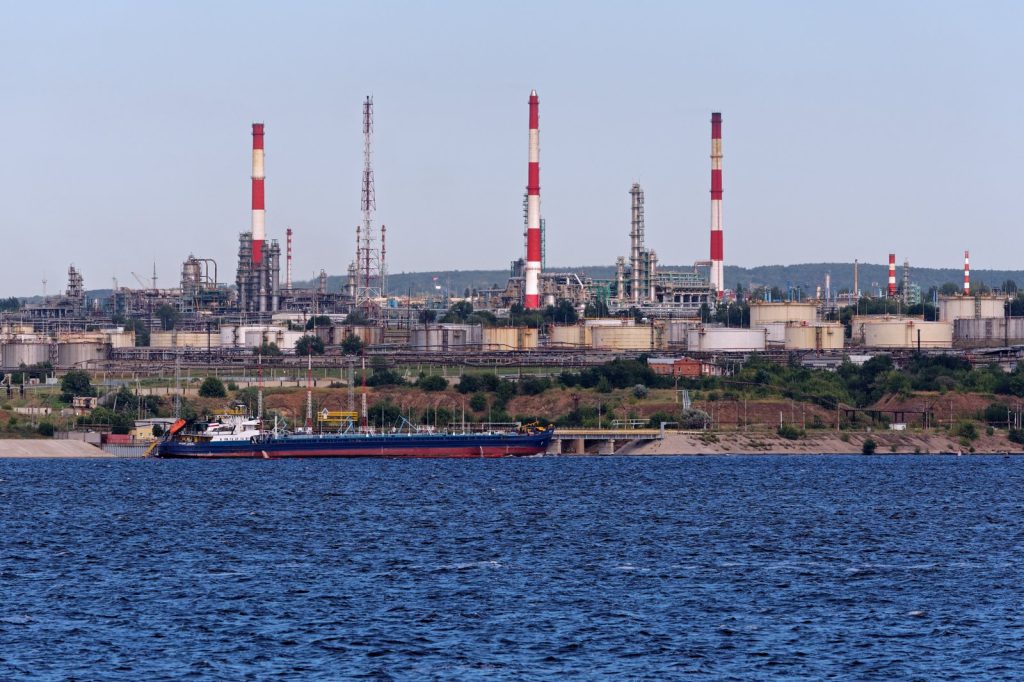
The United States is weighing a tariff of 50 percent or more on Russian oil sold to third countries, a trade measure that would directly target Moscow’s largest source of export revenue. The plan remains under discussion within the administration, and no final decision has been made, according to sources familiar with the internal deliberations.
If implemented, the tariffs would represent a significant escalation in economic pressure aimed at reducing the financial flows that support Russia’s wartime budget. Russia is the world’s third-largest oil producer, behind only the United States and Saudi Arabia, with total output of approximately 10.5 million barrels per day in 2023. In 2021, the country exported roughly 4.7 million barrels per day of crude oil and 2.8 million barrels per day of refined petroleum products.
Export revenue from oil and petroleum products reached an estimated $180 billion in 2022, underscoring the centrality of energy sales to the Russian economy. The proposed tariff, if adopted, would be imposed on foreign purchases of Russian crude and refined products, essentially adding a punitive cost to transactions that currently flow through normal commercial channels.
Legal Basis and the Shifting Buyer Landscape
The White House could implement the tariffs under either the International Emergency Economic Powers Act (IEEPA) or Section 232 of the Trade Expansion Act of 1962. Both statutes authorize the president to impose trade restrictions upon determining a national security threat.
That legal foundation would allow the administration to act without new legislation, though the timing and precise trigger remain under review. China and India have become the dominant destinations for Russian crude since Western sanctions reshaped global oil flows. In 2023, China accounted for roughly 45 percent of Russia’s seaborne crude exports, while India took approximately 30 percent.
Should the tariffs take effect, these two countries may seek alternative suppliers to avoid the added cost. Potential replacements include Saudi Arabia, Iraq, or the United States itself, which is currently the world’s largest oil producer.
A shift in purchasing patterns of this magnitude could tighten global supply and push prices upward, with direct consequences for consumers. The U.S. Energy Information Administration reported that the average price of Brent crude oil stood at $82 per barrel in 2023. A significant reduction in Russian supply – even if partially offset by increased output from other producers – could drive prices higher. Higher crude prices typically translate to higher gasoline costs; the average price of regular gasoline in the United States was $3.52 per gallon in 2023.
Any sustained increase would feed into broader inflation measures and affect household budgets.
Global Market Implications and What to Watch Next
The tariff plan represents a novel approach to energy sanctions, targeting Russian oil sold to third countries rather than imposing direct bans on U.S. purchases. The effectiveness of such tariffs depends heavily on enforcement mechanisms and on the willingness of China and India to comply.
Both nations were the largest buyers of Russian crude in 2023, and their cooperation – or lack thereof – will determine whether the tariffs meaningfully reduce Moscow’s export revenue or simply redirect trade flows through intermediaries. For global oil markets, the prospect of reduced Russian supply adds another variable to an already uncertain price outlook. A drop in available Russian barrels would tighten the balance between supply and demand, potentially benefiting other major producers while raising costs for import-reliant economies. The administration has not set a timeline for a final decision.
The outcome will be watched closely in Moscow, where energy revenues fund the federal budget, as well as in Beijing and New Delhi, where energy security and price stability are top priorities. The petroleum sector has been a cornerstone of Russia’s economy for decades; the Soviet Union developed vast oil fields and pipeline networks that later formed the backbone of the country’s export economy.
Russia holds a leading position in global oil and natural gas reserves and remains a major transit route for crude from neighboring Kazakhstan. Before 2022, it was the world’s largest exporter of natural gas, a role that gave it considerable geopolitical leverage. These proposed tariffs matter because energy trade directly shapes prices at the pump and pressures Moscow’s wartime budget.
American consumers feel the effect through gasoline costs and broader inflation, while shifts in who buys Russian crude can reorder global supply lines. The coming weeks will reveal whether the administration moves forward with the plan and how the major buyers respond.
{“@context”: “https://schema.org”, “@type”: “NewsArticle”, “headline”: “US weighs 50% tariff on Russian oil sold to third countries”, “description”: “WASHINGTON, July 10 — The United States is weighing a tariff of 50 percent or more on Russian oil sold to third countries, a trade…”, “datePublished”: “2026-07-10T09:30:00+00:00”, “author”: {“@type”: “Person”, “name”: “James Roberto”}, “publisher”: {“@type”: “Organization”, “name”: “InfoPulse Today”, “url”: “https://newsfeed.infopulsetoday.com/”}}




