
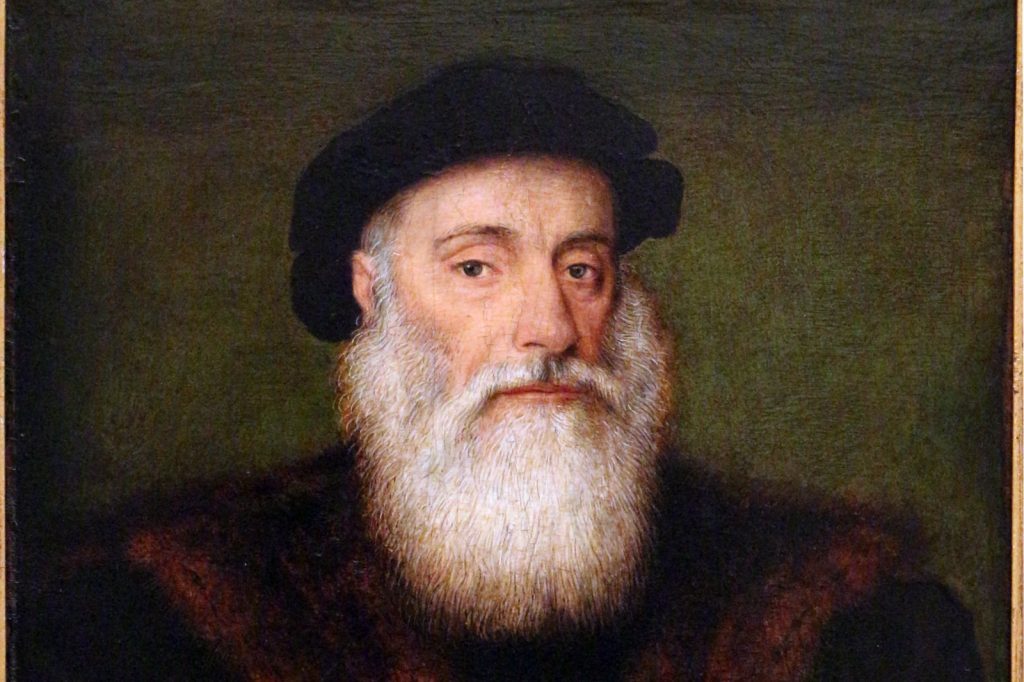
Vasco da Gama’s fleet slipped out of the Tagus near Lisbon on 8 July 1497. Depending on the account, he had no more than 170 men aboard, or 148. The ships were the São Gabriel under his own command, the São Rafael under his brother Paulo, the caravel Berrio, and a large store ship. Pêro de Alenquer, who had served as chief pilot for Bartolomeu Dias, came along for his knowledge of the Cape.
The goal was plain. When a crewman was asked on reaching India why the Portuguese had come all this way, he answered: to find Christians and spices. Dias had already rounded the southern tip of Africa in 1488, and da Gama was given the follow-up job of reaching India itself.
Three months without land
After resupplying at Cape Verde and leaving on 3 August, da Gama did something bold. Rather than creep along the African coast as Dias had done, he swung out into the mid-Atlantic in a wide curve, looking for favourable winds. His crews saw no land for about three months. It paid off: they reached the southern tip of Africa on 7 November, weeks ahead of Dias’s pace.
They rounded the Cape of Good Hope on 22 November. At Mossel Bay the fleet broke up its largest ship and redistributed men and stores among the other three. Fresh trouble followed up the coast. South African History Online records a clash with the Khoikhoi at St Helena Bay in which da Gama was wounded by a thrown spear. Scurvy, then a new disease to European sailors with no known cause or cure, was already thinning the crews.
At Malindi, on 15 April 1498, the local ruler gave the Portuguese a pilot and a chart for the Indian Ocean crossing. For years the pilot was said to be the celebrated navigator Ahmad Ibn Masdjid, but the World History Encyclopedia says scholars have since disproved that. The fleet left on 24 April.
Calicut and the long way home
The ships reached the Malabar coast near Calicut in May 1498: the 18th by one account, the 20th by another. The trip from Portugal had taken ten months. Then came a letdown. The Indians seemed content with the trade they already had and viewed the newcomers in their odd clothing with scepticism. Da Gama’s gifts of clothing and food fell well short of local custom. He did load a sample of pepper, ginger, cloves and cinnamon.
The return was worse. Leaving India in the autumn, the fleet met calms and storms, and more than 30 men died of scurvy. At Malindi in early January 1499 there were too few able hands left to sail every ship, so the São Rafael was abandoned. Paulo da Gama died in the Azores. The surviving ships reached Portugal in July and August 1499, and of the 170-odd who had left Lisbon, only around 55 made it home.
The reward was real. King Manuel minted a new gold coin, the ten-cruzado português, and da Gama received the title Admiral of the Indian Sea along with the right to be called Dom. More important, Portugal now had a sea route to Eastern goods that cut out the middlemen traders. The old Arabian caravan routes did not vanish overnight. Da Gama sailed to India twice more, in 1502 and 1524, and on the second of those trips, as viceroy, he fell ill and died at Cochin on Christmas Eve 1524.
Sources
- Vasco da Gama – World History Encyclopedia
- Vasco da Gama's Voyage of 'Discovery' 1497 – South African History Online




