
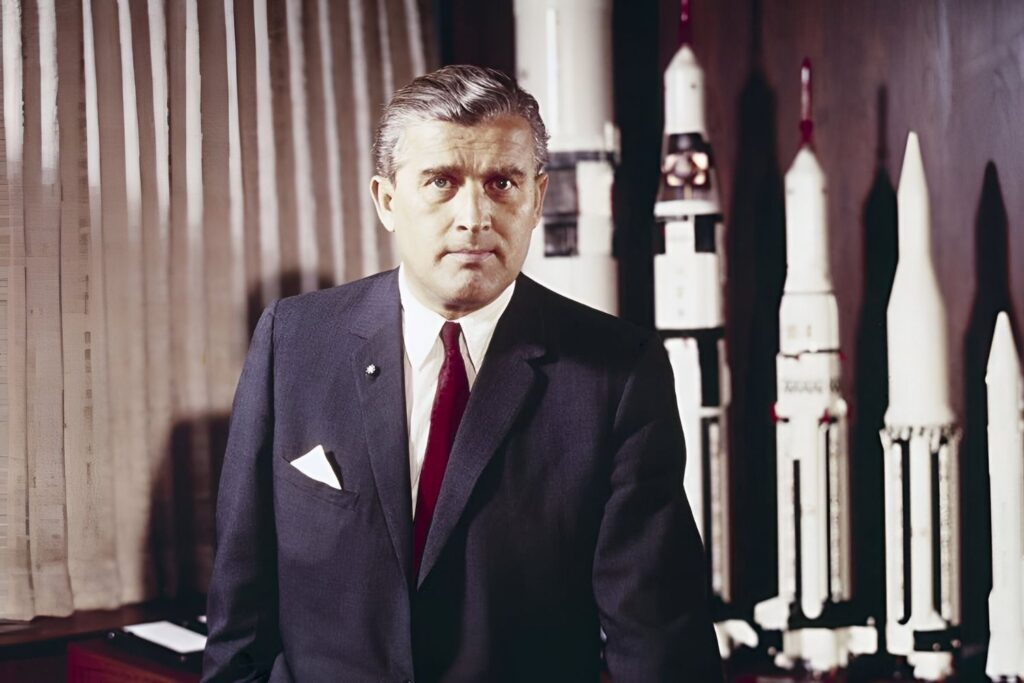
HUNTSVILLE, July 10 — The mechanics of how a Nazi rocket scientist ended up as the face of American lunar exploration remain one of the more uncomfortable threads in the space race narrative. Wernher von Braun, the German engineer who designed the V-2 rocket for Nazi Germany, later became a naturalized U.S. citizen and the man behind the Saturn V rocket that carried men to the Moon.
The catch is that von Braun’s path to NASA’s Marshall Space Flight Center, which he directed from 1960 to 1970, ran straight through Operation Paperclip. After World War II, he and many members of his team surrendered to the United States.
The U.S. government, eager to capture German rocket expertise, quietly brought them over. On closer reading, the arrangement was straightforward: the Americans got the hardware and the know-how; von Braun got a new career. The V-2 had been developed for Nazi Germany, but its engineering principles were the foundation for the Saturn V.
That rocket’s success — the Apollo Moon landings — is the part of the story that usually gets the headline. But the mechanics here also involve a parallel track, one the West knew little about at the time.
Sergei Korolev was the lead Soviet rocket engineer, and his résumé is equally stacked: the R-7 intercontinental ballistic missile, the launch of Sputnik 1, the Vostok spacecraft that carried Yuri Gagarin into orbit. Korolev’s identity, however, was a state secret. The Soviet government kept his name hidden from the public until after his death on January 14, 1966.
So while von Braun became a public figure, testifying before Congress and appearing in Walt Disney television specials, Korolev was a ghost. Follow the money — or in this case, the state funding — and the asymmetry becomes clear. The Soviet program was a closed system, driven by military imperatives and personal rivalry.
The American program, for all its Cold War urgency, operated under the scrutiny of a democratic press and a competitive aerospace industry.
The Intellectual Scaffolding
Neither von Braun nor Korolev started from scratch. The theoretical groundwork for spaceflight was laid decades earlier by two men who never built a rocket themselves. Konstantin Tsiolkovsky, a Russian theorist, published the rocket equation in 1903, establishing the mathematical relationship between rocket velocity, exhaust velocity, and mass.
His work was largely theoretical, but it provided the framework for every liquid-fueled rocket that followed. On the other side of the Atlantic, Robert H.
Goddard, an American pioneer, launched the first liquid-fueled rocket on March 16, 1926, from a farm in Auburn, Massachusetts. The flight was brief — a few seconds, a few dozen feet in the air — but it proved the concept. Goddard’s patents later became essential to the American space program, though his work was initially mocked by the press and underfunded by the government.
The irony is that von Braun, the German who built weapons for the Nazis, directly benefited from Goddard’s foundational work. And Korolev, the Soviet whose identity was erased from history, built on Tsiolkovsky’s equations.
The space race, for all its geopolitical drama, was a transatlantic collaboration of ideas — even as the engineers themselves were kept apart by ideology and secrecy.
The Bureaucratic Aftermath
Von Braun’s tenure at the Marshall Space Flight Center ended in 1970, as NASA’s budget contracted and the Apollo program wound down. He moved to Washington to work on long-range planning, but the political momentum had shifted. The Saturn V never flew again after Apollo 17.
The rockets were repurposed, mothballed, or turned into museum pieces. Korolev never saw the Moon landing.
He died in 1966 during a routine surgery, his identity still classified. The Soviet program struggled after his death, lacking his organizational genius and his ability to navigate the Kremlin’s competing factions. The N1 rocket, designed to compete with the Saturn V, failed in all four launch attempts.
The question that lingers, as of July 2026, is whether the current space race — between the Trump administration’s Artemis program, China’s expanding lunar ambitions, and private players like SpaceX — will replicate the same patterns. The mechanics are similar: national prestige, military applications, and a handful of engineers whose names will be remembered or erased depending on which side wins.
What to watch next: the degree to which the U.S. government chooses to publicize or obscure the backgrounds of its current rocket engineers. The von Braun precedent suggests that a willingness to look the other way, for the sake of a Moon landing, is not a new policy. It is a recurring one.




