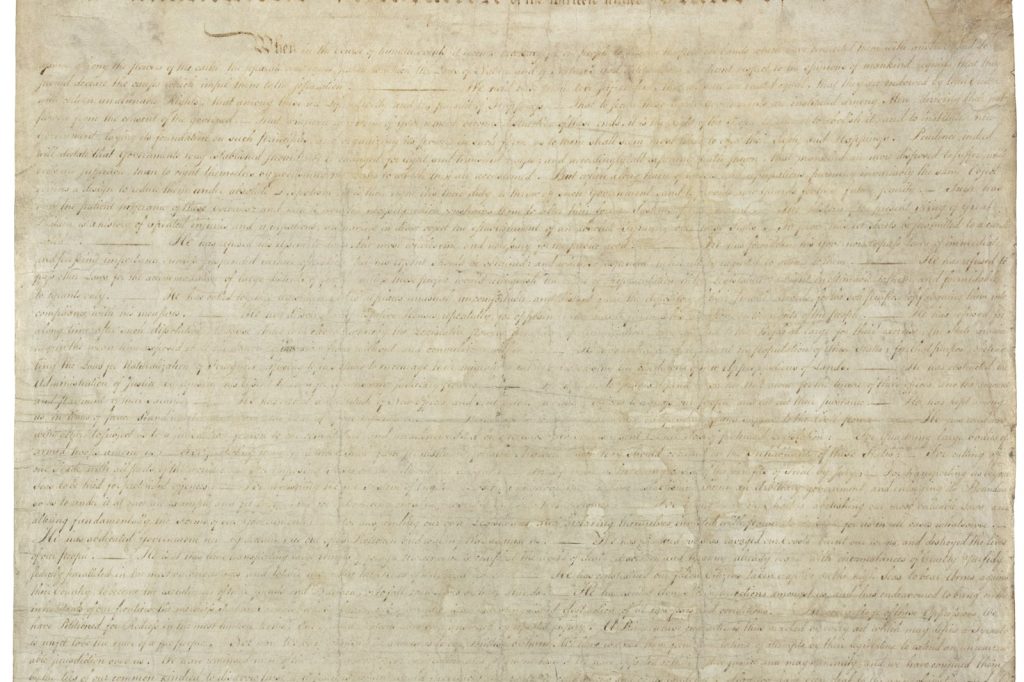
The claim under review, as the Declaration turns 250, is simple: that 1776 still pays out. On 25 June a webinar convened by the World Socialist Web Site put the question to a serious bench: James Oakes, Sean Wilentz, Richard Carwardine, Adam Hochschild, moderated by editorial chairman David North and litigator Eric Lee, with viewership past 2,000. The catch is the one the country keeps rediscovering: the document’s author held people as property, and the argument over what that does to the inheritance has not closed.
The revisionist case says the Revolution was no revolution at all, but a counter-revolution to protect slavery, a reading advanced by the New York Times’ 1619 Project and Gerald Horne. The panel’s answer was blunt. “In its time,” labor historian Thomas Mackaman noted, “nobody, including its enemies, thought it was anything but a revolution.” He and Wilentz called the method presentism and anachronism: the past arraigned by present standards, great events reduced to moral verdicts on individuals.
On closer reading, the contradictions are real enough; they are simply not the whole ledger. Jefferson wrote “All men are created equal” and owned slaves, condemned slavery in words and never in deeds, kept superb artisans in bondage at Monticello and freed none. Samuel Johnson’s question still stings: “How is it that we hear the loudest yelps for liberty from the drivers of Negroes?” Yet the historian Samuel Eliot Morison called those words “are more revolutionary than anything written by Robespierre, Marx, or Lenin, a continual challenge to ourselves, as well as an inspiration to the oppressed of all the world.” And of the nine slaveholding presidents, Washington alone freed his, the general who held the Continental Army together through Trenton, Princeton and Valley Forge, “first in war, first in peace, first in the hearts of his countrymen”.
The stakes, the panel argued, are contemporary. North opened by warning that the anniversary “unfolds amid an escalating assault on democratic rights” while noting open talk of dictatorial rule and an attempt to overturn the 2020 result. The Declaration, he said, “it indicted the existing social and political order and called for its overthrow in the most sweeping and universal terms,” and its principles outran their moment. Wilentz drew the line to the Alien Enemies Act of 1798, the one statute of its era still on the books and the basis for mass deportations. Oakes recorded that labor radicals and suffragists “repeatedly invoked the Declaration of Independence”, and that its equality claim “establishes an entirely new revolutionary standard by which every social movement from that point on is evaluated.”
The seminar’s own framing is the honest one: what was revolutionary, what limited, what betrayed, what carried forward, what unresolved. Two hundred fifty years on, the audit is still running, and both sides of the argument are spending the same inheritance.
Sources
- WSWS webinar on the American Revolution: The historical significance and contemporary relevance of 1776 – World Socialist Web Site
- Founding Fathers and Slaveholders