
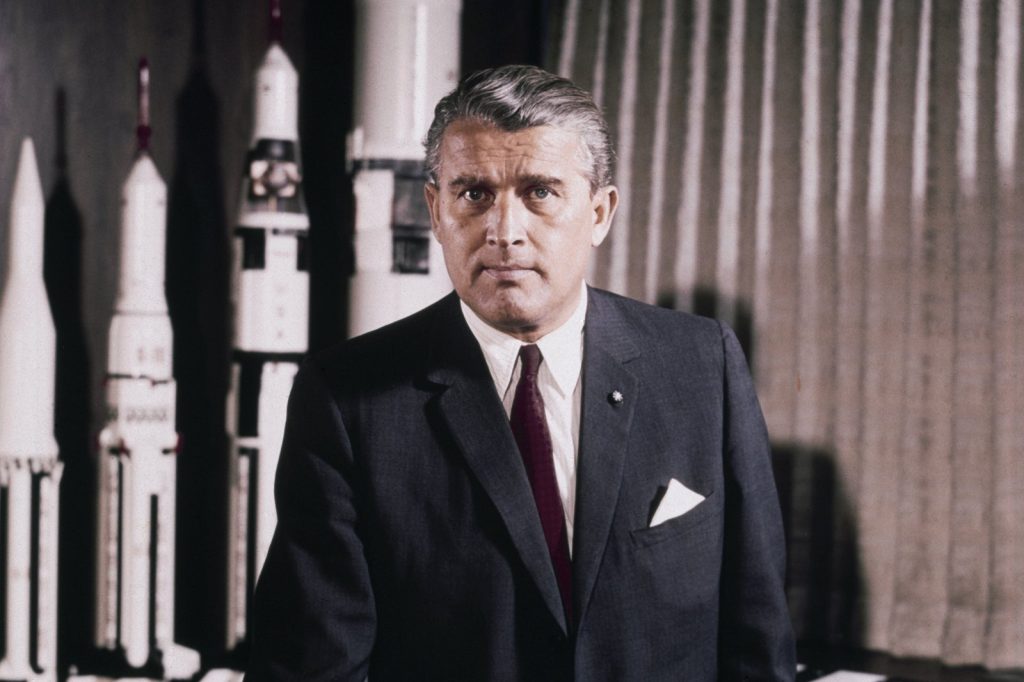
In February 1969, a few weeks after Apollo 8 circled the Moon, the man who ran NASA’s Marshall Space Flight Center sat in a West German consulate in New Orleans and answered a judge’s questions about slave labour. Wernher von Braun had not wanted to do it. He feared the publicity would hurt him and the agency. He denied personal responsibility all the same.
That scene holds most of what makes him so uncomfortable to remember.
A Prussian baron with a telescope
Von Braun was born on 23 March 1912 in Wirsitz, now Wyrzysk in Poland, into a prosperous aristocratic family. His mother gave him a telescope when he was confirmed. The family moved to Berlin in 1920. He did badly in physics and mathematics until, in 1925, he got hold of Hermann Oberth’s book on rocketry and, frustrated that he could not follow the maths, drove himself to the top of his class.
By late 1932 the German Army was paying for his research on liquid-fuel rockets, and he took a doctorate in physics in 1934. He rode with an SS equestrian unit in 1933 and 1934, joined the Nazi Party in 1937 and became a junior SS officer in 1940. He later called the party membership nominal, a shield for his career. The historian Michael Neufeld, of the National Air and Space Museum, says he had “sleepwalked into a Faustian bargain” and notes that Heinrich Himmler’s regard for the rocket work pushed him up to the rank of major by 1943.
Peenemünde and the V-2
At Peenemünde on the Baltic coast, von Braun was technical director. His team’s V-2 first flew successfully in October 1942. After British bombers hit the site on the night of 17-18 August 1943, production moved into an underground plant, the Mittelwerk near Nordhausen, worked by prisoners from the Mittelbau-Dora camp. Conditions killed many of them. NASA’s own account says von Braun knew how terrible they were and helped decide how the forced labour was used. He told the 1969 court he had seen the conditions for himself.
He was briefly in trouble with the regime too. In March 1944 the Gestapo held him for ten days after he allegedly made drunken remarks about Germany’s chances of winning. Albert Speer and General Dornberger argued he was indispensable. On 2 May 1945 he surrendered to American troops in the Alps.
From Fort Bliss to the Moon
Under Project Paperclip, he and an initial group of about 125 were sent to Fort Bliss in Texas. The Cold War turned a temporary arrangement into permanent immigration, and the army classified the uglier parts of his record. In 1950 the team moved to Huntsville, Alabama. A Jupiter C launched Explorer 1, the first American satellite, on 31 January 1958, a few months after Sputnik. Von Braun also became a public face for space travel, fronting three Walt Disney television programmes.
When his group moved from the army to NASA in 1960, he became director of the Marshall centre and chief architect of the Saturn V, the rocket that carried Apollo 11 to the Moon in July 1969. He left the agency in 1972 and died of cancer in Alexandria, Virginia, on 16 June 1977, aged 65.
His SS rank became widely known only in the 1980s, after his associate Arthur Rudolph went back to Germany rather than fight a denaturalization hearing. Neufeld calls him the most important rocket engineer and space promoter of the twentieth century, and says his legacy “will forever be tarnished by his service to a murderous regime.”
Sources
- Wernher von Braun and the Nazis | American Experience | Official Site | PBS
- Wernher von Braun – NASA
- Wernher von Braun | Biography, Quotes, & Facts | Britannica




