
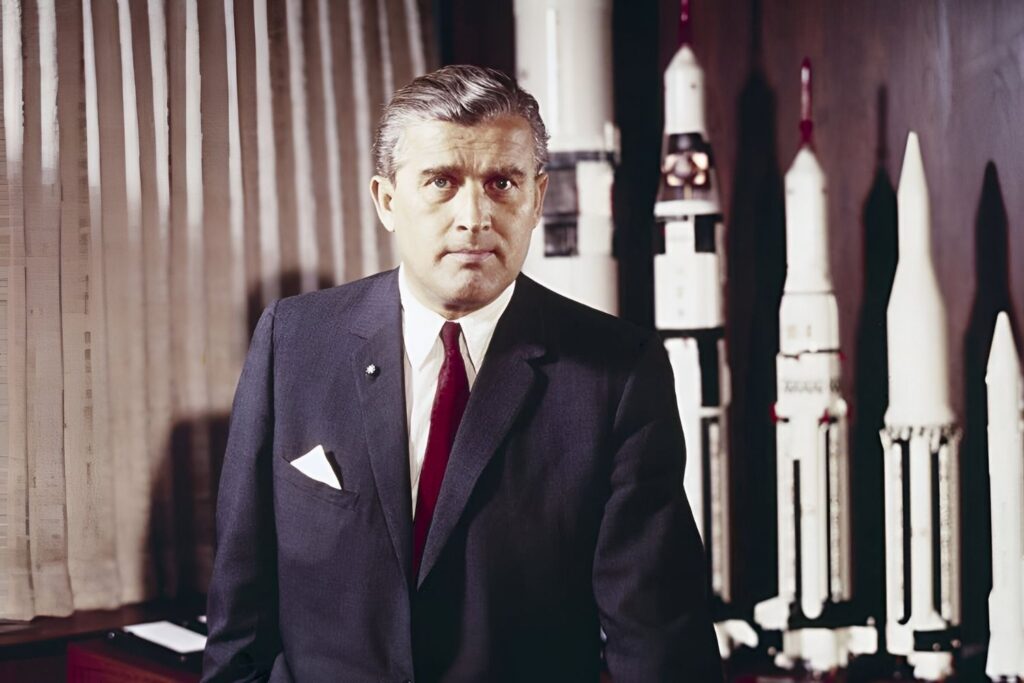
Neil Armstrong had barely finished walking on the Moon in July 1969 when Wernher von Braun started drawing up the next trip. Within weeks, the German-born rocket engineer was working on a plan to put people on Mars.
It was an odd moment to be asking for more. The Moon decision itself dated to 12 April 1961, when Yuri Gagarin became the first human in space. President John F Kennedy responded within weeks to recommendations from senior NASA managers, setting the goal of landing Americans on the Moon by the end of the decade. The Saturn V, the very large launcher von Braun engineered, was what made that goal reachable. His Saturn vehicles had started out funded by the army and passed to NASA from 1960.
A budget already shrinking
By the mid-1960s NASA was looking for ways to reuse Apollo hardware for longer lunar stays and for Earth-orbiting space stations in the 1970s. The money for those ideas never came. By the time of the first landing, budgets were falling, and the future of human spaceflight looked threatened. In 1965, at its peak, NASA had received 4 per cent of the US federal budget.
The agency had already begun to move toward a reusable shuttle in 1967, and by 1968 it had added “commonality” to “reusability” as the guiding idea behind what became the Integrated Space Program. Von Braun’s Mars plan of 1969 grew out of that work.
The ship
The plan had four main elements: the Saturn V, a Nuclear Shuttle, a Mars Mission Module and a Mars Excursion Module. It also needed the Space Shuttle to exist and the Saturn V to stay in production.
The expedition would assemble in Earth orbit, where three Nuclear Shuttles, each a rocket stage driven by a reactor instead of a chemical motor, would be clustered side by side. Liquid hydrogen would pass through tubes in the hot reactor and exit through a conventional nozzle. NASA had been studying the idea because it did away with the heavy oxidiser. The central stage would carry the Mission Module, with the Mars Excursion Module on top inside a shroud. The two outer stages would drop away once the ship reached escape velocity and turn back to Earth orbit, to be refuelled and flown again.
The assembled vehicle would be 82m long and weigh 726,180kg, with a crew of six. Von Braun wanted two ships to travel together, so that one could serve as a refuge if the other failed on the way out or back. Each Nuclear Shuttle was to be 48.7m long and 10m wide, weighing 210,000kg.
He calculated nine months to reach Mars, accepting a longer trip in exchange for more payload. Nobody knew whether people could stand that long in weightlessness. The longest flight so far had lasted barely two weeks. So he proposed joining the two Mission Modules nose to nose, a rigid structure 164m long, spinning around a common centre to create artificial gravity. The three crew members staying in orbit would otherwise have been weightless for 21 months.
The schedule
Von Braun picked an Earth departure of 12 November 1981, far enough off to build the hardware at an affordable pace, with arrival in Mars orbit on 9 August 1982. The crew would spend around 10 weeks there, sending probes to the surface to bring back material to be analysed and cleared of anything harmful. Three astronauts would then descend in the Mars Excursion Module, a cone-shaped craft able to support them for 30 to 60 days. A small rover would give them some mobility. There were no plans for a permanent base.
The ships would leave for home on 28 October 1982 and pass Venus on 28 February 1983, using its gravity to shave off speed before re-entry and to drop probes. Back in Earth orbit on 14 August 1983, the crew would return through the atmosphere in a Space Shuttle after checks to confirm they carried no Martian organisms.
Why it died
The logic held together, but the hardware did not exist. The Nuclear Shuttle, the Earth-orbit space base and the Space Shuttle were all without precedent, and nothing guaranteed they would work. The plan also needed NASA’s budget to double by 1974. Instead it was shrinking, and the Space Shuttle was not approved until January 1972, on a much smaller budget. The Nuclear Shuttle, the space base and the return to the Moon were all dropped, leaving only the Shuttle, due to begin operating in 1981.
Von Braun, who had led the German rocket programme from the mid-1930s until 1945, moved to NASA headquarters as Apollo wound down and took charge of long-range planning. His ideas ran well ahead of what the country would fund. Disillusioned, he left NASA in 1972 for a US aerospace company. In 1973 he was diagnosed with kidney cancer, yet he kept speaking at colleges and universities and helped found the National Space Society in 1975. He retired in 1976, died in 1977, and received the US National Medal of Science before the end.
To the last, he was frustrated that he never saw humans reach Mars.




