
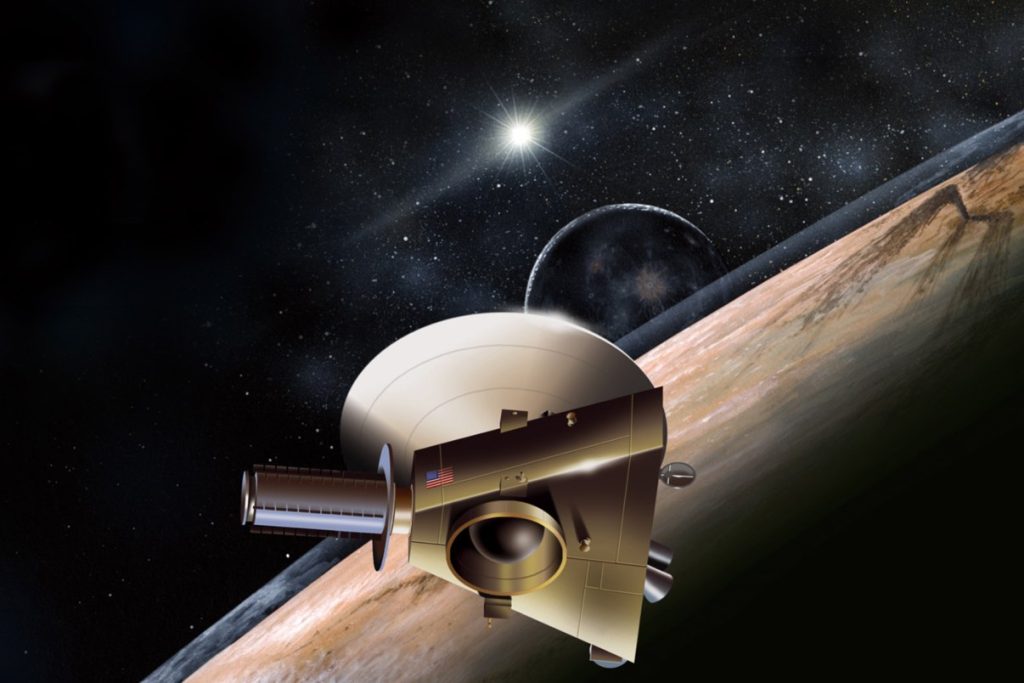
LONDON, July 9 — New Horizons, the spacecraft that gave us Pluto’s face, is now in the middle of a much longer second act. It is currently cutting through the Kuiper Belt at about 14 kilometers per second relative to the Sun, and as of 2023 it was roughly 50 AU from the Sun. The detail that matters: that is already well beyond the orbit of any planet, yet the probe still has decades of work ahead.
The spacecraft is expected to cross the heliopause — the boundary where the Sun’s magnetic influence gives way to the interstellar medium — sometime in the 2040s. That crossing is estimated to occur at a distance of 120 to 150 AU from the Sun.
After that, New Horizons will officially enter interstellar space, joining Voyager 1 and Voyager 2. Under the hood, the technical reality is that New Horizons will keep returning data on plasma, dust, magnetic fields, and cosmic rays until its radioisotope thermoelectric generator runs out of power. That is expected in the late 2030s.
So there is a narrow window: the probe will likely lose its voice before it reaches the heliopause, meaning the crossing itself will be recorded but not narrated in real time.
Still hunting for targets
The probe’s trajectory takes it through the Kuiper Belt, and the mission team is actively searching for additional flyby targets using ground-based telescopes, including the Subaru Telescope in Hawaii. If they find something, New Horizons may be able to swing past another Kuiper Belt object. No further planetary encounters are planned — the architecture of the mission does not allow for that — but a new flyby of a small body is not out of the question.
As ever, the search is constrained by time and light. The spacecraft is moving fast, and any target must lie along its narrow flight path.
The team is looking, but no new object has been announced.
A third perspective on the interstellar medium
After the heliopause crossing, New Horizons will provide a third perspective on the interstellar medium, complementing the data from the two Voyager probes. Voyager 1 crossed in 2012, Voyager 2 in 2018. Both are still sending back data, but they are aging, and their power is fading.
New Horizons will offer a different trajectory and a fresh set of instruments, giving scientists a more complete picture of the boundary region. The mission is expected to continue until at least the 2040s, though data transmission will cease when power is insufficient.
The spacecraft itself will keep going, eventually exiting the solar system entirely and traveling into the Milky Way galaxy. That part of the journey will be silent, but the data it sends back in the next decade and a half will be the real legacy.
{“@context”: “https://schema.org”, “@type”: “NewsArticle”, “headline”: “What Happens Next: New Horizons’ Path to the Heliopause and Beyond”, “description”: “LONDON, July 9 — New Horizons, the spacecraft that gave us Pluto’s face, is now in the middle of a much longer second act. It…”, “datePublished”: “2026-07-09T09:30:00+00:00”, “author”: {“@type”: “Person”, “name”: “Sebastian Smith”}, “publisher”: {“@type”: “Organization”, “name”: “InfoPulse Today”, “url”: “https://newsfeed.infopulsetoday.com/”}}




