
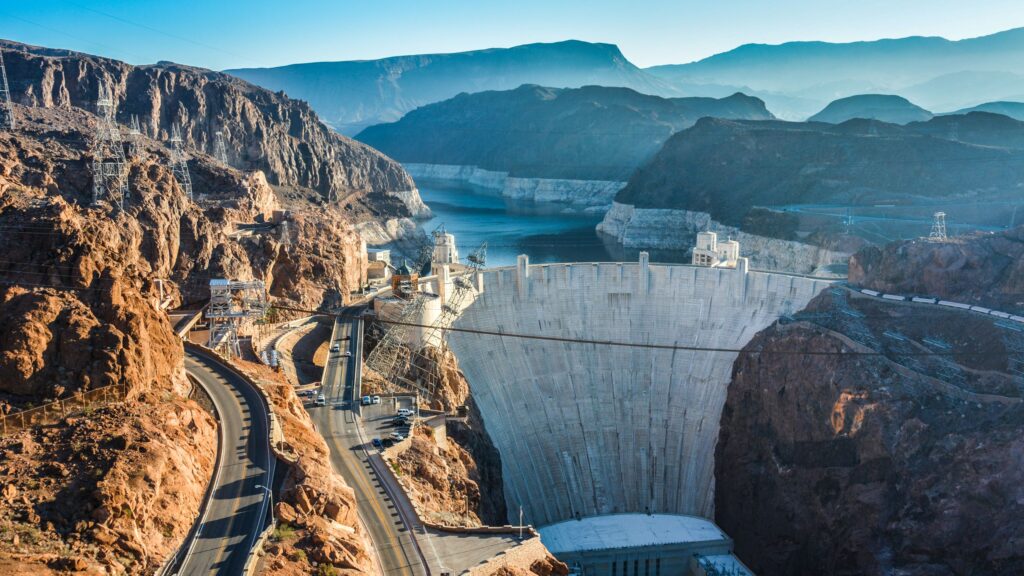
BOULDER CITY, Nevada, July 8 — The Hoover Dam stands 726 feet tall on the Colorado River at the Arizona-Nevada border, a concrete arch-gravity dam that created Lake Mead, the largest reservoir in the United States by volume. Constructed between 1931 and 1936, the project employed up to 5,000 workers and cost $49 million — equivalent to roughly $890 million in 2023 dollars. It now provides hydroelectric power to about 1.3 million people across Nevada, Arizona, and California, with a power plant capacity of 2,080 megawatts.
Under the hood, the technical reality of the Hoover Dam is that it was one of the most ambitious engineering projects of its era. The dam itself is a massive wedge of concrete designed to hold back the full force of the Colorado River, and the numbers that define it are still striking nearly a century later.
The power plant’s 2,080 megawatts of capacity feeds into a grid that serves major urban centres and agricultural regions across three states. The detail that matters for anyone tracking water and power infrastructure in the American West is that this single structure, built during the Great Depression, remains a cornerstone of regional energy supply. The project was a New Deal initiative under President Franklin D.
Roosevelt, aimed at flood control, irrigation, and rural electrification. It was not an isolated effort.
The Tennessee Valley Authority, created by Congress in 1933, built a system of 49 dams across the Tennessee River watershed, covering parts of seven states. The TVA’s largest dam, the Fontana Dam, completed in 1944, stands 480 feet high — shorter than Hoover by a considerable margin. The TVA system generates about 33,000 gigawatt-hours of electricity annually and serves approximately 10 million people.
As ever with large-scale federal infrastructure, the scale of the ambition matched the scale of the geography. The TVA’s 49 dams transformed the Tennessee River watershed, a region that spans seven states, into a managed system for power generation, flood control, and navigation.
The TVA’s annual electricity output of roughly 33,000 gigawatt-hours dwarfs what Hoover alone produces, but the two projects shared a common DNA: both were federal responses to the economic and social crises of the 1930s, and both were designed to reshape the relationship between Americans and their natural resources.
The New Deal’s twin pillars
Hoover Dam and the TVA system are often discussed in the same breath because they represent two faces of the same New Deal impulse. Hoover was a single, monumental structure on a major western river; the TVA was a distributed network of dozens of dams across a vast eastern watershed. Both were launched under Roosevelt’s administration, and both had the explicit goals of flood control, irrigation, and rural electrification.
The detail that matters is that before these projects, vast stretches of the American South and West had no access to reliable electricity. The dams changed that, enabling urban growth and agricultural expansion on a scale that would have been unthinkable without them.
The Hoover Dam’s construction employed up to 5,000 workers at its peak, many of them labouring in dangerous conditions in the narrow canyon of the Colorado River. The project cost $49 million at the time — a figure that, adjusted for inflation to 2023, comes to roughly $890 million. That investment has been repaid many times over in the form of electricity sales, water supply, and flood mitigation.
Lake Mead, the reservoir created by the dam, is the largest by volume in the United States, and it serves as a critical water storage facility for the entire lower Colorado River basin. The TVA’s approach was different in structure but similar in ambition.
Instead of one giant dam, the authority built 49 dams across the Tennessee River and its tributaries, creating a system that could manage water flows across a region covering parts of seven states. The Fontana Dam, the tallest in the TVA system at 480 feet, was completed in 1944 and is a concrete gravity dam that generates power for the region. The TVA system as a whole produces about 33,000 gigawatt-hours of electricity annually, serving approximately 10 million people.
That is a substantial portion of the electricity consumed in the southeastern United States.
Transformation of the American landscape
These projects transformed the American West and South, enabling urban growth and agricultural expansion. The Hoover Dam made possible the development of cities like Las Vegas and Los Angeles by providing reliable water and power. The TVA system electrified rural areas of Tennessee, Alabama, Mississippi, Kentucky, Georgia, North Carolina, and Virginia, bringing lights, refrigeration, and industrial development to regions that had been largely without electricity.
The economic and social impact of these projects is difficult to overstate. Before the dams, much of the rural South and West was dependent on kerosene lamps and hand-pumped wells.
After the dams, factories could operate, farms could irrigate, and homes could be wired for modern appliances. The technical reality of both projects is that they required the federal government to take on roles that had previously been left to private enterprise or local government. The Hoover Dam was built by the Bureau of Reclamation, a federal agency.
The TVA was a federal corporation created by an act of Congress. In both cases, the scale of the investment and the complexity of the engineering were beyond what private capital could or would have undertaken.
The result was a network of infrastructure that reshaped the geography of the United States and set the stage for the post-war economic boom. As ever, the detail that matters for anyone looking at these projects today is that they are still operating, still generating power, and still managing water flows nearly a century after they were built. The Hoover Dam’s power plant, with its 2,080 megawatts of capacity, continues to supply electricity to about 1.3 million people.
The TVA system, with its 49 dams and 33,000 gigawatt-hours of annual output, serves about 10 million people. These are not historical relics; they are working infrastructure that remains central to the American energy and water systems.
Looking forward
The question that hangs over both projects now is one of maintenance and adaptation. The Hoover Dam and the TVA dams were built in an era when the climate was relatively stable and the demands on water and power were lower. Today, the Colorado River basin faces prolonged drought, and the levels of Lake Mead have dropped significantly in recent years.
The TVA system faces its own challenges, including aging infrastructure and changing patterns of electricity demand. The federal government, under the current administration, is grappling with how to maintain and upgrade these assets while also considering new approaches to water and power management.
The Hoover Dam’s capacity of 2,080 megawatts is still a significant contribution to the western grid, but the dam itself is nearly a century old. The concrete is aging, the turbines require regular maintenance, and the reservoir behind the dam is under stress from reduced snowpack and increased water demand. The TVA’s 49 dams are similarly aging, and the authority has been investing in upgrades to keep the system operational.
The technical reality is that these dams will need sustained investment to continue functioning at their current levels. What to watch next is how the federal government and the states that depend on these projects manage the tension between maintaining existing infrastructure and building new capacity.
The Hoover Dam and the TVA system were transformative when they were built, but they were designed for a different era. The question now is whether they can be adapted to meet the needs of the 21st century, or whether new approaches will be required. The detail that matters is that these projects remain the backbone of water and power supply for millions of Americans, and their future will shape the development of the regions they serve for decades to come.




