WASHINGTON, November 9, 2026 — Democrats are planning to defend clean energy tax credits and EPA grants from repeal and funding cuts by the Trump administration. The party’s efforts are focused on protecting key provisions of the 2022 Inflation Reduction Act, which authorized $391 billion for energy and climate change, the largest such investment in U.S. history.
Background On The Inflation Reduction Act
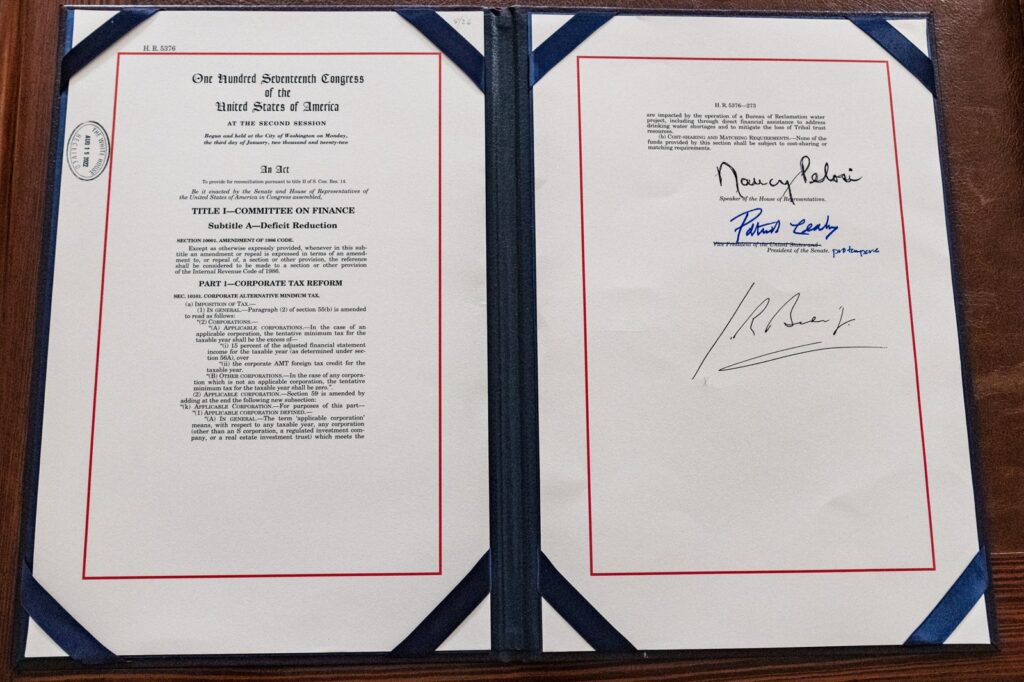
The Inflation Reduction Act, signed into law by President Joe Biden on August 16, 2022, aimed to reduce the federal government budget deficit, lower prescription drug prices, and invest in domestic energy production while promoting renewable energy. The law included tax credits for renewable electricity production, investment credit for energy property, and nuclear power production. According to the Congressional Budget Office and Joint Committee on Taxation, the law will raise $738 billion from tax reform and prescription drug reform to lower prices, as well as authorize $891 billion in total spending.
Clean Energy Provisions At Risk
The 2025 One Big Beautiful Bill Act essentially slashed much of the support and financial incentives in the Inflation Reduction Act. The law repealed the EPA’s authority to administer the $7 billion Solar for All program, which was funded through the Inflation Reduction Act. The program aimed to expand access to solar energy in low-income communities. Massachusetts won $156 million under the program, which could have reduced energy costs by 20% for 31,000 low-income and disadvantaged homes. However, the Trump administration canceled the program, calling it a “boondoggle.”
Democratic Efforts To Counter Fossil Fuel Expansion
Democrats are prioritizing the defense of clean energy tax credits, including those for wind, solar, and nuclear power production. The Inflation Reduction Act provided $4.5 billion in multiyear funding for the Internal Revenue Service, which includes $4.2 billion in mandatory funding for the IRS in FY2027. The IRS’s FY2027 appropriations request is $9.8 billion, a 12% decrease from the FY2026 enacted amount. The Democratic efforts are crucial in countering the Trump administration’s fossil fuel agenda, which has led to the cancellation of several clean energy projects, including a $20 million EPA grant for a wind energy project in Kotzebue, Alaska.
Impact On Clean Energy And Climate Change
The Inflation Reduction Act’s clean energy provisions are critical in promoting renewable energy and reducing greenhouse gas emissions. The law’s investment in clean energy is expected to bring down inflation in the medium-to-long term. The Democrats’ efforts to defend these provisions are essential in ensuring the continued growth of the clean energy sector and the reduction of the federal government’s budget deficit. As Juliana Reed, executive director of the Biosimilars Forum, noted, the Biosimilars Access and Affordability Act would create clearer criteria for delaying Medicare price negotiation of biologics, which could impact the development of clean energy technologies. The outcome of the Democrats’ efforts will have significant implications for the clean energy sector, climate change, and the U.S. economy. The IRS’s FY2027 budget request includes $4.2 billion in mandatory funding, which will be crucial in supporting the agency’s enforcement and technology efforts.
Sources
- Inflation Reduction Act
- How the Biosimilars Access and Affordability Act Redefines IRA Delays
- DOGE cuts cost tribes $470M, gutting funding for climate projects
- What’s next for US energy policy after the midterm elections?
- $156 million for Mass. solar projects in limbo after courts say EPA illegally withheld funds
- FY2027 Internal Revenue Service Budget Request
Photo: The White House (Public domain)