
One number tells you nearly everything about iron ore: 98. That is the percentage of all mined iron ore that goes straight into making steel. Not construction stone, not decorative gravel, not fill dirt.
Steel. From bridges to car frames to the rebar inside concrete walls, almost every ton of this rock ends up as the backbone of modern industry.
The rock itself is not one thing. It is a family of minerals, each with a different iron concentration. Magnetite runs at 72.4 percent iron.
Hematite sits at 69.9 percent. Below them, goethite holds 62.9 percent, limonite 55 percent, and siderite just 48.2 percent.
These numbers matter because they determine which ore gets dumped straight into a blast furnace and which requires processing first. Ores with iron content above 60 percent — typically hematite and magnetite — earn the label “natural ore” or “direct shipping ore.” They go directly into blast furnaces. No intermediate steps.
No upgrading. That direct path makes them disproportionately valuable. A blast furnace fed on high-grade ore produces pig iron faster and cheaper than one forced to work with lower grades.
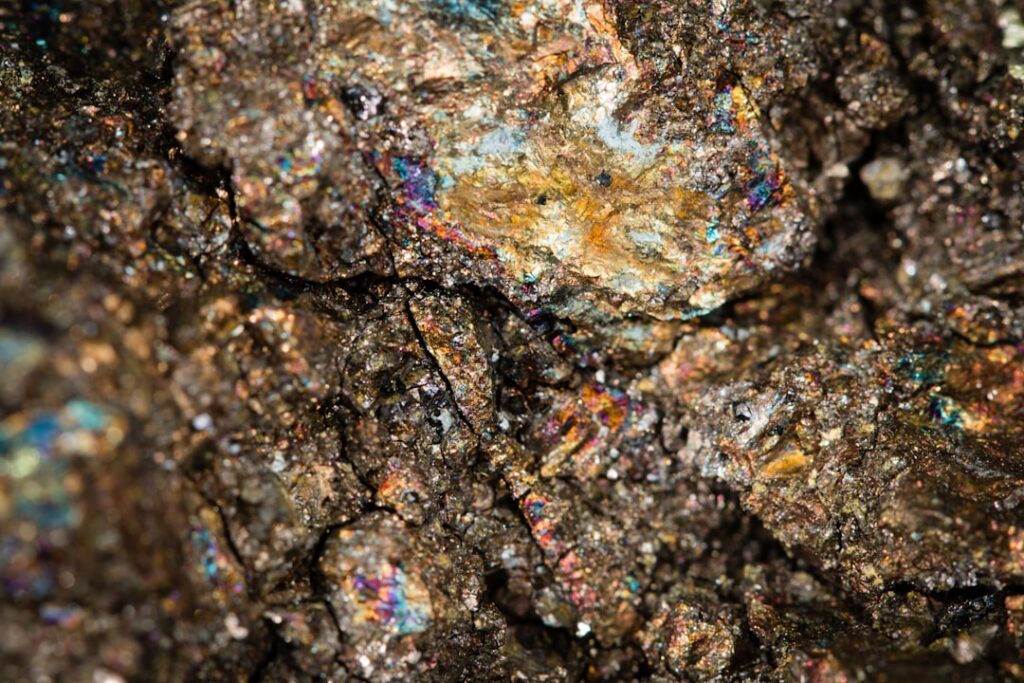
And pig iron is the raw material for steel. The colors of these ores vary wildly.
Dark grey. Bright yellow. Deep purple.
Rusty red. But the economic logic is uniform: higher iron content means lower cost per ton of finished steel.
This is not a subtle market signal. It is the central fact of the entire iron ore trade. The global economy depends on this arrangement.
Without iron ore, there is no pig iron. Without pig iron, there is no steel. Without steel, modern construction collapses, manufacturing stalls, and the supply chains for everything from automobiles to appliances grind to a halt.
That 98 percent figure is not incidental. It is structural.
Industry experts have noted the importance of iron ore to the global economy. Christopher LaFemina, a mining analyst at Barclays, has commented on the subject. The exact wording of his remarks is not available in the report, but the point stands: this is not a niche commodity.
It is the raw material underpinning the material world. The practical implications are straightforward.
Countries that control high-grade iron ore deposits hold strategic leverage. Steelmakers that secure long-term supplies of direct shipping ore insulate themselves from price volatility. Mining companies that can consistently deliver magnetite or hematite above 60 percent iron command premium prices.
The geology is fixed. The economics follow. Lower-grade ores are not useless.
They are simply more expensive to use. Goethite, limonite, and siderite require beneficiation — upgrading through crushing, grinding, magnetic separation, or flotation — before they can feed a blast furnace.
That adds cost, energy, and time. In a tight market, those costs can determine which mills run at profit and which shut down. The report makes clear that iron ore comes in these five principal forms.
Magnetite and hematite dominate the trade. Goethite, limonite, and siderite fill the lower tiers.
Each has its place. But the market rewards concentration. High iron content is the prize.
None of this is new. The Romans mined iron ore. The Industrial Revolution ran on it.
The skyscrapers of the twentieth century rose on steel made from it. What has changed is the scale.
Global steel production now exceeds 1.8 billion tons annually. That requires an enormous, continuous flow of iron ore. The 98 percent figure means that almost every ton mined is destined for a blast furnace or a direct reduction plant.
There is no alternative use at scale. There is no substitute.
The color of the rock does not matter. The iron content does. And the iron content determines whether the ore goes straight to the furnace or takes a detour through a processing plant.
That is the single fact that governs the economics of an entire industry.




