
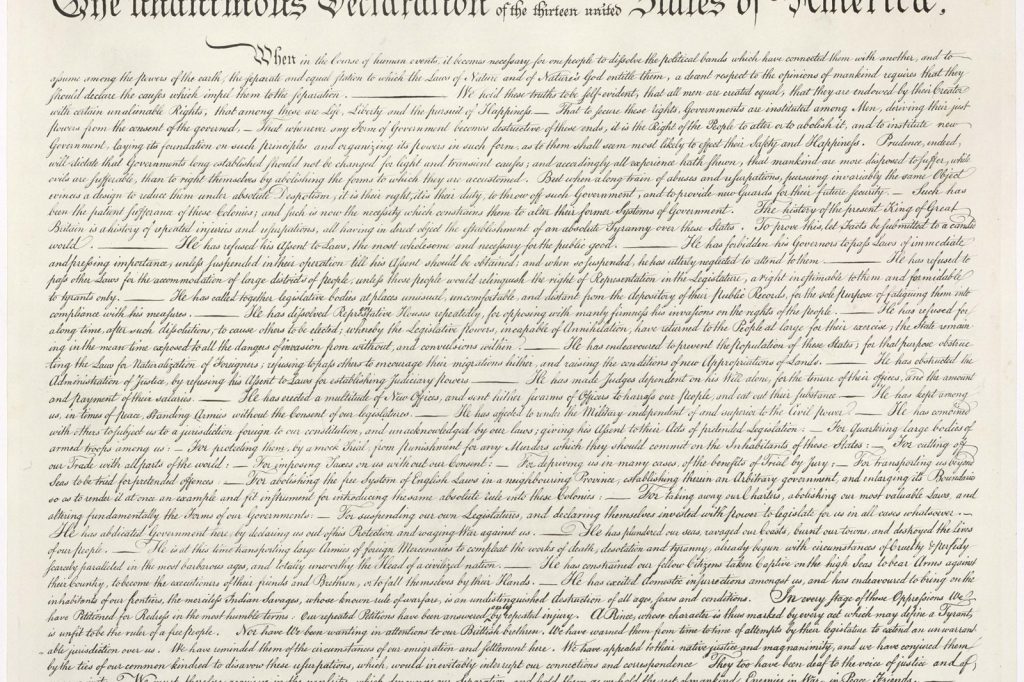
WASHINGTON — Two hundred and fifty years after Thomas Jefferson put pen to parchment, the legal foundation of that act is drawing new attention. Not from historians alone. Legal scholars.
Activists. Judges.
The sentence itself is well known. “We hold these truths to be self-evident: that all men are created equal and endowed by their Creator with certain unalienable rights, among them life, liberty, and the pursuit of happiness.” But the source material for those words, and what the Founders actually meant by them, is the subject of a fresh reckoning as the nation marks its semiquincentennial. Jefferson was a lawyer.
That fact matters. The Declaration’s structure reflects his training.
He drew heavily from Sir William Blackstone, whose Commentaries on the Laws of England, published in 1757, shaped common law in England, the colonies, and eventually the U.S. Constitution. Blackstone’s framework is explicit. Natural rights come from the Creator.
They include life, liberty, and the pursuit of happiness. Critically, Blackstone states that the natural right to life begins in the womb. That right, he argued, belongs to unborn children as well as those already born.
Jefferson and the other Founders understood this clearly, the source material asserts. The Declaration’s opening was not rhetorical flourish.
It was a legal and philosophical assertion defining the Republic’s moral boundaries. Author Walter Isaacson has called that sentence “The Greatest Sentence Ever Written.” The stakes, as America looks back on 250 years, go beyond praise. The argument put forward is that America has drifted from those boundaries.
The question being asked by some observers is whether the nation still holds those truths to be self-evident. “The Founders built a legal order on a specific understanding of rights,” one constitutional scholar familiar with the source material said.
“That understanding is under direct challenge today.” The calculus of the founding rested on unalienable rights. Not granted by government. Not to be taken away by government.
The Declaration was a legal document as much as a political one. It asserted that certain rights predate law itself. Life.
Liberty. The pursuit of happiness.
All from the Creator. All beginning, per Blackstone, before birth. That point is not academic.
It has real consequences for current debates. The source material signals a call to reflect on whether those boundaries have held.
Many say they have not. The nation is divided on what “life” means, what “liberty” means, and who qualifies for “the pursuit of happiness.” The anniversary has brought these tensions into sharper focus. Celebrations are underway.
Parades. Fireworks. Speeches.
But beneath the pageantry, a harder conversation is taking place. It is a conversation about original meaning.
About whether the Republic’s moral boundaries were abandoned somewhere along the way. “We are being forced to decide if we still believe what we said we believed,” one activist said. “The words are there.
The question is whether we mean them.” Blackstone’s influence on Jefferson is not new knowledge. But the weight of that influence, and its implications for the unborn, is being reexamined.
The Declaration’s assertion of unalienable rights was not abstract. It was a binding claim about the nature of human beings. That claim, the source material argues, included the unborn from the start.
America’s semiquincentennial is a time for celebration. It is also a time for scrutiny. The sentence that started the American experiment is being read again.
This time, people are paying attention to what it actually says.




