
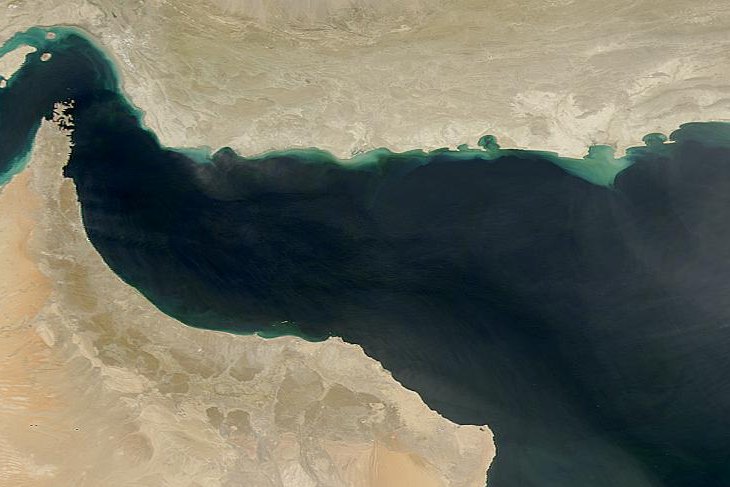
The narrow waters of the Strait of Hormuz have for centuries served as a critical maritime corridor, linking the Persian Gulf to the Gulf of Oman and providing the only sea passage from the Gulf to the open ocean. Ancient Greek mariners described its entrance in the first-century navigational guide known as the Periplus of the Erythraean Sea. Today, the waterway remains a vital artery for global energy supplies, carrying a large share of the world’s seaborne oil and liquefied natural gas.
For several Gulf states—including Iraq, Kuwait, Bahrain, Qatar, and the United Arab Emirates—the strait is the sole maritime outlet, making any disruption to traffic through it capable of causing severe energy shortages for Europe and Asia. That dependence gives any threat against the strait immediate global economic significance.
Iran has long wielded the threat of closing the strait as strategic leverage. During the Iran-Iraq War in the 1980s, both sides attacked oil tankers and laid naval mines in and near the waterway. In later decades, Iranian officials periodically warned they could block the strait during crises with the United States.
Such threats did not lead to any sustained closure; the strait remained open even as regional conflicts flared elsewhere, unlike other strategic passages that have been disrupted for extended periods. The waterway lies between Iran to the north and the Musandam Peninsula, shared by Oman and the United Arab Emirates, to the south, and at its narrowest points is only a few dozen miles wide, making a credible obstruction an enduring flashpoint.
A Parallel Naval Force and Its Commander
The Islamic Revolutionary Guard Corps Navy, a branch of Iran’s armed forces established in 1985, operates separately from Iran’s regular navy. It focuses on asymmetric warfare, employing speedboats, anti-ship missiles, and naval mines. The IRGC Navy has approximately 20,000 personnel and operates small fast-attack craft, anti-ship missiles, and naval mines. Its tactics include using small boats to swarm larger vessels and deploying naval mines, a method used during the Iran-Iraq War from 1980 to 1988.
The force’s anti-ship missile arsenal includes the Noor and Qader systems, both with ranges up to 200 kilometers. Rear Admiral Alireza Tangsiri has served as the IRGC Navy’s commander since 2018.
He has publicly stated that the IRGC can block the strait if necessary, a position consistent with a broader Iranian strategy to use the threat of closure as leverage. In July 2019, IRGC forces seized the British-flagged tanker Stena Impero in the strait, holding it for two months. The IRGC Navy is funded through Iran’s national budget; according to the Stockholm International Peace Research Institute, Iran’s total military spending was estimated at $17.4 billion in 2023, though IRGC-specific allocations are not publicly disclosed.
Recurring Threats and Geopolitical Context
The IRGC Navy has repeatedly threatened to close the Strait of Hormuz, notably in 2008, 2012, and 2019, during periods of heightened tensions with the United States. These capabilities directly apply to any operation in the confined waters of the strait, where a sustained obstruction remains a credible scenario. The United States has designated the IRGC as a terrorist organization since April 2019.
The IRGC Navy’s specialized asymmetric tactics—swarming with small fast-attack craft and deploying naval mines—are particularly suited to the strait’s geography. Because the waterway is narrow, the combination of speedboats, mines, and anti-ship missiles gives Tehran a means to threaten a vital chokepoint that carries much of the world’s seaborne energy trade.
The strategic significance of the strait was already recognized in ancient times, but in the modern era, its stability directly affects energy prices, shipping routes, and the risk of broader military confrontation in the region. Rear Admiral Tangsiri’s public statements about blocking the strait are part of that longstanding strategic calculus, one that has been tested repeatedly but has never resulted in a prolonged closure.




