
When NASA last sent humans beyond low Earth orbit, Richard Nixon was in the White House and the nation had just finished its Apollo program. Apollo 17 flew in December 1972–nearly five decades ago. No crew has left the protective envelope of Earth orbit since.
That long hiatus ends with Artemis II, the first crewed flight of the Orion spacecraft and the Space Launch System rocket. And commanding that mission is Reid Wiseman, a career Navy fighter pilot and engineer whose path from a Maryland drumline to the Moon’s vicinity reflects the deliberate, test-oriented approach NASA is taking to revive human deep-space exploration.
From Drumline to Fighter Cockpit to Space Station
Wiseman was born in Baltimore in 1975 and grew up in a Maryland suburb. He attended a public high school, where he played golf and was part of the drumline.
After earning a bachelor’s degree in computer science from Rensselaer Polytechnic Institute and a master’s degree in systems engineering from Johns Hopkins University, he was commissioned as a Navy officer. Wiseman flew F-14 Tomcats from aircraft carriers, later graduated from test pilot school, and logged years of flight testing. That technical foundation, layered with operational experience, is what the broader stakes of Artemis II demand.
In 2009, NASA selected Wiseman as an astronaut. He flew on Expedition 40/41 to the International Space Station in 2014, spending 165 days in space.
Between the cockpit of a fighter, the test pilot’s discipline, and a long-duration stay on the station, Wiseman gained direct experience in evaluating spacecraft performance under real conditions. He also served as chief of the Astronaut Office at NASA Johnson Space Center from 2020 to 2022, a role that oversees the training and assignment of all NASA astronauts. What this signals is a commander who has both the engineering pedigree and the institutional leadership credentials.
The 10-Day Shakedown That Sets the Stage for Lunar Landings
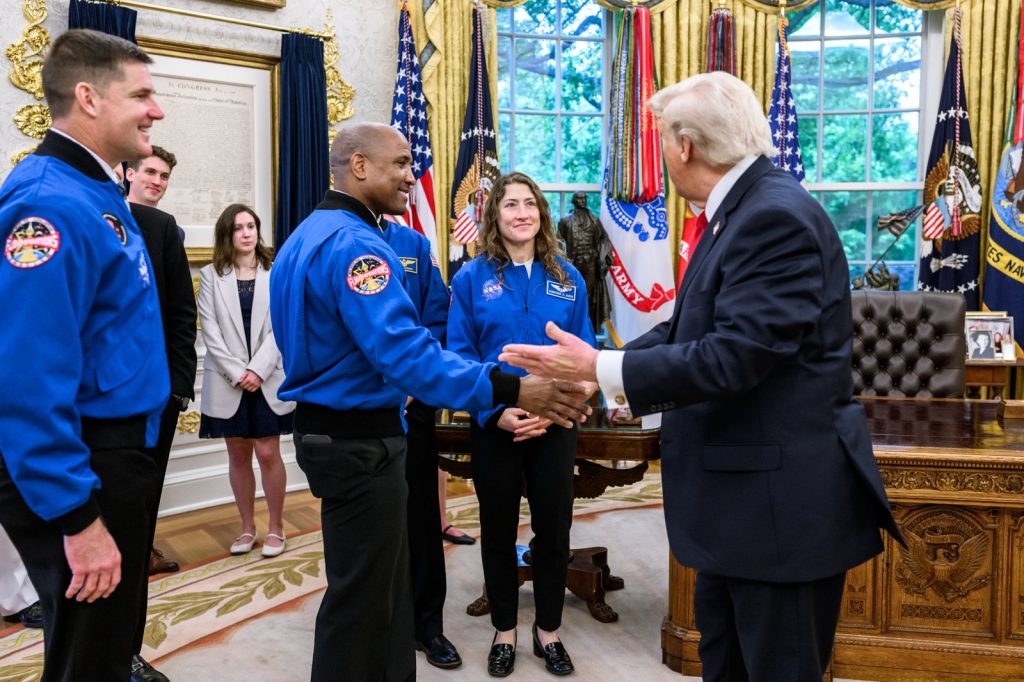
The Artemis II mission itself is a 10-day flight around the Moon. Wiseman’s crew includes pilot Victor Glover, mission specialist Christina Koch, and Canadian astronaut Jeremy Hansen.
The objective is clear: test all of Orion’s systems with humans aboard. This is not a symbolic gesture. It is a deliberate, strategic step forward.
Without a successful crewed shakedown flight, future Artemis missions that aim to land astronauts on the lunar surface cannot proceed. Every system–life support, navigation, propulsion, communications–must be validated with a crew in the loop.
Artemis II was originally scheduled for November 2024. That timeline has shifted, but the mission’s purpose has not. The broader stakes are about proving that the hardware works. Wiseman’s role as commander places him at the center of that verification process.
His background as a test pilot and his previous service on the International Space Station give him direct experience in evaluating spacecraft performance under real conditions. For readers, this mission represents the return of human deep-space exploration.
It is not merely a repeat of the Apollo flights but a step toward establishing a sustained presence beyond Earth.
What to Watch Next
What to watch next is whether the mission timeline firms up and how Wiseman’s leadership shapes the operational tempo. The commander in charge of that first step is a career Navy pilot and engineer who has spent much of his life preparing for this moment. Strategically, this is the first crewed flight of the Orion spacecraft and Space Launch System rocket. Wiseman is the man at the helm.
The chessboard is set. The move is his.




