
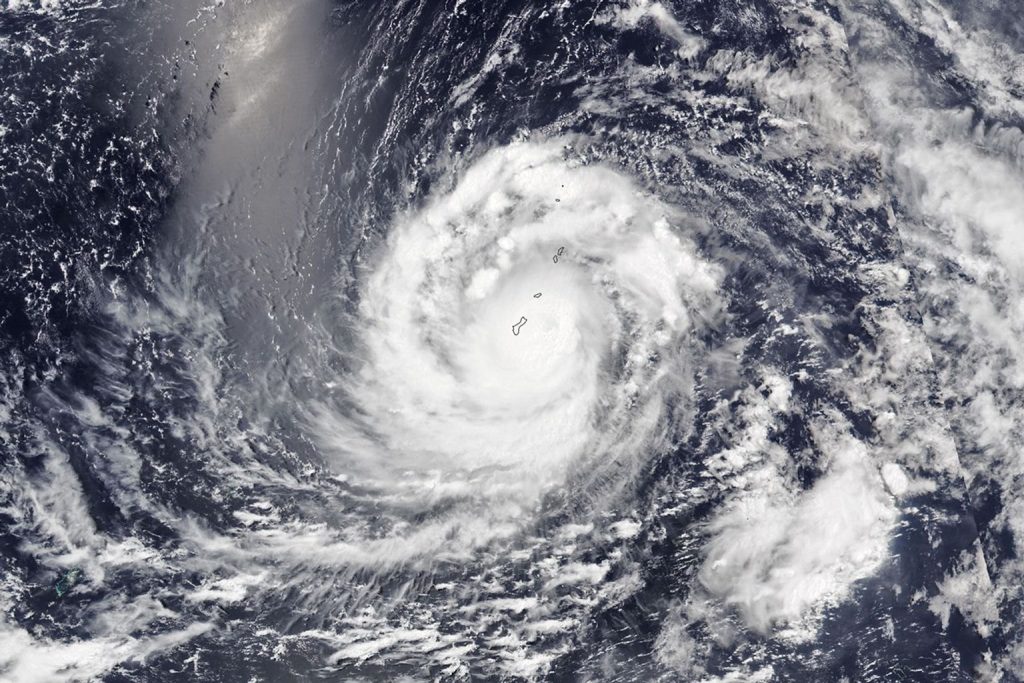
A powerful storm is approaching Guam with winds that have reached catastrophic levels. Typhoon Mawar now carries sustained winds of 282 kilometers per hour, equivalent to 175 miles per hour, placing it at Category 5 strength on the Saffir-Simpson scale. The island territory, home to 168,801 people, lies directly in the storm’s projected path.
Guam occupies a vulnerable position in the western Pacific Ocean within Micronesia. As the largest and southernmost island in the Mariana chain, it faces exposure to typhoons each season. The territory spans 210 square miles, or 540 square kilometers, totaling 130,000 acres. High population density across this relatively small area amplifies the potential for destruction. When a storm of this magnitude strikes a confined landmass, the damage concentrates across the entire territory simultaneously, leaving no room for dissipation.
Winds at this speed can tear roofs from concrete structures, snap power poles, and transform loose objects into dangerous projectiles. The capital city of Hagåtña is expected to experience a direct impact, as is Dededo, the most populous village on the island. The Chamorros, who constitute the largest ethnic group in Guam, are preparing for the storm. While they have endured previous typhoons, Mawar presents an unusual threat due to its wide wind field and anticipated heavy rainfall.
As an organized, unincorporated territory of the United States, Guam has access to federal resources. However, these resources must travel across the Pacific Ocean, meaning residents must rely on themselves during the immediate hours of the typhoon. Authorities have issued standard but critical advisories urging people to seek shelter and stockpile food, water, and other essentials.
The Northern Mariana Islands, including Saipan, Tinian, and Rota, also lie within the storm’s projected path. Although these islands have smaller combined populations than Guam, they face similar risks with potentially slower recovery due to less developed infrastructure.
The aftermath of a typhoon of this magnitude extends beyond the storm’s passage. Guam’s economy, which depends heavily on tourism and the U.S. military presence, will likely come to a halt. Repairs to infrastructure including homes, businesses, power grids, and water systems could take weeks or months. The Federal Emergency Management Agency will deploy, but Pacific logistics present significant challenges. Airports and ports may sustain damage, complicating relief efforts.
While the people of Guam possess a strong sense of community that aids resilience, community alone cannot withstand 175-mile-per-hour winds or restore a power grid quickly. The storm will test the territory’s infrastructure and reveal the limits of disaster preparedness on a small island. Authorities have advised residents to stay indoors and avoid travel, but for many, this means enduring a storm capable of destroying their homes. The psychological burden and immediate physical danger remain substantial. Typhoon Mawar will pass, but its effects will persist, carrying high costs in money, time, and disrupted lives.




