
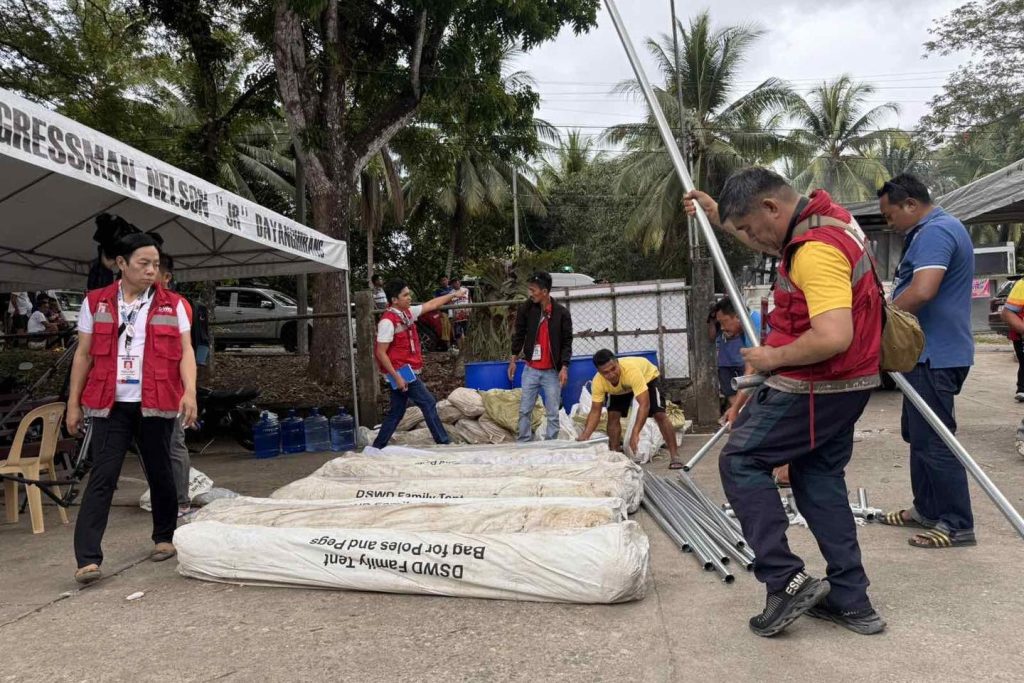
Manay, Davao Oriental – On 10 October, the town of Manay experienced an unusual seismic event that unfolded in two nearly equal‑strength shocks. The first tremor registered a magnitude of 7.4, followed shortly by a second jolt measuring between 6.7 and 6.8.
The back‑to‑back quakes, known to seismologists as a “doublet” or “multiplet,” produced a casualty count of eight fatalities and more than 400 injuries, while inflicting extensive damage on homes, roads and public facilities throughout the municipality and surrounding areas. In a typical earthquake sequence, a main shock is succeeded by a series of aftershocks that are generally at least 1.2 magnitude units lower and gradually decrease in both frequency and intensity. The Manay event deviated from this pattern; the two principal shocks were separated by less than 0.4 magnitude units and struck in close temporal proximity.
Because the second quake arrived with almost the same force as the first, it acted as a fresh, full‑strength impact rather than a diminishing aftershock. The doublet nature of the event has complicated emergency response and recovery planning.
Structures that might have survived a single 7.4‑magnitude tremor were subjected to additional stress when the 6.7‑6.8 shock hit the already weakened buildings. The compounded damage is evident in the collapsed homes, broken roadways and ruined public buildings reported across Davao Oriental. Officials note that the second shock did not merely add to the destruction; it amplified the overall impact. Recovery efforts now face the challenge of rebuilding in an environment where standard disaster protocols—based on the assumption that the most severe shaking occurs only once—may no longer be sufficient.
Engineers and planners are being urged to consider designs capable of withstanding two major quakes in rapid succession. The need for resilient, sustainable infrastructure is a pressing concern, especially for essential facilities such as schools and hospitals that must remain operational after repeated shocks.
Energy security is also a focal point of the post‑quake assessment. The doublet knocked out the local power grid, leaving communities without electricity for critical services. Authorities highlight the importance of distributed renewable energy systems—solar panels paired with battery storage—as a practical solution to maintain lighting, communication and medical triage when centralized power fails.
While the death toll stands at eight and the injured exceed 400, the broader implication of the Manay doublet lies in its rarity and the lessons it offers for future seismic preparedness. The event underscores that the conventional model of a dominant main shock followed by weaker aftershocks does not apply in all cases.
Communities in earthquake‑prone regions must now account for the possibility of near‑equal, consecutive tremors when planning construction standards, emergency response, and energy resilience.




