
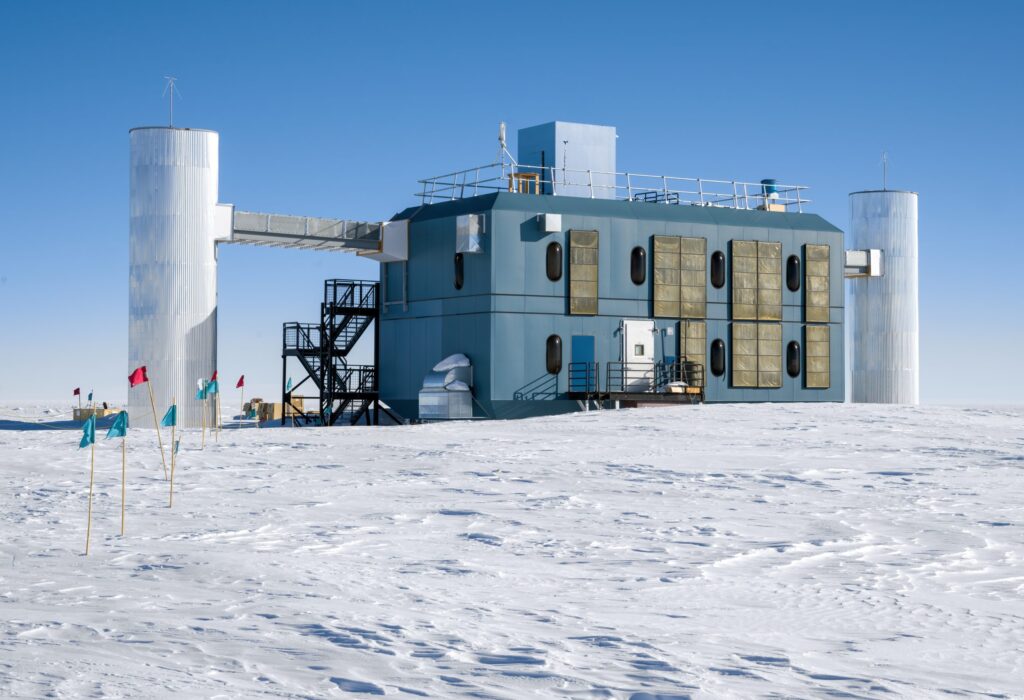
Scientists with the IceCube Collaboration announced today that their detector, embedded deep within the Antarctic ice at the Amundsen‑Scott South Pole Station, has identified a diffuse flux of high‑energy neutrinos that originates from the plane of our own galaxy. This marks the first time the Milky Way has been imaged in neutrino light, adding a novel messenger to the suite of wavelengths—visible, radio and X‑ray—used to map the cosmos.
Neutrinos are produced in some of the most violent astrophysical environments, such as supernova remnants, collapsing stars and the turbulent regions surrounding black holes. Because they interact only weakly with matter, they travel in straight lines from their sources, carrying information that photons cannot always convey. The IceCube Neutrino Observatory, a project led by the University of Wisconsin–Madison and classified as a CERN‑affiliated experiment, is specifically designed to capture these elusive particles.
IceCube’s detection array consists of thousands of digital optical modules (DOMs) frozen into a cubic‑kilometre volume of clear Antarctic ice. Each DOM houses a photomultiplier tube and a single‑board computer that record the brief blue‑light flashes produced when a neutrino collides with an ice molecule.
The signals are transmitted to a surface counting house where researchers reconstruct the particle’s direction and energy. Analysis of several years of data revealed not a single point source but a steady, diffuse glow of neutrinos aligned with the Milky Way’s galactic plane. This glow represents the combined output of innumerable sources spread throughout the galaxy, from ancient stellar remnants to the chaotic centre of the Milky Way.
Extracting the galactic signal required sophisticated statistical methods to separate it from a background of atmospheric neutrinos generated when cosmic rays strike Earth’s atmosphere. The result builds on the pioneering work of the Antarctic Muon And Neutrino Detector Array (AMANDA), which demonstrated the feasibility of ice‑based neutrino detection.
IceCube’s much larger instrumented volume provides the sensitivity needed to collect enough events for a statistically significant detection. While IceCube has previously reported neutrinos from distant active galaxies and a flaring blazar, observing our own galaxy in neutrinos opens a new investigative window. High‑energy neutrinos can pinpoint locations where particles are accelerated to energies far beyond those achievable in terrestrial accelerators.
By correlating neutrino maps with gamma‑ray and radio observations, astronomers hope to identify the specific accelerators responsible for the Milky Way’s most energetic particles. The collaboration plans upgrades to the detector that will improve its angular resolution and overall sensitivity, potentially allowing individual galactic neutrino sources to be resolved within the diffuse emission.
The South Pole remains an ideal site for such work: the exceptionally clear, cold ice and the stable environment enable continuous, all‑sky monitoring as the Earth rotates. Today’s discovery demonstrates that the Milky Way is not only a luminous swirl of stars and gas but also a persistent source of ghostly neutrino radiation, offering a fresh perspective on the energetic processes shaping our cosmic neighbourhood.




