
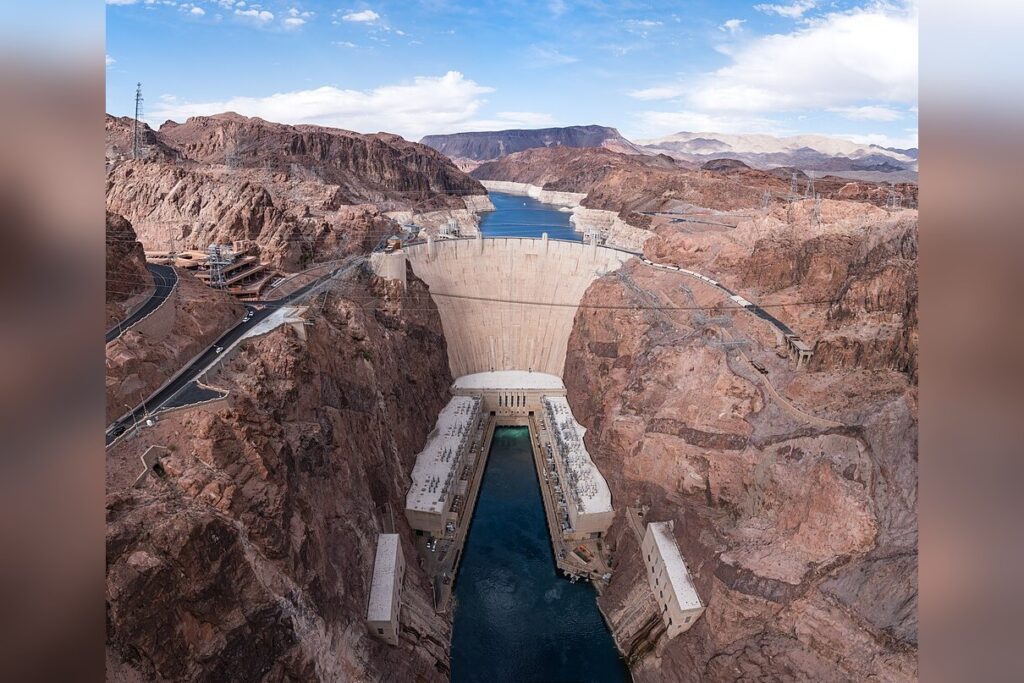
BOULDER CITY, Nevada, July 11 — The Hoover Dam stands as a monument to a particular kind of American ambition, the sort that reshapes a continent’s hydrology and lights a desert. Constructed between 1931 and 1936 on the Colorado River at the Arizona-Nevada border, the dam is a massive concrete arch-gravity structure. Under the hood, the engineering is brutally simple: a 726-foot wall of concrete, 1,244 feet across, holding back the largest reservoir in the United States by volume.
Lake Mead, the reservoir it created, has a capacity of 28.9 million acre-feet. That is a number that still impresses, even after decades of drought and political wrangling over the Colorado River’s diminishing flows.
The dam was built by the Bureau of Reclamation under Commissioner Elwood Mead, with chief engineer John L. Savage calling the shots. The project cost $49 million — equivalent to about $1 billion today — and employed up to 5,251 workers.
The official fatality count during construction was 96. The technical reality of the dam’s power generation is equally stark.
It provides hydroelectric power with a capacity of 2,080 megawatts, supplying electricity to California, Nevada, and Arizona. That power, as ever, is the detail that matters: it made the growth of Las Vegas and Los Angeles possible, for better or worse.
The Tennessee Valley Authority: A Different Model
While the Hoover Dam was a single, spectacular intervention, the Tennessee Valley Authority took a different approach. Created by Congress in 1933 under President Franklin D. Roosevelt, the TVA is a federally owned corporation that manages the Tennessee River system across seven states: Tennessee, Kentucky, Alabama, Mississippi, Georgia, North Carolina, and Virginia.
It was not one dam but a system of them. TVA built a series of dams, including Norris Dam, completed in 1936 at 265 feet high, and Wilson Dam, originally built between 1918 and 1925 and later expanded.
By 1944, the authority had constructed 16 dams. The scale of the transformation is hard to overstate. By 1940, the system had a generating capacity of 2,500 megawatts.
These projects controlled floods, generated electricity, and promoted economic development across a region that had been among the poorest in the country. The contrast with the Hoover Dam is instructive.
Both were federal projects, both used concrete and steel to tame rivers, but the TVA was a regional development corporation, not a single-purpose dam. The detail that matters is that the TVA’s mandate was broader: flood control, navigation, and economic development, not just power and irrigation.
Transformation and Displacement
The environmental and social costs of these projects were significant. The Hoover Dam and the TVA dams transformed the American landscape, enabling irrigation of 1.5 million acres in the Colorado River basin. By the 1950s, the flood damage reduction from these projects was estimated at $240 million annually.
That is a real number, a concrete benefit. But the projects also displaced communities.
Over 15,000 people were relocated for TVA reservoirs alone. That is not a footnote; it is a central fact of the story. Families were moved, towns were flooded, and the landscape was remade.
The wry observation here is that the same concrete that brought light to cities also drowned the past. The Hoover Dam and the TVA dams represent two faces of the same impulse: to control nature for human benefit.
The technical reality is that they succeeded, at a cost that is still being calculated. As the Colorado River basin faces a future of reduced flows and the Tennessee Valley grapples with aging infrastructure, the legacy of these projects is more relevant than ever.
{“@context”: “https://schema.org”, “@type”: “NewsArticle”, “headline”: “Hoover Dam and TVA tamed rivers, reshaped the American nation”, “description”: “BOULDER CITY, Nevada, July 11 — The Hoover Dam stands as a monument to a particular kind of American ambition, the sort that reshapes a…”, “datePublished”: “2026-07-11T09:30:00+00:00”, “author”: {“@type”: “Person”, “name”: “Sebastian Smith”}, “publisher”: {“@type”: “Organization”, “name”: “InfoPulse Today”, “url”: “https://newsfeed.2bme.xyz/”}}




