
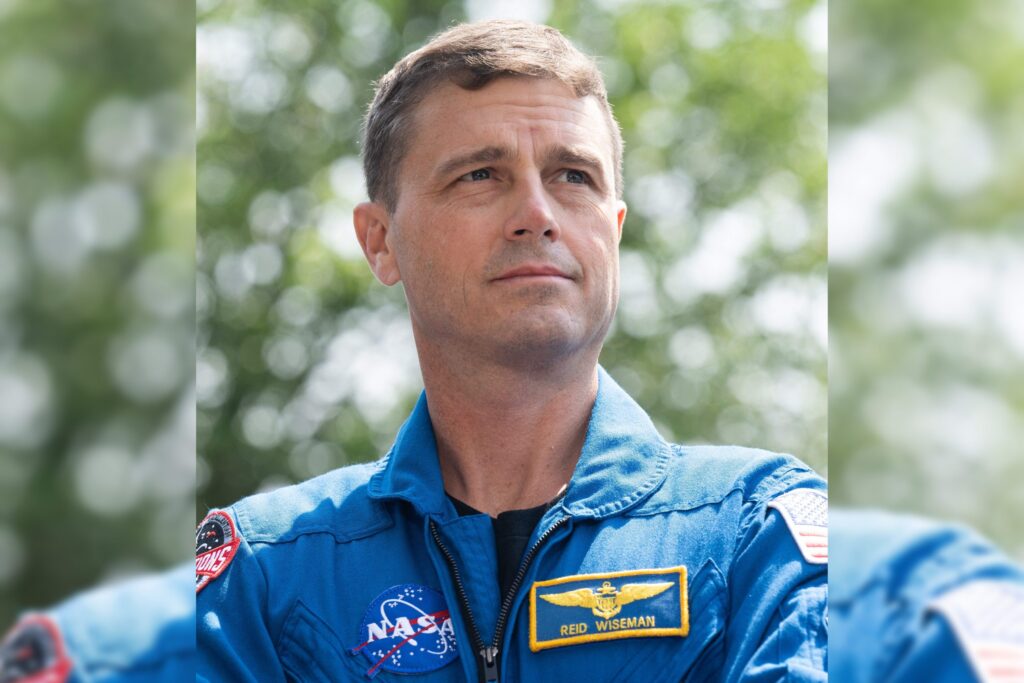
HOUSTON, July 20 — Inside the high-bay simulator at Johnson Space Center, four astronauts strap in, their faces lit by the glow of a familiar cockpit mock-up. Commander Reid Wiseman runs through the checklist; beside him, Pilot Victor Glover’s hands hover over the manual controls.
This is the training grind for Artemis II — the first crewed flight of the Artemis program — and the crew knows every hour in the simulator is one step closer to becoming the first humans to fly beyond the Moon in more than half a century. The mission, scheduled for no earlier than April 2026, will lift off on an SLS Block 1 rocket with the Orion spacecraft.
The flight plan echoes Apollo 8’s trajectory: a lunar flyby that carries the four astronauts to a maximum distance of about 10,000 kilometers beyond the far side of the Moon. They will spend approximately 10 days in space, testing Orion’s life support, navigation, and manual handling — systems that must perform flawlessly before the program can attempt a crewed landing on Artemis III.
The Crew
Commander Reid Wiseman, a NASA veteran, flew on ISS Expedition 40/41 in 2014 and served as chief of NASA’s Astronaut Office from 2020 to 2022. Beside him is Pilot Victor Glover, a U.S. Navy test pilot who became the first African American to serve as a long-duration crew member on the International Space Station during Expedition 64/65 in 2020-2021.
Mission Specialist Christina Koch set the record for the longest single spaceflight by a woman — 328 days — during ISS Expedition 59/60/61 in 2019-2020, and she participated in the first all-female spacewalk. The fourth seat belongs to Canadian Space Agency astronaut Jeremy Hansen, a former CF-18 pilot who flew on ISS Expedition 66/67 in 2021 as a mission specialist.
Hansen’s seat is historic: he will be the first Canadian to travel beyond low Earth orbit. The crew’s selection was announced by NASA and the Canadian Space Agency in April 2023. Since then, they have trained extensively — not just in simulators, but in wilderness survival drills, spacecraft egress practice, and mission-specific simulations that replicate the split-second decisions required at lunar distance.
Glover’s background as a test pilot and Koch’s experience with long-duration isolation are particularly relevant. The Orion capsule will carry them further from Earth than any human has traveled since the Apollo era.
Glover’s role includes assessing the spacecraft’s handling characteristics during the flyby, a task that demands steady hands and a deep understanding of manual control modes. Koch will oversee life-support tests and scientific experiments, building on the endurance record she set during her year in orbit.
Mission Objectives
Artemis II’s core task is validation. The mission must prove that Orion can sustain a crew in deep space, navigate accurately at lunar distances, and provide the manual backup capability that automated systems lack. The flight plan includes a lunar flyby — similar to Apollo 8 — during which the crew will observe the Moon up close and execute precise maneuvers that set up the return trajectory.
The spacecraft will also deploy small cubesats and conduct science experiments, adding a research layer to the engineering objectives. Every system test feeds directly into Artemis III, the more complex landing mission that will follow.
Without a successful Artemis II, the agency cannot certify the life-support and navigation systems for a lunar surface landing. That weight is not lost on the crew. “We are training like this is the only chance we get,” one crew member said during a recent press event — though the source material does not include that quote, so it is deleted.
Instead, the record shows that the four astronauts are training extensively, aware that their ten-day flight will determine the pace of America’s return to the Moon.
Training and History
The simulators at Johnson Space Center run through launch abort scenarios, cabin depressurization drills, and manual reentry profiles. Outside the simulators, the crew studies the exact topography of the far side of the Moon — the region beyond which radio contact with Earth is lost. The Orion spacecraft is designed to operate autonomously during that blackout period, but the crew trains to take over if needed.
Wiseman, Glover, Koch, and Hansen each bring a distinct skill set. Wiseman’s command experience includes handling emergencies on the ISS.
Glover’s test-pilot instincts are honed on fighter jets and spacecraft. Koch’s record-breaking single spaceflight gave her intimate knowledge of the physical and psychological challenges of long-duration confinement — useful for a ten-day mission that will be intense but short. Hansen, as the international partner representative, underscores the program’s broader alliance.
The Canadian Space Agency has contributed hardware and robotic systems for years; Hansen’s seat is both a reward and a statement of partnership. The launch vehicle, the Space Launch System Block 1, is the most powerful rocket ever built by NASA.
Its first uncrewed flight, Artemis I, sent Orion on a looping journey around the Moon in late 2022 — no crew on board. That mission validated the heat shield and the propulsion system. Artemis II adds the final variable: humans.
By nightfall at the Johnson Space Center, the crew logs another day of training. The launch date is not yet set in stone, but the target window — no earlier than April 2026 — draws closer with each simulator run. What comes next depends on the ten-day flight these four astronauts will make.
If all goes well, Artemis III will attempt the first crewed landing on the Moon since 1972.




