
WASHINGTON, July 21 — The launch escape system, a piece of engineering that separates crew from catastrophe, is undergoing a quiet but consequential evolution. Once a tower-mounted solid rocket that yanked a capsule clear of an exploding booster, the technology now comes in three distinct forms — each reflecting a different strategic calculus among the world’s space powers. The stakes are straightforward: a critical failure on the pad or during ascent, and seconds decide whether astronauts live or die.
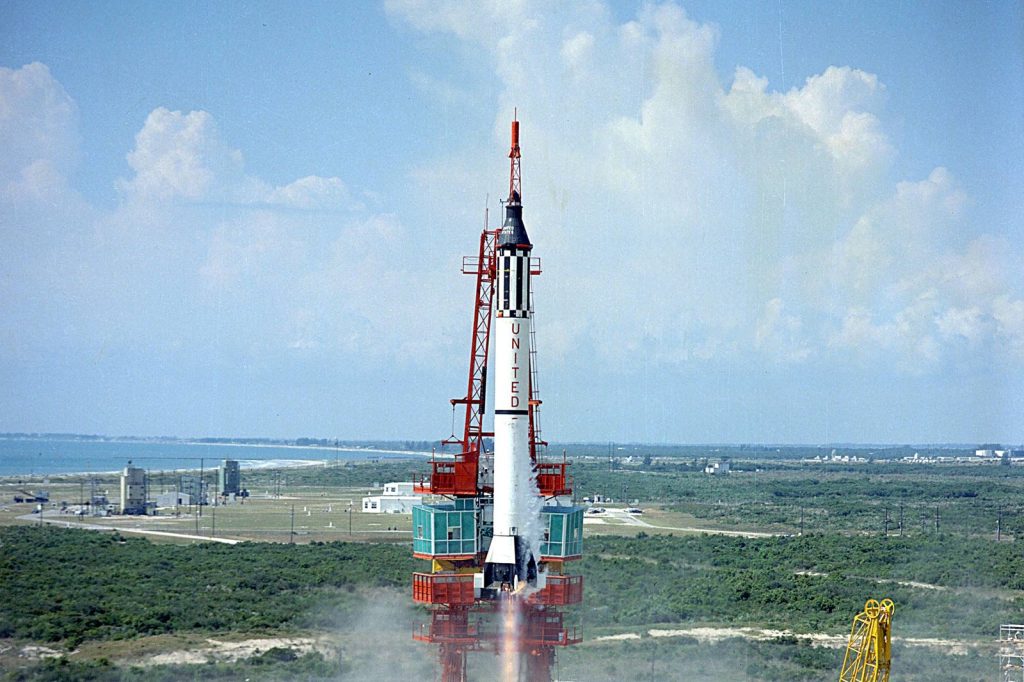
The original concept dates to 1958, when Maxime Faget proposed using a rocket to pull the capsule away. The first operational test came in March 1959, on a Project Mercury flight.
That system was built by the Grand Central Rocket Company in Redlands, California — later known as Lockheed Propulsion Company. The Apollo escape tower shared many similarities. Today, the United States fields three different approaches.
The Orion spacecraft uses a Mercury/Apollo-style escape rocket mounted on a tower — a system that provides high thrust for a short burn, then jettisons during normal flight. That is a proven, conservative design.
SpaceX’s Dragon 2 integrates hypergolic liquid-fueled abort thrusters into the capsule itself — no tower, no jettison event. Boeing’s Starliner places its abort thrusters in the service module. Each choice signals a distinct engineering philosophy, and each carries implications for crew safety and mission integration.
The Three Families of Escape
The source material lays out three types. The tower-mounted solid rocket, used on Mercury, Apollo, Orion, Soyuz, and Shenzhou, is a brute-force solution: pull the capsule away, deploy parachutes. It works from the pad through ascent.
The tower is discarded when no longer needed. Ejection seats — used on Vostok, Gemini, and on Space Shuttle Columbia during testing — mimic military aircraft systems, but only function within a limited range of altitudes and speeds.
The Space Shuttle initially carried ejection seats for two pilots during test flights, then removed them once the orbiter was deemed operational. After the 1986 Challenger disaster, the remaining shuttles were fitted with a crew evacuation system that used parachutes worn over spacesuits, but that system was only usable during controlled glide — a far cry from the instantaneous pull of an abort tower. Russia’s Soyuz uses the SAS — Sistema Avariynogo Spaseniya — a tower-based system.
The Soviet Proton launcher flew with an escape tower under the Zond and TKS programs, but all those flights were unmanned. China’s Shenzhou also uses the tower design.
What this signals is a split between legacy systems and newer integrated approaches.
Strategic Implications
For American military and civilian spaceplanners, the choice of escape system is not merely technical. It reflects the broader stakes of human spaceflight reliability and the ability to certify vehicles for crewed missions. The Crew Dragon’s integrated abort system, for instance, was a key factor in NASA’s decision to certify it for regular crew rotations to the International Space Station.
Boeing’s Starliner, still working through its own certification hurdles, has a different abort architecture — one that has been subjected to intense scrutiny. Strategically, the United States now operates a mixed fleet of crew vehicles: Orion (tower), Dragon 2 (integrated), Starliner (service module thrusters).
Each represents a hedge against a single point of failure in crew escape capability. The calculus shifts depending on the mission profile — Orion goes to the Moon, Dragon and Starliner service low Earth orbit. No other nation operates such a diversity of crewed launch abort systems.
China and Russia each use one type. This gives the United States operational flexibility, but also a more complex certification and training burden.
The source also notes the absence of any crewed Proton flights — a reminder that not every heavy lifter has been human-rated. That matters for future architectures. The Space Launch System, for example, uses Orion with its escape tower.
Commercial providers use their own integrated designs. What this signals is that the era of a single government-designed escape system is over; private industry now builds its own, with NASA providing oversight. No specific new event drove this story on July 21, 2026.
Rather, the underlying technology and its geopolitical distribution remain a quiet but critical fact of spaceflight. Every crewed launch — whether from Cape Canaveral, Baikonur, or Jiuquan — relies on one of these three approaches.
The failure of a launch escape system would be a catastrophe, and the difference between life and death is written in the hardware choices made decades ago and refined today.




