
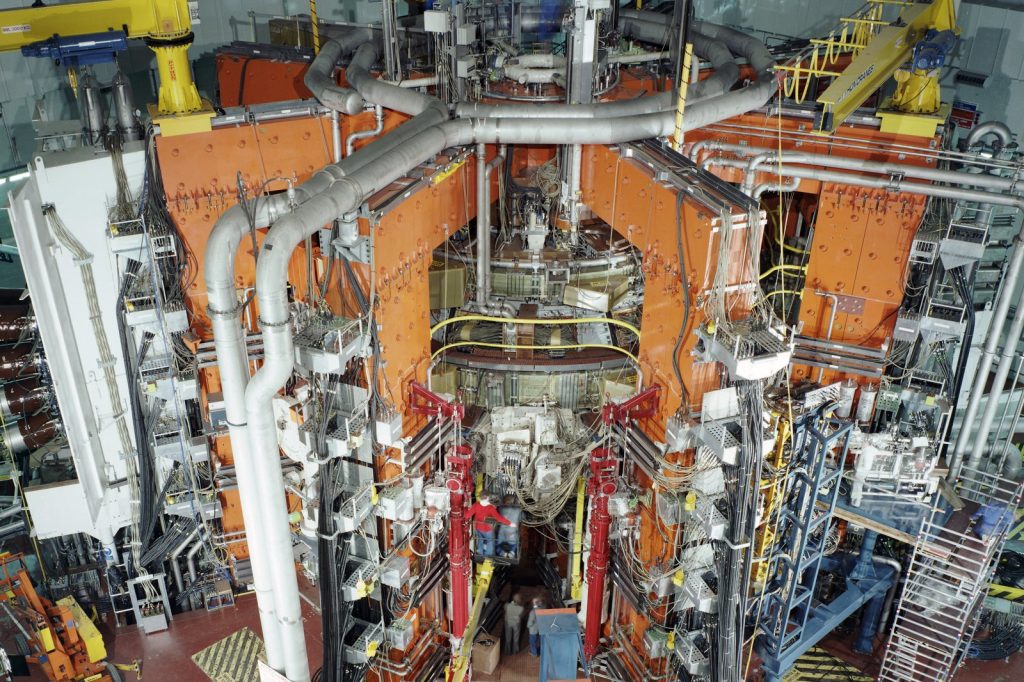
LONDON, July 25 — Against the backdrop of a decommissioning effort that will stretch into the 2040s, the Joint European Torus now stands silent in the Oxfordshire countryside, its plasma chambers cold. Yet the debates that surrounded its shutdown in December 2023 continue to reverberate in the corridors of fusion research, as Europe confronts a critical gap between the end of one era and the uncertain start of the next.
JET — a magnetically confined plasma physics experiment based on the tokamak design — was more than a machine; it was a joint European project that, at the time of its construction, was larger than any comparable tokamak. Located at the Culham Centre for Fusion Energy, it began operation in 1983 and spent the best part of a decade increasing its performance.
In 1991 came a landmark: the first experiments including tritium, making JET the first reactor in the world to run on the production fuel mix of 50–50 tritium and deuterium. Between 1991 and 1993, a divertor design was added, significantly improving performance. Then, in 1997, JET set a record: it reached the closest approach to scientific breakeven, with a Q value of 0.67 — producing 16 megawatts of fusion power while injecting 24 megawatts of thermal power to heat the fuel.
It was not quite break-even, but it was a powerful demonstration of what might one day be possible.
The road to ITER
Between 2009 and 2011, JET was shut down for a major rebuild, adopting concepts being used in the development of the ITER project in Saint-Paul-lès-Durance, Provence, southern France. In December 2020, an upgrade commenced using tritium, an explicit contribution to ITER’s needs. JET’s principal aims had always been about preparing the ground for a full-scale reactor: investigating the scaling of plasma behaviour, plasma-wall interaction, additional heating methods such as neutral beam injection and ion cyclotron resonance, and—critically—the production and confinement of alpha particles from fusion reactions and consequent fusion self-heating.
But it is the wider picture that now unsettles many in the scientific community. Immediately after the announcement of JET’s closure at the IAEA conference in London in October 2023, the group ‘Scientists for JET’ launched a petition calling for a review of the decision.
What is at stake, they argued, is a research time gap and personnel loss between JET’s shutdown and the start of ITER’s operations. In the corridors of European fusion institutes, that worry has never fully dissipated. JET finished operations in December 2023.
Decommissioning is expected to last until 2040. The tokamak itself, now inert, will be dismantled piece by piece.
For the scientists who worked on it, the machine was not just hardware but a repository of knowledge — and the fear is that, without a bridge experiment in the years ahead, much of that expertise may scatter before ITER can pull it back together.
Sources
{“@context”: “https://schema.org”, “@type”: “NewsArticle”, “headline”: “JET, Europe’s fusion reactor, shuts down after 40 years”, “description”: “LONDON, July 25 — Against the backdrop of a decommissioning effort that will stretch into the 2040s, the Joint European Torus now stands silent in…”, “datePublished”: “2026-07-25T09:30:00+00:00”, “author”: {“@type”: “Person”, “name”: “Beatrice Bianchi”}, “publisher”: {“@type”: “Organization”, “name”: “InfoPulse Today”, “url”: “https://newsfeed.infopulsetoday.com/”}, “citation”: [{“@type”: “CreativeWork”, “url”: “https://en.wikipedia.org/wiki/Joint_European_Torus”}]}




