
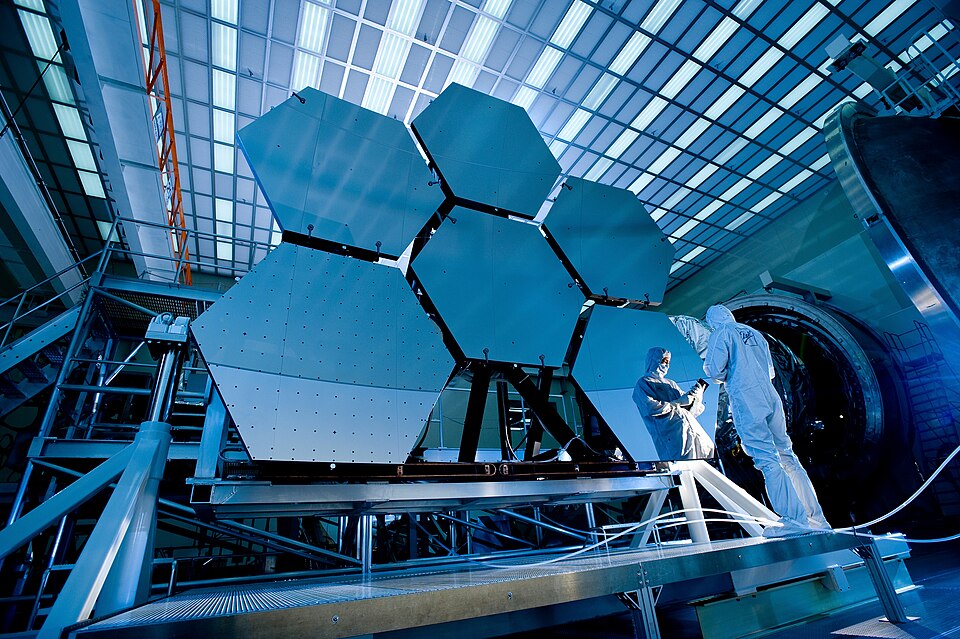
PARIS, Aug. 3 — The shift is subtle but unmistakable: the era of the single-agency space triumph is over. The James Webb Space Telescope, the most complex observatory ever flown, was never one country’s flagship. It was a transatlantic handoff of specialized expertise — and Europe’s fingerprints are all over the machine.
That story runs straight through this city. The European Space Agency, headquartered in Paris and founded in 1975, did far more than buy a ticket on Webb.
It built and supplied the Ariane 5 launch vehicle that carried the telescope into space on Dec. 25, 2021, from the Guiana Space Centre. It also provided the Near Infrared Spectrograph, or NIRSpec, plus half of the Mid-Infrared Instrument and the telescope’s near-infrared detector arrays. NASA led the overall project, handling management, systems engineering, and the development of the primary mirror and sunshield.
The Canadian Space Agency, founded in 1989, supplied the Fine Guidance Sensor that keeps Webb’s pointing precise, along with the Near Infrared Imager and Slitless Spectrograph, designed specifically for exoplanet detection and characterization.
Europe’s Critical Pieces
For ESA, this was not a cameo role. The Ariane 5 launch alone made Europe the one agency trusted to put the $10 billion telescope safely into orbit. NIRSpec gives Webb the ability to observe many targets at once in near-infrared light — the instrument has already become a workhorse for studying the early universe.
The financial stakes reflect the depth of that involvement. Total project cost exceeded $10 billion, with NASA contributing approximately $8.8 billion, ESA €700 million, and CSA CA$200 million.
Those figures tell the real story: cutting-edge astronomy is now a consortium business, with each partner banking on the others’ strengths.
The Network Underneath
What’s changing is the sheer scale of the enterprise. The collaboration pulled in over 300 universities, organizations, and companies spread across 29 U.S. states and 14 countries, including the UK, Germany, France, and Italy. Webb’s hardware is a map of global industrial and scientific capacity, not just an American or European artifact.
Even the telescope’s day-to-day life is transnational. Operations are managed by the Space Telescope Science Institute in Baltimore, Maryland — the same institute that oversees the Hubble Space Telescope.
That continuity matters: one team, two generations of astronomy’s greatest hits. The trend underneath is clear. No future deep-space flagship will be built alone.
The next big observatories, whatever and wherever they are, will likely follow Webb’s architecture of distributed responsibility, specialized instruments, and shared risk. Watch this space.
Webb is still early in its mission, and Europe’s investment in it is a down payment on a longer game. The partnership that delivered this telescope is not a one-off — it’s the operating system for what comes next.
Sources
{“@context”: “https://schema.org”, “@type”: “NewsArticle”, “headline”: “NASA, ESA, CSA Collaborate on James Webb Space Telescope”, “description”: “PARIS, Aug. 3 — The shift is subtle but unmistakable: the era of the single-agency space triumph is over. The James Webb Space Telescope, the…”, “datePublished”: “2026-08-03T09:30:00+00:00”, “author”: {“@type”: “Person”, “name”: “Maria Romano”}, “publisher”: {“@type”: “Organization”, “name”: “InfoPulse Today”, “url”: “https://newsfeed.2bme.xyz/”}, “citation”: [{“@type”: “CreativeWork”, “url”: “https://en.wikipedia.org/wiki/European_Space_Agency”}]}




