
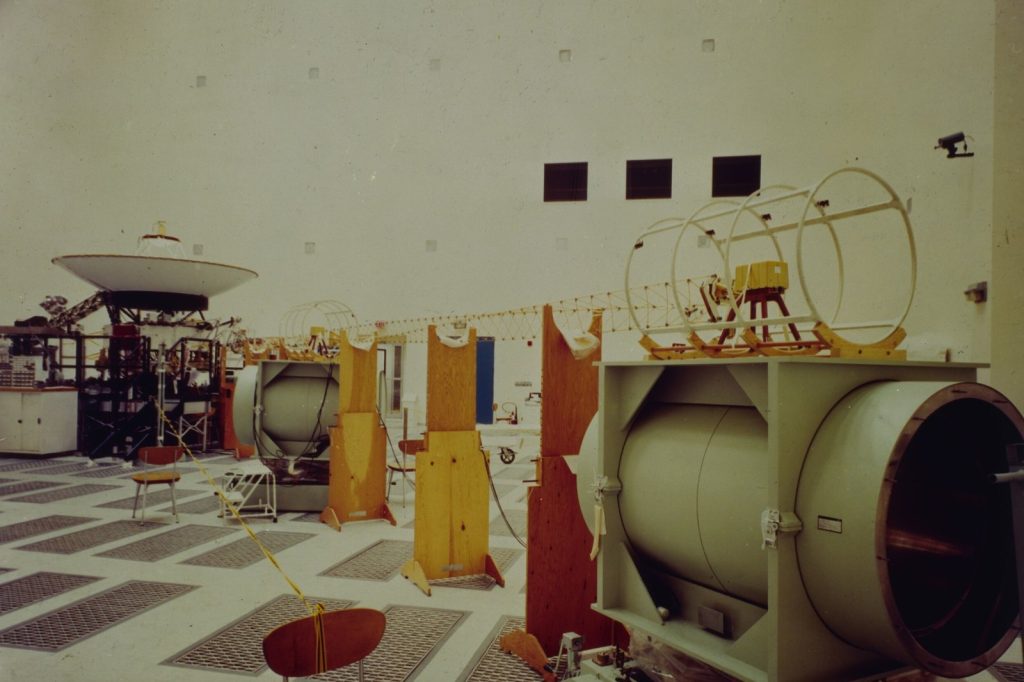
PASADENA, August 5 —
The Voyager program, an enduring testament to human ingenuity and our relentless quest to understand the cosmos, continues to inspire decades after its inception. Behind the breakthrough of exploring our solar system’s distant reaches, the vision of scientists and engineers launched twin spacecraft, Voyager 2 and Voyager 1, into the unknown in late 1977.
Voyager 2 embarked first, lifting off on August 20, 1977, followed by its sibling, Voyager 1, on September 5, 1977. These remarkable probes were meticulously designed to leverage a rare alignment of planets, enabling them to use gravity assists for an unprecedented tour of the outer solar system. It was a bold plan, driven by the collective ambition to peer into worlds previously only imagined.
A Pioneer’s Grand Tour
Voyager 1 quickly demonstrated its capabilities, reaching Jupiter in March 1979. It delivered stunning, detailed images of the gas giant’s iconic Great Red Spot, captured the active volcanoes erupting on its moon Io, and unveiled the intricate patterns of Jupiter’s ring systems. The mission then propelled the spacecraft onward, bringing it to Saturn in November 1980. There, Voyager 1 meticulously studied the planet’s atmosphere, its magnificent rings, and its moons, providing crucial observations of Titan, Saturn’s largest moon, which it revealed to possess a thick, nitrogen-rich atmosphere.
After successfully completing its primary mission, Voyager 1 continued its journey, pushing further into the void of deep space. Its trajectory, set at an angle of about 35 degrees north relative to the plane of the solar system, ensures a path that will never see it return to our home system.
Beyond Our Solar System
A truly historic moment arrived on August 25, 2012, when Voyager 1 crossed the heliopause. This crucial boundary marks the point where the solar wind’s influence diminishes, no longer strong enough to push back the interstellar wind. With this crossing, Voyager 1 became the first human-made object to enter interstellar space, a monumental achievement that redefined our understanding of our place in the galaxy.
This journey into the vastness beyond our solar system is a direct result of incredible human foresight and scientific expertise. The program’s success is built upon the dedication of many, whose work transformed ambitious ideas into tangible exploration.
The Architects of Exploration
Among the key figures whose contributions were essential to the Voyager program’s success was scientist and astronomer Carl Sagan. He played a major role in designing the Golden Record, a message to any extraterrestrial intelligence the spacecraft might encounter. Another pivotal contributor was Charley Kohlhase, a Jet Propulsion Laboratory engineer responsible for calculating the complex gravity-assist trajectories that made the multi-planet tour possible. These individuals, and many others, are the human story behind these incredible journeys.
As we look to the future, the Voyager program, managed by NASA’s Jet Propulsion Laboratory, stands as a powerful reminder of what human curiosity and collaboration can achieve. It continues to send back data from interstellar space, a distant echo of the human spirit reaching out into the cosmos, inspiring new generations to dream of what lies beyond.
Sources
{“@context”: “https://schema.org”, “@type”: “NewsArticle”, “headline”: “Voyager Spacecraft Reach Edge Of Solar System After Decades”, “description”: “PASADENA, August 5 — The Voyager program, an enduring testament to human ingenuity and our relentless quest to understand the cosmos, continues to inspire decades…”, “datePublished”: “2026-08-05T09:30:00+00:00”, “author”: {“@type”: “Person”, “name”: “James Roberto”}, “publisher”: {“@type”: “Organization”, “name”: “InfoPulse Today”, “url”: “https://newsfeed.infopulsetoday.com/”}, “citation”: [{“@type”: “CreativeWork”, “url”: “https://en.wikipedia.org/wiki/Voyager_program”}]}




