
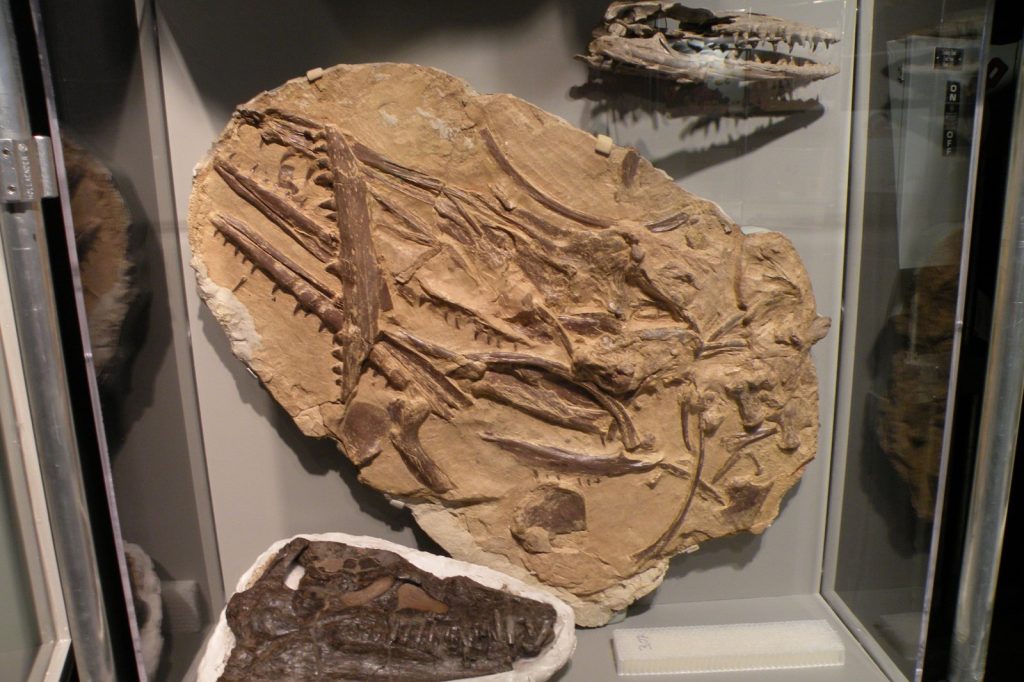
The recent identification of a massive ichthyosaur skeleton from England’s Westbury Formation, announced on 17 April 2024, is prompting scientists to rethink long‑standing ideas about the maximum size attainable by Triassic marine reptiles. Dubbed Ichthyotitan, the specimen is now recognized as the largest marine reptile ever documented, a distinction that immediately reshapes the baseline for ichthyosaur size estimates.
Prior to this discovery, the Westbury Formation was already celebrated for its rich fossil assemblage, but the new find dwarfs all previously recovered specimens from the same strata. Its sheer dimensions extend the known size range for ichthyosaurs, forcing paleontologists to revisit assumptions about growth limits, ecological roles, and evolutionary pathways within the group. Researchers are now turning their attention to the bones themselves—along with any associated shells, exoskeletal fragments, and potential molecular traces—to piece together how such a gigantic predator lived.
Key questions revolve around its feeding strategy: a creature of this magnitude would have required either exceptionally large prey or an unusually efficient method of capture. Determining its diet will be essential for reconstructing the food web that supported it.
The presence of Ichthyotitan also carries implications for the ancient environment preserved in the Westbury Formation. The sedimentary record captures a specific interval of the Triassic seas, and the existence of a top‑tier predator suggests a highly productive marine ecosystem capable of sustaining large trophic levels. Geologists are therefore re‑examining the depositional conditions that allowed both the animal’s growth and its preservation.
For the broader field of evolutionary biology, the find fills a notable gap in the fossil record of marine reptiles. The trend toward gigantism in ichthyosaurs is now confirmed to have reached its apex earlier than many models had predicted, prompting a revision of timelines that chart the rise of massive marine vertebrates.
Beyond academia, the discovery is set to influence public engagement and funding streams. Museums are already expressing interest in displaying the bones, anticipating that the spectacle of the world’s largest known marine reptile will attract visitors and generate support for further research. Local landowners near the Westbury outcrop may also experience heightened attention from both amateur collectors and professional teams eager to explore the site.
The ripple effect extends to other fossil localities as well. If the Westbury Formation can yield a reptile of such scale, scientists will reassess comparable strata worldwide, looking for overlooked evidence of similarly large organisms.
Comparative studies are likely to emerge, using Ichthyotitan as a new benchmark against which other Triassic marine fossils are measured. While the initial announcement sets the direction for future work, detailed analyses of the specimen will take time. Reconstructing behavior, habitat preferences, and precise dietary habits cannot be achieved from a single bone; it requires years of careful study, including comparative anatomy, sedimentology, and possibly even biochemical testing. Nevertheless, the impact of the Westbury find is immediate.
It establishes a new standard for what constitutes a “giant” in ancient seas and invalidates several earlier assumptions about ichthyosaur size limits. As researchers delve deeper into the bones and the surrounding rock, the scientific community will continue to gauge the broader implications of this remarkable discovery.
Sources
- Ichthyotitan Severnensis: 11-year-old girl’s fossil… – The Times of India
- Is Ichthyotitan the largest marine reptile yet… | National Geographic




