
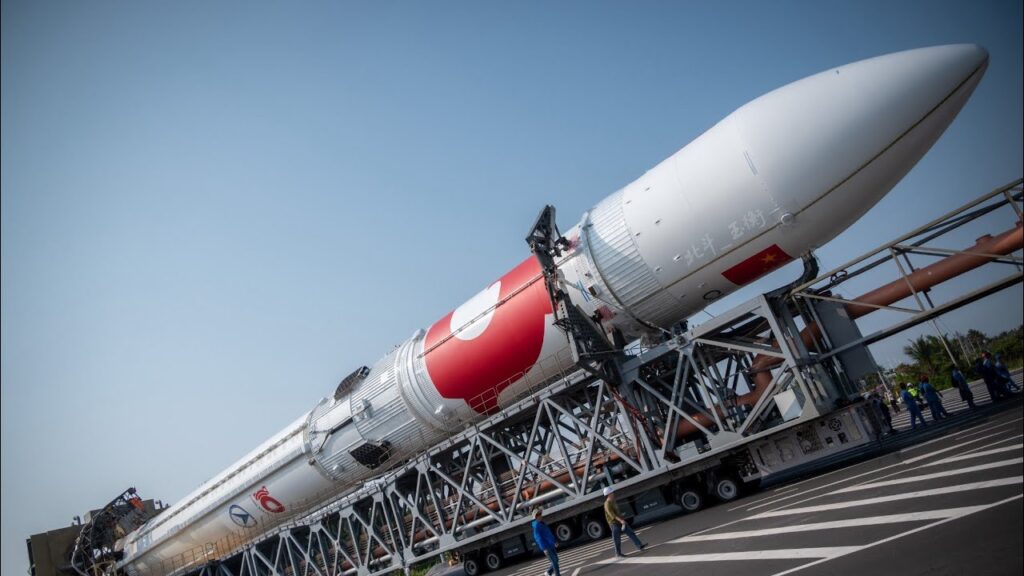
BEIJING, July 10 — For an engineer who started working on Chinese rockets in the 1990s, Li Dong has spent the last few years trying to make them land back on the pad. Li is the chief designer of the Long March 10 series at the China Academy of Launch Vehicle Technology (CALT), a subsidiary of the China Aerospace Science and Technology Corporation (CASC). The rocket family made its maiden flight last June, when the Long March 10B variant lifted off on June 23, 2024.
His career goes back further. Li worked on the Long March 2F, the rocket that launched China’s Shenzhou crewed spacecraft.
He holds a degree in aerospace engineering from Beihang University, formerly the Beijing University of Aeronautics and Astronautics, and has published more than 30 papers on rocket propulsion and reusability. In 2018, Li was appointed chief designer of the Long March 10 series. The job put him in charge of developing reusable rocket technology.
Under his leadership, the team built the YF-100K engine, a variant of the existing YF-100, and the landing guidance system that helps a rocket stage steer itself back to Earth. The mechanism is straightforward in concept: instead of discarding an entire rocket stage after launch, the vehicle fires its engines again to slow its descent and lands vertically, ready for another flight.
In interviews, Li has said the goal is to cut launch costs by 50 percent through reusability. Li is also involved in the development of the Long March 9, a super-heavy rocket expected to have a reusable first stage. That project feeds into China’s broader space program, which aims for a crewed lunar landing by 2030.
What researchers found, over years of test stands and flight data, is that the YF-100K engine had to handle throttling and reignition in ways the original YF-100 was not designed for. The landing guidance system then had to calculate position and velocity in real time, adjusting the engine thrust to bring a multi-ton stage to a gentle touchdown.
Intriguingly, the work ties together two strands of Chinese rocketry: the older, proven Long March 2F that sent astronauts into orbit, and the newer push for reusability that borrows concepts from SpaceX’s Falcon 9 but uses homegrown hardware. Li’s background at Beihang University places him in a generation of Chinese aerospace engineers trained after the Cultural Revolution, when the country began rebuilding its technical universities.
The school’s alumni include a number of senior figures at CASC and CALT. The Long March 10B maiden flight in June 2024 was a key milestone. It demonstrated the basic vehicle could fly, though the reusable landing system was not tested on that first mission.
Li’s team has since been refining the YF-100K engine and the guidance software through ground tests and simulations. The cost target — a 50 percent reduction — matters because China’s space program is expanding.
The country operates its own space station, Tiangong, and plans crewed lunar missions. Cheaper launch vehicles would allow more frequent flights and heavier payloads. Li has published extensively on the science behind reusability.
His papers cover engine combustion stability, thermal protection for landing legs, and the control algorithms that guide a rocket stage back through the atmosphere. The work is technical, but the goal is plain: turn a disposable piece of hardware into a reusable one. The Long March 9 super-heavy rocket, which Li is also helping to develop, is designed to lift large payloads to the Moon or beyond.
Its reusable first stage would follow the same basic approach as the Long March 10 series, though on a much larger scale. No launch date for the Long March 9 has been announced.
For now, Li’s focus remains on the Long March 10 series and proving that reusability works at scale. The 2024 maiden flight showed the rocket could get off the ground. The next step is to bring one back.
{“@context”: “https://schema.org”, “@type”: “NewsArticle”, “headline”: “Li Dong Leads China’s Long March 10 Reusable Rocket Revolution”, “description”: “BEIJING, July 10 — For an engineer who started working on Chinese rockets in the 1990s, Li Dong has spent the last few years trying…”, “datePublished”: “2026-07-10T09:30:00+00:00”, “author”: {“@type”: “Person”, “name”: “Henry Thomas”}, “publisher”: {“@type”: “Organization”, “name”: “InfoPulse Today”, “url”: “https://newsfeed.2bme.xyz/”}}




