
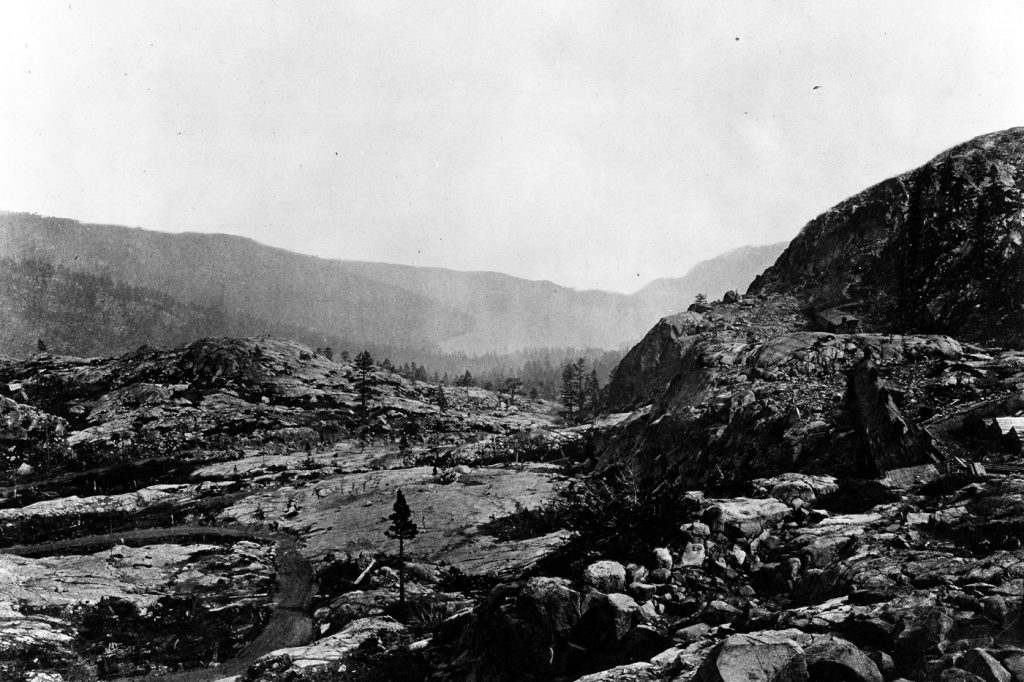
Work on Tunnel No. 6 of the Central Pacific Railroad began on October 14, 1865. Severe winter storms shut it down almost at once. When crews came back in April 1866, they were facing some of the hardest rock on the line at Donner Pass.
The finished Summit Tunnel ran 1,659 ft, the longest the Central Pacific built and the longest on the Transcontinental Railroad. At roughly 7,030 ft above sea level, it was the highest tunnel in the world.
Granite and black powder
Chinese tunnel crews worked three 8-hour shifts, six days a week. The Irish construction foremen put in 12-hour days. By September 1866 all the work was inside the west and east portals, so it went on through the winter of 1866-67.
Progress was slow. Black powder barely scratched the granite, which the construction engineer, John R. Gilliss, described as “medium quality” rock “crossed by seams in every direction.” In February 1867 the Chinese crews switched to nitroglycerine. It was the first time anyone in the United States used it for construction, and its blast pressure was over 100 times greater than black powder. The rate of advance across the tunnel’s four headings climbed sharply. For safety, chemist James Howden made the explosive on site.
A shaft to let in air
To speed things along, crews began a central shaft on August 27, 1866. It measured 8 ft by 12 ft and dropped 72.9 ft to the tunnel. Once the tunnel broke through on August 29, 1867, fresh air could move along its whole length, a real relief for the men inside.
Tracks were laid and the tunnel was complete on November 30, 1867. Gilliss reported that the two headings met with offsets “too small to measure.” The first locomotive passed through the next day, December 1, 1867.
The winter of 1866-67
Donner Pass averages over 400 inches of snow a year. The winter of 1866-67 was the worst recorded in the Sierra Nevada up to then, with a total snowfall of over 44 ft. Snow was still 15 ft deep at the summit in April and 11 ft in May, and it did not clear until July 1867. At both portals the drifts were deep enough that snow tunnels of 50 ft to 200 ft had to be dug so workers could get in and haul out spoil.
The tunnel’s top arched heading had a diameter of 16 ft, and the bottom measured 16 ft wide by 11 ft high. The granite was hard enough that no timbering was needed. The Southern Pacific Company last used the Summit Tunnel in 1993.




