
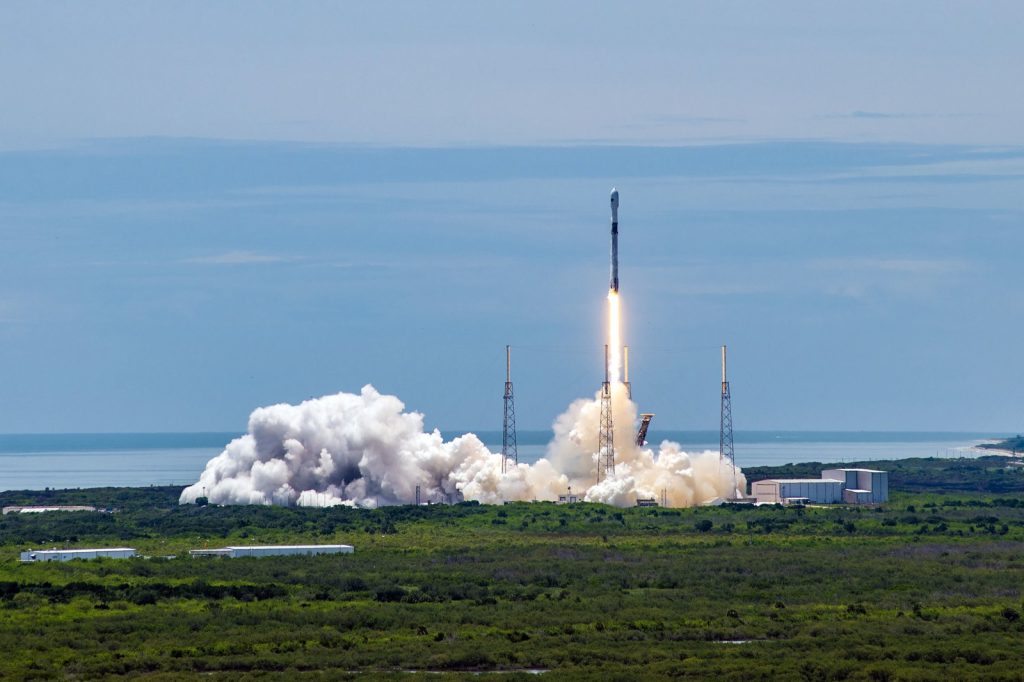
On December 21, 2015, a Falcon 9 first-stage booster that had just put satellites into orbit flipped around, relit its engines, and settled onto a landing pad at Cape Canaveral, Florida. It was the first time an orbital-class rocket’s first stage came back intact and was cleared to fly again.
The aerospace establishment had long called reusability “economically impractical and engineering-wise impossible.” That landing ended the argument. SpaceX later repeated it on autonomous drone ships, which took recovery beyond coastal sites.
The old model: use once, throw away
For more than 60 years before SpaceX arrived, launch vehicles were built to be discarded. A first stage, the biggest and most expensive part of any rocket, either broke apart on re-entry or sank into the ocean once its fuel ran out. Imagine airlines scrapping every plane after one flight and billing passengers for it. Payload costs to orbit ran to tens of thousands of dollars per kilogram.
Elon Musk founded SpaceX in 2002 on the premise that reusability was the only route to mass access to space.
What the filing shows
SpaceX’s S-1 prospectus, filed with the SEC, puts numbers on the result. In 2025 Falcon 9 carried roughly 90% of global commercial orbital launches. The most-flown boosters have each completed 34 successful missions, a pace no single-use program can match. The Space segment brought in $4.1 billion in revenue that year. Consolidated revenue reached $18.67 billion.
The same filing records a net loss of approximately $4.9 billion for 2025. SpaceX spent approximately $3 billion on Starship development in that single year, which the S-1 gives as the main reason the Space segment posted an operating loss.
Starship and the next step
Falcon 9 recovers only its first stage. Starship is designed so that both the Super Heavy booster and the Starship spacecraft can be reflown quickly. It can carry more than 100 metric tons to low Earth orbit in one mission, and NASA has chosen it as the crewed lunar lander for the Artemis program. At Starbase in Texas, the “Mechazilla” mechanical arm has already caught a Super Heavy booster in mid-air.
The reusable launch business also supports SpaceX’s other segments. The company says Starlink has deployed over 9,600 satellites across 164 countries, something it could not have done without cheap Falcon 9 flights.
Valuation
An S-1 amendment filed on June 1, 2026 set a fixed offer price of $135 per share for a Nasdaq listing under the ticker SPCX, planned for June 12, 2026. Roughly 555.6 million Class A shares were on offer, aiming to raise approximately $75 billion at a valuation of approximately $1.75 trillion. That would top Saudi Aramco’s $25.6 billion IPO from 2019 as the largest public offering on record. The valuation works out to a price-to-sales multiple of roughly 94 times. Musk would keep approximately 82% of voting power after the offering through super-voting Class B shares.
Sources
Sources
- How SpaceX Reusable Rockets Reshape the Space Economy: From…
- Reusable Rockets Are Transforming Spaceflight | Global Aerospace




