
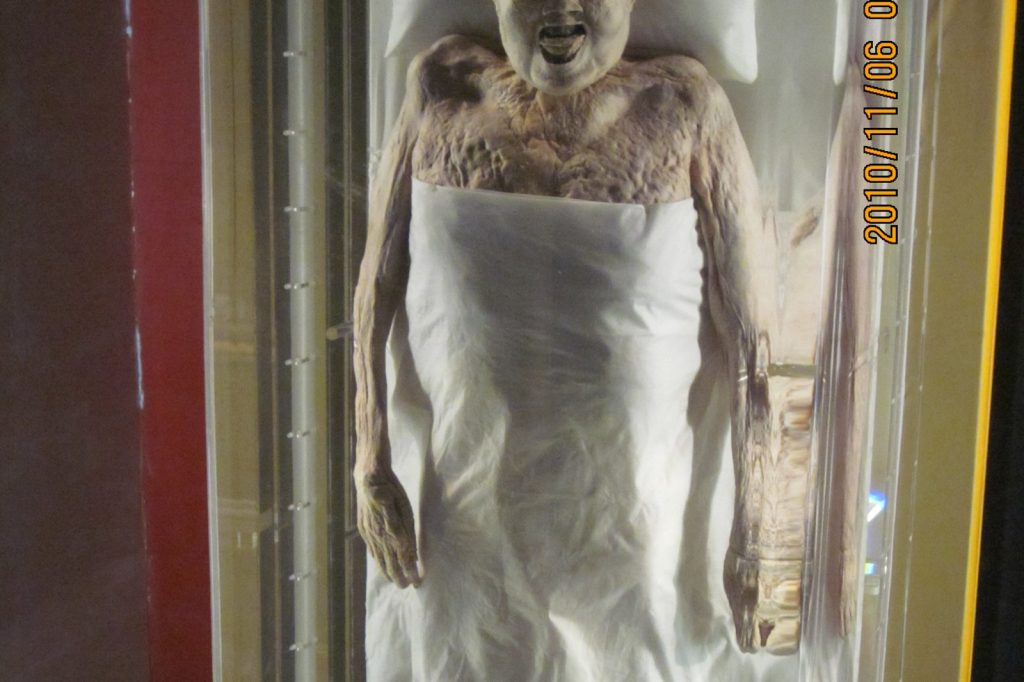
CHANGSHA — The 138 melon seeds found inside Xin Zhui’s stomach did not rot. They did not turn to dust. They remained, intact and identifiable, for more than two millennia.
That single fact has haunted archaeologists since the first reports emerged from the Mawangdui excavation in the early 1970s. Xin Zhui died around 150 BCE.
Her body was sealed inside four nested coffins, buried under a mound known as Horse King Mound on the outskirts of what is now Changsha. When hospital workers digging an air raid shelter broke through into a wooden burial chamber in 1971, they had no idea what they had found. The provincial museum was called.
Formal excavation began in January 1972. More than 1,500 local high school students were brought in to help.
What they uncovered changed the field of ancient preservation. The innermost coffin, when opened, revealed a woman whose skin was still soft. Her joints still bent.
Her internal organs were intact. The melon seeds in her stomach proved she had eaten a meal shortly before death — and that the body had never fully decayed. No one can fully explain why.
The tomb was sealed with layers of charcoal and white clay. The coffins were lacquered.
The burial chamber was airtight. But those conditions exist in other ancient tombs, and none have produced anything like Xin Zhui. She is, by any measure, the best-preserved human body ever recovered from the ancient world.
The consequences of that discovery reach far beyond one hillside in Hunan Province. Archaeologists now study the tomb’s construction methods, the chemical composition of the sealing materials, the specific conditions of temperature and humidity that kept decomposition at bay.
The goal is not academic curiosity. It is replication. If scientists can understand exactly how Xin Zhui was preserved, they may be able to apply that knowledge to modern preservation — of bodies, of organic materials, of archaeological finds that would otherwise be lost to time.
The tomb itself yielded more than just a body. The burial complex contained three tombs, part of a family plot. Silk manuscripts, lacquerware, textiles, and a painted silk banner depicting the afterlife were all recovered.
Those artifacts are now studied in museums around the world. But the body remains the center of attention.
For the 1,500 students who helped excavate the site, the experience was formative. They did not expect to find a 2,140-year-old noblewoman. They expected dirt and rocks.
What they got was an encounter with the ancient world so immediate that it felt like an intrusion into a recent death. That unsettling quality — the sense that Xin Zhui had died last week, not two millennia ago — is what continues to draw researchers and the public alike.
The Hunan Provincial Museum now houses Xin Zhui’s body in a climate-controlled display. Visitors see her as she was found: skin intact, features recognizable, a woman from the Western Han dynasty who looks like she could wake up at any moment. She does not.
She will not. But the questions she raises — about how the ancients preserved their dead, about what we can learn from their methods, about the limits of decay — remain very much alive. What comes next is not a mystery.
It is a research agenda. Scientists will continue to study the tomb’s sealing materials.
They will analyze the chemical environment inside the burial chamber. They will attempt to replicate the conditions that kept Xin Zhui intact for 2,140 years. Whether they succeed is an open question.
But the attempt itself would not exist without the shovels of those hospital workers in 1971, breaking through into a void that contained something no one expected to find.
{“@context”: “https://schema.org”, “@type”: “NewsArticle”, “headline”: “Melon Seeds Found in Stomach of 2,140-Year-Old Mummy Remain Intact”, “description”: “CHANGSHA — The 138 melon seeds found inside Xin Zhui’s stomach did not rot. They did not turn to dust. They remained, intact and identifiable,…”, “datePublished”: “2026-06-24T10:54:00+00:00T09:30:00+00:00”, “author”: {“@type”: “Person”, “name”: “Henry Thomas”}, “publisher”: {“@type”: “Organization”, “name”: “InfoPulse Today”, “url”: “https://newsfeed.infopulsetoday.com/”}}




