
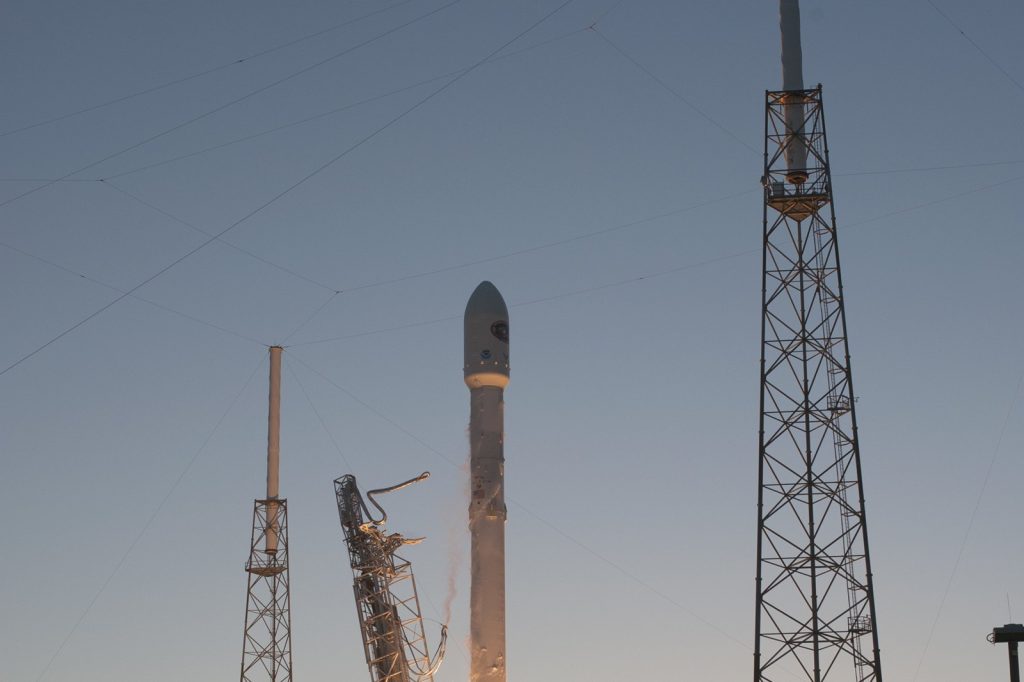
CAPE CANAVERAL, August 1 — Millions of kilometers from Earth, a lone sentinel keeps watch, offering an unprecedented view of our home planet and the powerful forces of the sun that shape its very existence. The Deep Space Climate Observatory, known as DSCOVR, continues its vital mission, delivering critical data from its unique vantage point, a testament to international collaboration and technological prowess. From the L1 Lagrange point, a gravitationally stable position approximately 1.5 million kilometers away, DSCOVR maintains a constant, unbroken gaze.
It sees the sunlit side of Earth, an unparalleled perspective that allows for continuous observation of our planet’s climate and vegetation. This mission, a collaboration between NASA, NOAA, and the U.S. Air Force, represents a remarkable leap in our ability to understand the intricate dance between our star and our world.
The satellite’s journey began on February 11, 2015, lifting off from Cape Canaveral Air Force Station in Florida aboard a SpaceX Falcon 9 rocket. That launch marked a significant milestone for SpaceX, representing its first deep-space mission for NASA and signaling a bold expansion beyond its established low-Earth orbit deliveries. The contract for this launch alone was valued at $97 million, part of the mission’s approximate $340 million total cost.
Eyes on Earth, Eyes on the Sun
DSCOVR’s primary objectives are twofold: to monitor solar wind conditions and to provide early warnings of geomagnetic storms. These solar events have the potential to impact infrastructure on Earth, making DSCOVR’s constant vigilance invaluable. The observatory replaced NASA’s Advanced Composition Explorer (ACE) spacecraft, which had been monitoring space weather since 1997, bringing a new generation of capability to this critical task.
On the ground, scientists describe the detailed information flowing back from DSCOVR. The satellite carries advanced instruments designed for its dual role.
The Plasma-Magnetometer (PlasMag) focuses on the solar wind, while the Earth Polychromatic Imaging Camera (EPIC) captures full-disk images of Earth across multiple wavelengths. These images offer a vivid, real-time look at our planet, informing climate scientists and researchers worldwide.
The Lingering Companion
Yet, the story of DSCOVR’s launch carries an additional, intriguing detail. After successfully delivering the observatory to its intended trajectory, the Falcon 9 rocket’s upper stage was left in a high-altitude orbit. Without sufficient fuel to return to Earth or escape the Earth-Moon system, this 4.4-ton stage has since followed an erratic path, influenced by the gravitational pulls of both the Earth and the Moon.
It remains a silent, unseen companion to the groundbreaking mission it helped enable. As DSCOVR continues its work, the data it transmits promises to unlock further insights into the complex systems governing our planet and the space environment around it.
The continuous stream of information from 1.5 million kilometers away ensures that humanity’s understanding of its place in the cosmos continues to expand, offering a truly global perspective on our climate and the forces that shape it.
Sources
{“@context”: “https://schema.org”, “@type”: “NewsArticle”, “headline”: “SpaceX’s 2015 DSCOVR Launch Enables Lunar Impact 7 Years Later”, “description”: “CAPE CANAVERAL, August 1 — Millions of kilometers from Earth, a lone sentinel keeps watch, offering an unprecedented view of our home planet and the…”, “datePublished”: “2026-08-01T09:30:00+00:00”, “author”: {“@type”: “Person”, “name”: “Isabella Moore”}, “publisher”: {“@type”: “Organization”, “name”: “InfoPulse Today”, “url”: “https://newsfeed.infopulsetoday.com/”}, “citation”: [{“@type”: “CreativeWork”, “url”: “https://en.wikipedia.org/wiki/Deep_Space_Climate_Observatory”}]}




