
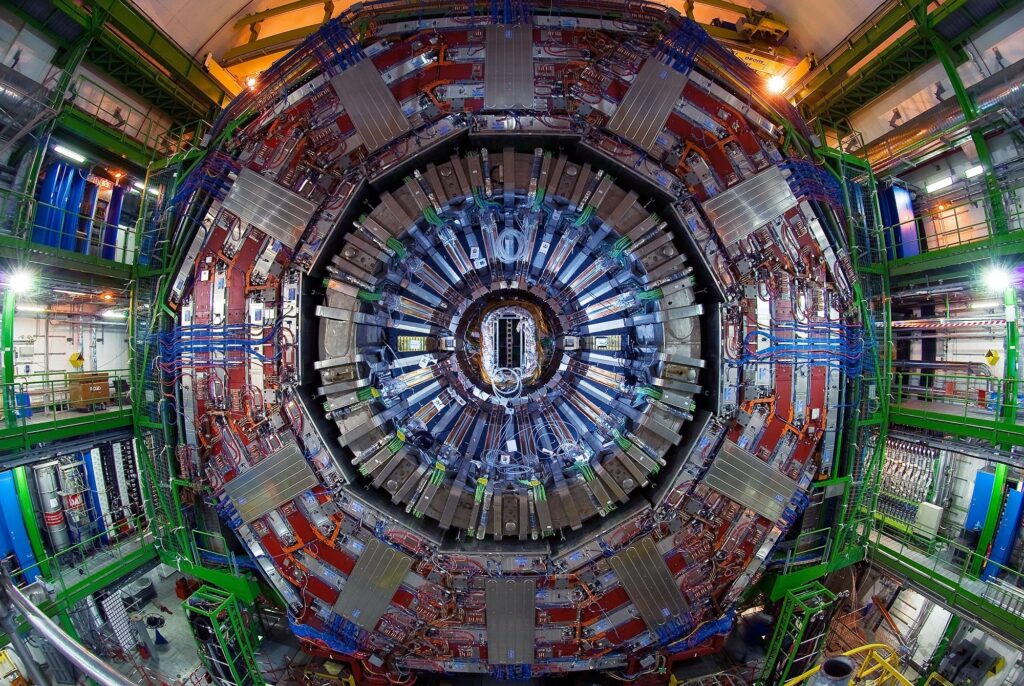
GENEVA, August 14 — The shift is unmistakable: the Large Hadron Collider is pushing deeper into the origin of matter, recreating conditions that vanished microseconds after the Big Bang and hunting for violations of fundamental quantum rules that could explain why our universe is made of something rather than nothing. The world’s largest and most powerful particle accelerator, operated by the European Organization for Nuclear Research (CERN) near Geneva, Switzerland, has been at the forefront of this quest since its inauguration in 2008.
By accelerating protons and heavy ions to nearly the speed of light and colliding them at energies up to 13 tera-electronvolts (TeV), the LHC is probing the extreme edges of physics.
Recreating the early universe
At the heart of this effort is the ALICE detector. Short for A Large Ion Collider Experiment, ALICE is built to study the quark-gluon plasma, a state of matter that existed in the first microseconds after the Big Bang. By smashing heavy ions together, ALICE recreates this primordial soup, allowing scientists to investigate how baryon number—a quantum number that remains constant in most particle interactions—may have been violated in the early universe.
Watch this space: if baryon number violation is observed, it could help explain the asymmetry between matter and antimatter. Another critical experiment, LHCb (Large Hadron Collider beauty experiment), is zeroing in on the decays of B mesons, particles that contain a bottom quark.
Its mission: to search for charge conjugation parity (CP) violation, a phenomenon first observed in 1964 by James Cronin and Val Fitch in the decay of neutral kaons. CP violation is one of the three conditions outlined by Andrei Sakharov in 1967 as necessary to explain the matter-antimatter asymmetry we observe today. LHCb has already delivered.
In 2020, it announced the observation of tetraquarks, exotic particles that could provide new insights into the strong interaction and the conservation of baryon number. What’s changing here is the pace—each discovery edges physicists closer to understanding the forces that shaped our universe.
A collider in constant evolution
The LHC’s Run 3, which began in July 2022 after a three-year shutdown for upgrades, is expected to operate until 2025. But the ambition doesn’t stop there. Plans for a high-luminosity upgrade (HL-LHC) are already in motion, with operations projected to begin around 2029.
The goal? To increase the LHC’s luminosity by a factor of 10, enabling the collection of significantly more data.
More data means more opportunities to probe rare processes—processes that may finally reveal baryon number violation or other phenomena that have, so far, eluded detection. The trend underneath is clear: the LHC is not just a machine; it’s a evolving platform for discovery, constantly pushing the boundaries of what’s possible.
What’s next
With Run 3 still underway and the HL-LHC on the horizon, the LHC’s potential is far from exhausted. The next chapter will be defined by higher luminosity, more collisions, and a deeper dive into the fundamental questions of our universe. The shift is toward precision, scale, and the rare events that could rewrite physics.
Watch this space.
Sources
{“@context”: “https://schema.org”, “@type”: “NewsArticle”, “headline”: “Large Hadron Collider Probes Quark-Gluon Plasma for Matter-Antimatter Clues”, “description”: “GENEVA, August 14 — The shift is unmistakable: the Large Hadron Collider is pushing deeper into the origin of matter, recreating conditions that vanished microseconds…”, “datePublished”: “2026-08-14T09:30:00+00:00”, “author”: {“@type”: “Person”, “name”: “Maria Romano”}, “publisher”: {“@type”: “Organization”, “name”: “InfoPulse Today”, “url”: “https://newsfeed.2bme.xyz/”}, “citation”: [{“@type”: “CreativeWork”, “url”: “https://en.wikipedia.org/wiki/Large_Hadron_Collider”}]}




