
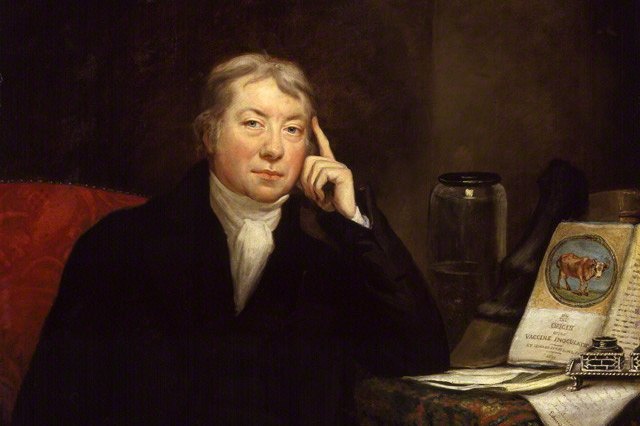
LONDON, July 8 — The mechanics of immunity were a mystery in 1796, but Edward Jenner saw a pattern and bet an eight-year-old boy’s life on it. The claim: that a mild infection from a cow could shield a human from smallpox, a disease that killed an estimated 300-500 million people in the 20th century alone. The catch: Jenner had to prove it, step by step, with no modern lab and no safety net.
On closer reading, the story is not merely a triumph of compassion; it is a case study in clinical logic. Jenner, an English physician and scientist born in Berkeley, Gloucestershire, had trained in London under John Hunter, a surgeon known for his insistence on empirical observation.
That training paid off when Jenner noticed that milkmaids who contracted cowpox — a mild disease — seemed immune to smallpox. He did not simply take their word for it. In May 1796, he inoculated James Phipps, an eight-year-old boy, with material taken from a cowpox sore on a milkmaid’s hand.
Phipps developed a mild fever but recovered. Then came the real test.
In July 1796, Jenner exposed Phipps directly to smallpox. The boy showed no symptoms. The immunity held.
Jenner published his findings in 1798 in a book titled “An Inquiry into the Causes and Effects of the Variolae Vaccinae.” The term “vaccine” itself derives from “vacca,” the Latin word for cow — a direct nod to the source material. The British government moved with unusual speed for the era. By 1840, it had banned variolation, the riskier earlier method of deliberately infecting people with smallpox to produce a mild case, and began providing free vaccination.
The mechanism behind the method
The mechanics here are straightforward in retrospect but were revolutionary at the time. Jenner had essentially weaponised a benign pathogen to train the immune system against a lethal one. He did not understand the cellular biology — the germ theory of disease was still decades away — but he understood cause and effect.
The boy survived. The immunity held.
The data was replicable. Jenner’s work did not stop with smallpox. His method laid the foundation for modern immunology and vaccination, a framework that would eventually save countless lives beyond the original disease.
The World Health Organization declared smallpox eradicated in 1980, the first disease ever eliminated by human effort. Follow the money: eradication meant the end of vaccination campaigns, the end of treatment costs, and the end of an estimated 300-500 million deaths that would have occurred in the 20th century alone had the disease persisted.
The man behind the science
Jenner was not solely a physician. He studied natural history, including the behavior of cuckoos, and was elected a Fellow of the Royal Society in 1789. That breadth of curiosity — a willingness to observe patterns across species — is what led him to the cowpox-smallpox connection.
He was not the first to notice the milkmaid immunity, but he was the first to test it systematically and publish the results. The British government’s 1840 ban on variolation and shift to free vaccination marked one of the earliest public health interventions by a modern state.
It was a direct consequence of Jenner’s published data. The catch: the transition took more than four decades, a reminder that even clear evidence does not always produce immediate policy change.
What to watch next
The legacy of Jenner’s work is now embedded in every vaccine development pipeline. The same principle — expose the immune system to a harmless version of a pathogen to build protection — underpins modern vaccines for polio, measles, influenza, and Covid-19. Researchers continue to refine the method, using genetic sequencing and synthetic biology to accelerate development.
The question now is whether the global infrastructure built on Jenner’s foundation can respond as decisively to emerging threats as it did to smallpox. Consult your doctor for medical advice.




