
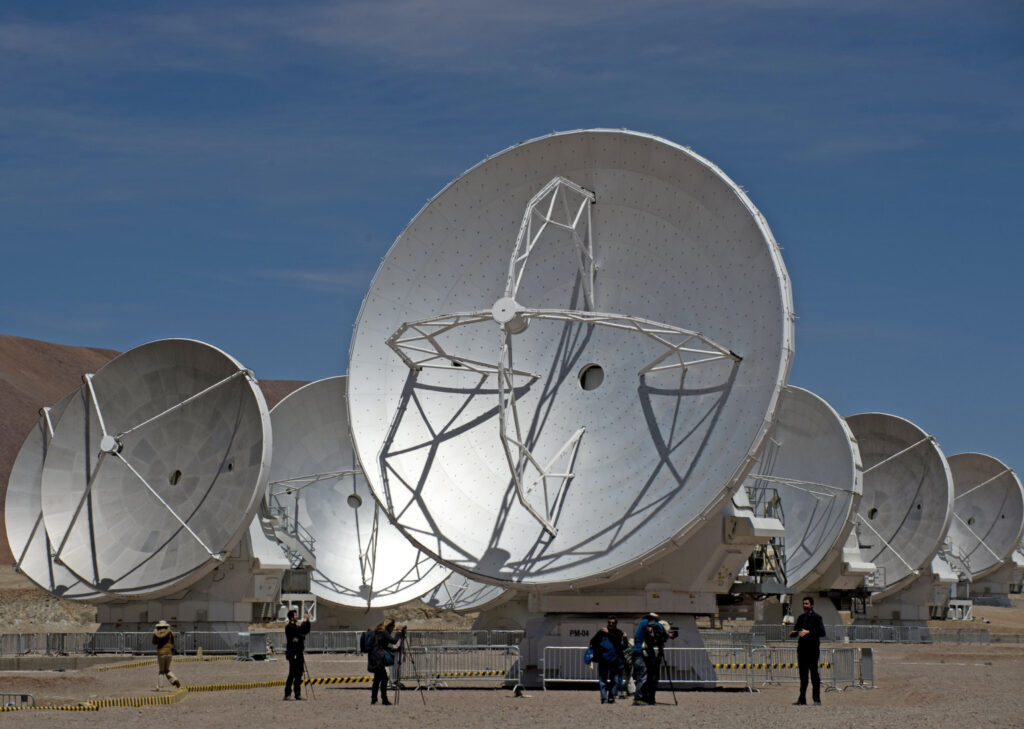
SAN PEDRO DE ATACAMA, July 13 — The wind rips across the Chajnantor plateau at 5,000 meters, a thin, oxygen-starved gale that sends dust skittering across the world’s most powerful radio telescope. Up here, in the high Atacama Desert of northern Chile, the sky is so dry and clear it is almost black in the daytime. This is the home of the Atacama Large Millimeter/submillimeter Array — ALMA — and it is rewriting the story of the cosmos, one faint radio whisper at a time.
The array is a sprawling network of 66 high-precision antennas, each one a dish that peers into the universe at millimeter and submillimeter wavelengths. It is a kind of vision invisible to the human eye, tuned to the cold, dark clouds of gas and dust where stars are born and complex chemistry unfolds.
ALMA began scientific operations in 2011, and since then, it has become the premier instrument for detecting the faint molecular signals that drift across interstellar space. Its breakthrough came early. In August 2012, astronomers using ALMA reported the detection of glycolaldehyde in the Sagittarius B2 molecular cloud.
That might sound like a mouthful of lab jargon, but glycolaldehyde is a simple sugar — a building block for the more complex molecules that make up life. Finding it in a cloud of gas far from Earth was a seismic moment.
The detection was only possible because of ALMA’s extraordinary sensitivity and resolution. The telescope, an international partnership involving Europe, North America, East Asia, and the Republic of Chile, can pick up signals so faint that earlier instruments simply could not see them. On the ground, residents describe the antennas as a field of giant white flowers, tilting and turning in perfect synchronization, all focused on the same patch of sky.
A New Window on the Universe
The discovery of glycolaldehyde was not a fluke. It was the first of many. Since that 2012 finding, ALMA has been used to detect other complex organic molecules in space, steadily building a catalog of the chemical inventory of the cosmos.
Each new detection adds a piece to the puzzle of how life’s ingredients are distributed across the galaxy. The array sits at an altitude of about 5,000 meters — 16,400 feet — in one of the driest places on Earth.
That altitude is no accident. Water vapor in the atmosphere absorbs millimeter-wavelength light, making it nearly impossible to observe these signals from lower elevations. Here on the plateau, the air is thin and bone-dry, offering a clear window into the universe that is unmatched anywhere on the planet.
By nightfall, the temperature plunges, and the antennas are silhouetted against a sky thick with stars. Astronomers huddle in the control building, bundled against the cold, watching data stream in from the array.
It is a scene of quiet intensity — scientists waiting for a signal that has traveled far to reach them.
What Comes Next
The partnership that built ALMA — a coalition of nations pooling resources and expertise — has proven that big science can work across borders. The telescope is not just a machine; it is a monument to what is possible when countries collaborate on something ambitious. And it is still early days.
The array continues to push deeper into the universe, searching for more complex molecules, more distant galaxies, more clues to how stars and planets — and perhaps life — form. For now, the antennas keep turning.
The data keeps flowing. And in the high desert of Chile, the faint radio signals from the far reaches of the galaxy are being heard, loud and clear.




