
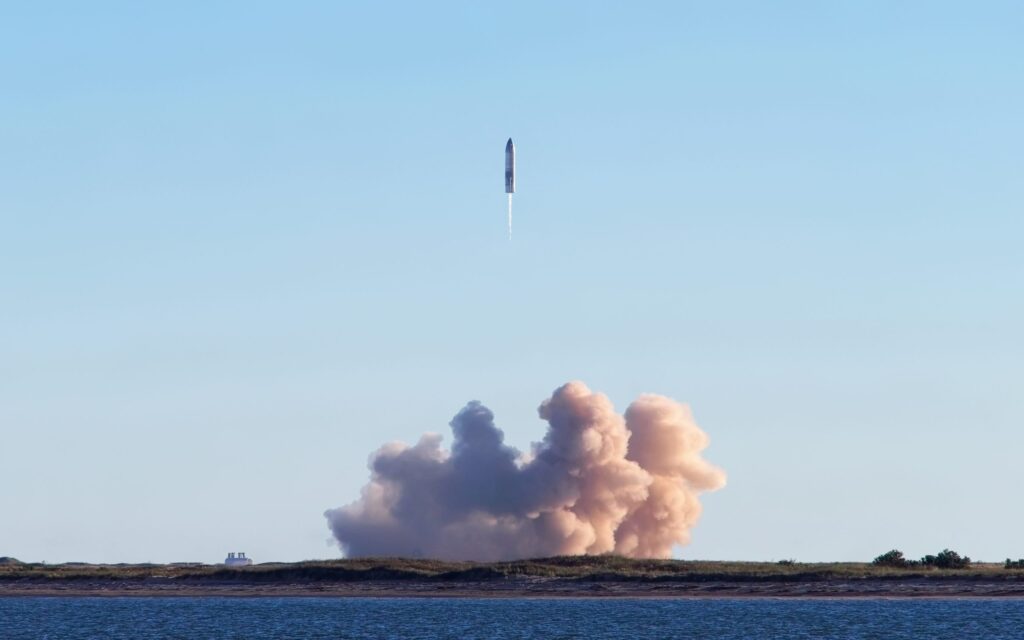
On May 27, 2025, at 23:36 coordinated universal time, SpaceX carried out the ninth flight test of its Starship launch system. The test featured Ship 35 paired with Booster 14‑2, the first Super Heavy booster to fly a second time.
Liftoff occurred from the company’s Texas launch complex at 6:36 p.m. local clock time, drawing attention from space‑watchers and industry analysts. The flight profile aimed to repeat the objectives that had been set for Flights 7 and 8, both of which ended without success. While the booster was not slated for a catch‑and‑return maneuver, engineers planned for it to splash down after a landing‑burn sequence.
Instead of a nominal trajectory, the booster was flown at a deliberately steeper angle of attack to stress its aerodynamic surfaces and collect data on control behavior during descent. During ascent, Ship 35 managed to hit the velocity target that had been defined for the mission.
This marked the first time any V2‑configured Starship upper stage achieved that speed, a notable step forward for the program. However, the upper stage encountered multiple problems: a leak in its propellant feed system and a loss of attitude control. These issues prevented Ship 35 from completing most of its planned on‑orbit tasks.
Booster 14‑2, after completing the aggressive‑angle descent phase, began its landing burn. Shortly after ignition, the booster broke apart over the pre‑designated splashdown zone in the Gulf of Mexico.
Although the vehicle did not survive intact, the test still fulfilled its primary goal of gathering high‑angle‑of‑attack data, which engineers consider valuable for refining future flight‑control algorithms. The outcome underscores SpaceX’s iterative test philosophy: each flight, whether ending in a soft landing, a splashdown, or a breakup, supplies information that pushes the design envelope. By deliberately pushing the booster beyond normal flight conditions, the team obtained insight into structural loads, control authority, and thermal environments that would be difficult to predict through simulation alone.
Looking ahead, the data from Flight 9 will feed into the development roadmap for Starship. The company’s long‑term ambition remains to produce a fully reusable launch vehicle capable of transporting crews and cargo to the Moon, Mars, and other destinations across the solar system.
Success in that endeavor would represent a major step toward a sustained human presence beyond Earth. With each successive test, SpaceX accumulates operational knowledge and hardware maturity. The fact that Ship 35 reached its planned velocity, despite the setbacks it suffered, demonstrates measurable progress in the upper‑stage propulsion and guidance systems.
Observers anticipate that upcoming flights will build on these lessons, moving the system closer to routine, rapid‑reuse operations. As the next launch window approaches, the space community watches closely.
The continued effort to push the vehicle’s performance boundaries—through aggressive flight profiles, rigorous instrumentation, and honest assessment of failures—keeps the program on a path that many believe could eventually make interplanetary travel practical.




