
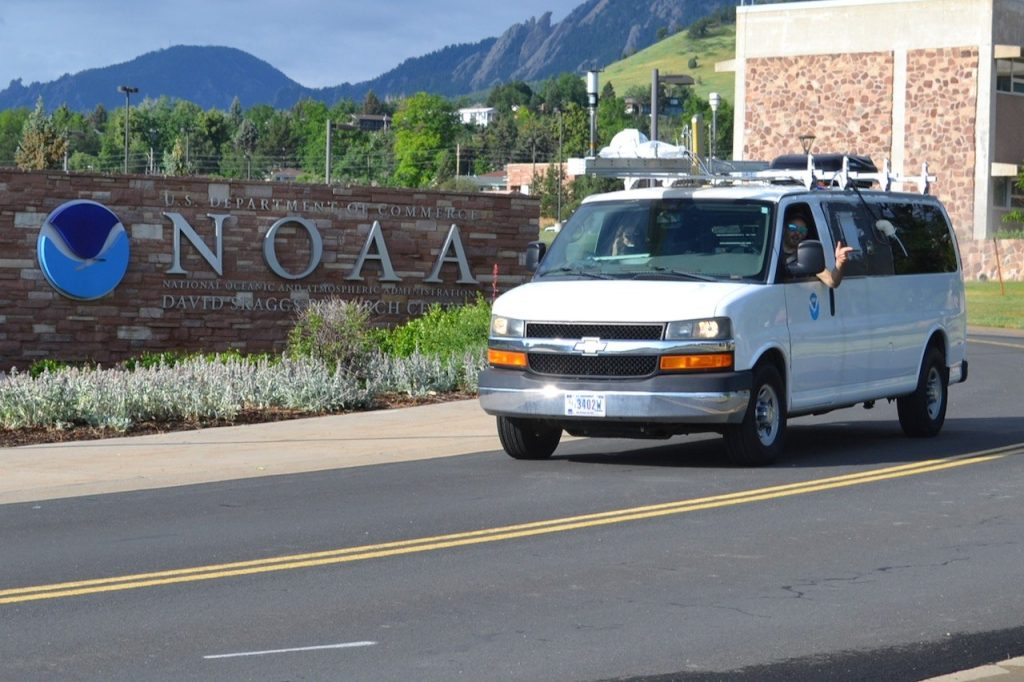
BOULDER, July 7 — On a clear Colorado morning, Daniel Murphy walks into his office at the National Oceanic and Atmospheric Administration carrying data that, by his own description, is unprecedented. The atmospheric scientist has worked at NOAA’s Boulder campus since 1990, and the particles he is now finding in the stratosphere are unlike anything he has seen before. Murphy is the lead author of a 2024 study published in Geophysical Research Letters that documented a discovery: aluminum from disintegrating satellites has turned up in stratospheric aerosol particles.
The research drew on samples collected between 2022 and 2024 by NASA’s WB-57 high-altitude research aircraft, flying at 18 kilometers — roughly 11 miles — above the Earth’s surface. What the samples revealed is that 10% of stratospheric sulfuric acid particles now contain aluminum.
That figure, Murphy’s team found, has been climbing since 2019. The mechanism is straightforward. When satellites reach the end of their operational life, they are deliberately deorbited and incinerated in the atmosphere.
That incineration vaporizes the spacecraft’s metal components, including aluminum, which then condenses into particles that linger in the stratosphere. Murphy holds a Ph.D. in atmospheric chemistry from the University of California, Berkeley, and he has spent decades studying the chemistry of the upper atmosphere.
This, he says, is new. “The current rate of satellite re-entries is unprecedented,” Murphy has stated. He warned that if planned mega-constellations continue to grow, the cumulative impact could be significant.
The scene in the stratosphere is changing faster than regulators have kept pace. Murphy testified before Congress in March 2024, appearing before the House Committee on Science, Space, and Technology to describe what his team had found. He called for more research into the long-term effects of satellite incineration on both ozone chemistry and climate.
His work has not gone unnoticed outside the scientific community. Environmental groups have cited Murphy’s findings as they push the Federal Communications Commission to regulate satellite deorbits more tightly.
The FCC currently licenses satellite constellations, but critics argue the agency has not adequately considered the atmospheric consequences of burning up thousands of spacecraft. By nightfall in Boulder, Murphy is still at his desk. The WB-57 flights that produced his data were a rare window into a part of the atmosphere that most people never think about.
But the implications, he has told colleagues, stretch from the ozone layer down to the ground.
The mechanics of a changing stratosphere
The stratosphere is not empty. It contains a thin haze of sulfuric acid particles, formed naturally from volcanic sulfur dioxide and from human-caused emissions. Those particles play a role in ozone chemistry and in how the atmosphere reflects and absorbs sunlight.
Murphy’s study found that aluminum now makes up a measurable fraction of those particles — a fraction that is growing. The WB-57 is one of the few aircraft capable of sampling at 18 kilometers.
It is a Cold War-era bomber converted for high-altitude research, and its flights between 2022 and 2024 gave Murphy’s team direct samples of what is actually in the stratosphere right now. The aluminum they found did not come from volcanoes or from natural dust. It came from satellites.
The timing matters. The first large satellite constellations began launching in the late 2010s.
As those spacecraft age out and are replaced, the number of re-entries is accelerating. Murphy has pointed out that the 10% figure is not static — it has been increasing since 2019, and there is no reason to expect that trend to reverse.
A scientist on the record
Murphy has been at NOAA since 1990, long before the current boom in satellite launches. His career has spanned shifts in how scientists understand the upper atmosphere, from the discovery of the ozone hole to the present moment. He holds a Ph.D. from UC Berkeley and has authored dozens of peer-reviewed papers.
But the 2024 study in Geophysical Research Letters has drawn attention far beyond the usual academic circles. In his March 2024 testimony before the House Science Committee, Murphy laid out the evidence plainly.
The aluminum particles are there. Their concentration is rising. The long-term effects on ozone chemistry and climate are not yet understood.
He called for more research. Environmental groups have taken up his findings as evidence that the FCC should require satellite operators to account for atmospheric impacts when applying for deorbit licenses.
The argument is that the current regulatory framework was designed for a time when satellite re-entries were rare. That time has passed.
What comes next
The planned growth of mega-constellations means thousands more satellites will enter the stratosphere in the coming years. Murphy has stated that if those plans proceed, the cumulative impact could be significant. What that significance looks like in practice — whether it shifts ozone concentrations, alters particle chemistry, or affects how the stratosphere interacts with the rest of the atmosphere — remains an open question.
For now, the data from the WB-57 flights stands as a baseline. Murphy and his team at NOAA continue to analyze samples.
The 2024 study was not the end of the research; it was the beginning of a new line of inquiry.




