
LONDON, July 10 — The world’s monetary system, built for centuries on the tangible weight of precious metal, now rests entirely on government-issued fiat currency. The last major nation to sever its formal link to gold was Switzerland, which exited the gold standard in the year 2000. That departure marked the final chapter of a long retreat that began in earnest on August 15, 1971, when President Nixon ended dollar-to-gold convertibility for the United States.
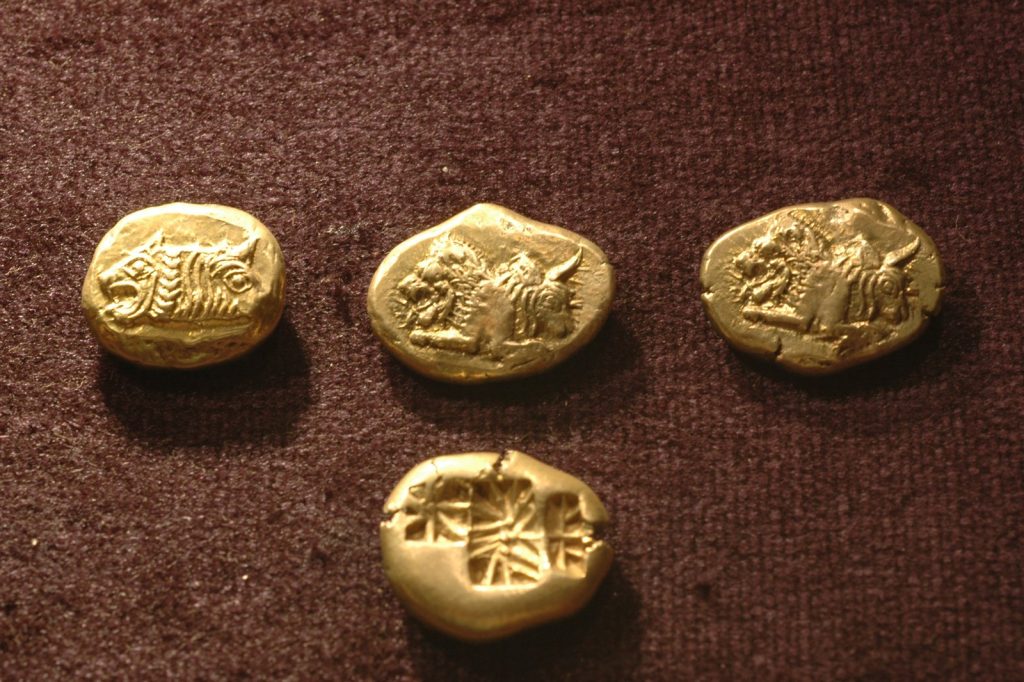
The story of coinage itself begins much earlier. According to the historical record, the first standardized metal coins were struck in Lydia around 600 BCE under King Alyattes.
These early coins were made from electrum. The innovation did not remain confined to Anatolia. It spread to ancient Greece, to Persia, and eventually to Rome, laying the foundation for monetary exchange across the Mediterranean world for centuries.
For much of modern history, the gold standard served as the anchor for international finance. The United Kingdom formally adopted it in 1821.
Germany followed in 1871, Japan in 1897, and the United States enshrined the standard into law with the Gold Standard Act of 1900. Under that act, the U.S. dollar was defined as 23.22 grains of fine gold. Officials confirmed that this system provided a fixed measure of value, tying the currency of each participating nation to a specific quantity of the metal.
The geopolitical landscape shifted dramatically after World War II. In 1944, delegates from 44 allied nations gathered at Bretton Woods, New Hampshire, to design a new international monetary order. The Bretton Woods Agreement fixed the U.S. dollar at $35 per troy ounce of gold.
Other major currencies were then pegged to the dollar, creating a system in which the greenback served as the world’s primary reserve currency, backed by the U.S. gold stock. That arrangement held for nearly three decades.
But by the early 1970s, persistent U.S. trade deficits and rising inflation had put pressure on the system. Foreign governments, particularly France, began demanding gold for their dollar holdings. The record shows that President Nixon, facing a run on U.S. gold reserves, announced on August 15, 1971, that the United States would no longer convert dollars into gold at the fixed rate.
The move effectively ended the Bretton Woods system and pushed the world toward a regime of floating fiat currencies — money not backed by a physical commodity but by the full faith and credit of the issuing government. The strategic context is clear.
For the United States, the decision gave the Treasury and the Federal Reserve far greater flexibility to manage the domestic economy. Monetary policy could now respond to unemployment, inflation, and recession without the constraint of a fixed gold peg. For other nations, however, the end of Bretton Woods introduced new volatility.
Exchange rates began to float, and the value of currencies became subject to market forces and the credibility of central banks. Switzerland’s departure from the gold standard in 2000 was the last act of a long historical process. The Swiss franc had been one of the world’s most stable currencies, and its link to gold was seen by many as a symbol of the country’s financial conservatism.
Officials confirmed that the move to fully fiat money was a practical recognition that the gold standard no longer suited the needs of a modern, globalized economy. The evolution from Lydian electrum coins to digital fiat currency spans more than 2,600 years.
The gold standard dominated the 19th and early 20th centuries, providing a common discipline for the world’s major economies. The United Kingdom led the way in 1821, followed by Germany in 1871, Japan in 1897, and the United States in 1900. Each nation tied its currency to a fixed weight of gold, creating a system in which international trade could be settled with confidence.
The Bretton Woods system represented a modified gold standard, with the dollar at its center. The fixed rate of $35 per troy ounce of gold was intended to prevent the competitive devaluations that had plagued the interwar period.
For a quarter-century, it worked. But the fundamental tension between expanding global trade and a limited supply of gold eventually proved unsustainable. Nixon’s 1971 announcement was the decisive break.
The dollar was no longer “as good as gold” in the sense of a guaranteed conversion. The world moved to a system in which the value of money depended on the policies of central banks and the confidence of markets. The last major country to leave the gold standard was Switzerland in 2000.
What to watch next. The shift to fiat currency has given central banks unprecedented power to expand the money supply.
That power has been used aggressively in recent decades, particularly during financial crises. The long-term consequences of this monetary architecture remain a subject of debate among economists and policymakers. The historical trajectory — from Lydian electrum to Swiss fiat — suggests that the form of money evolves with the needs of the state and the economy.
Whether the current system will prove durable over centuries, as gold did, is an open question.




