
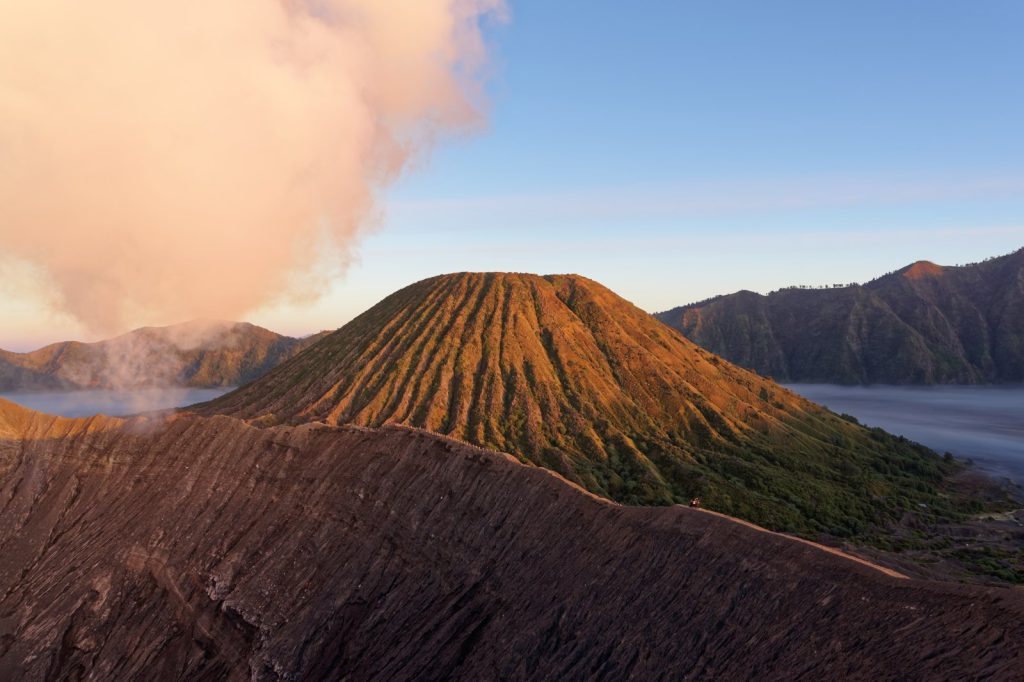
What the Ring of Fire Really Is
The term Ring of Fire describes a horseshoe‑shaped zone of volcanoes and earthquake belts that follows the edge of the Pacific Ocean for about 40,000 kilometres. It is not a single structure but the surface manifestation of plate tectonics all around that ocean. The Earth’s lithosphere is broken into rigid plates that grind, spread, and dive past one another. Along the Pacific margin, dense oceanic plates slip beneath lighter continental plates in a process called subduction. As the sinking plate descends and warms, water bound in its rocks is released, which lowers the melting temperature of the mantle above and creates magma. This magma rises to the surface, building the volcanic chains that define the belt. The same convergent motions also generate the planet’s largest earthquakes; roughly three‑quarters of the world’s active volcanoes and about ninety percent of its seismic events occur along this ring.
Why Indonesia Lies at the Heart of the Belt
Indonesia occupies one of the most complicated junctions on the Ring of Fire. Here the Indo‑Australian plate plunges beneath the Eurasian plate along the Sunda Trench, while the Pacific and Philippine Sea plates push in from the east. The interaction creates a roughly 5,000‑kilometre arc of islands — Sumatra, Java, Bali, Nusa Tenggara and the islands beyond — that is built almost entirely by volcanism driven by subduction. The nation hosts 127 active volcanoes, more than any other country, and close to ninety million people live near enough to feel their impact. Prominent examples such as Anak Krakatau, Semeru, Merapi, Lewotobi and Ile Lewotolok are all offspring of the same tectonic engine.
The Global Nature of the Belt
Because the Ring of Fire stretches around the entire Pacific rim, periods of heightened activity often appear simultaneously in distant locations. In the same weeks that Indonesian volcanoes show increased unrest, Guatemala’s Fuego maintains its near‑constant explosions, Ecuador’s Reventador stays active, and, just outside the Pacific boundary, Italy’s Etna produces its own vivid eruptions. These events are not linked to one another; each volcano sits on a separate plate boundary and follows its own timetable. What they share is the common setting of convergent margins where plates meet.
Does a Cluster of Eruptions Signal a Larger Catastrophe?
The sight of many volcanoes erupting at once naturally raises the question of whether a big event is imminent. Scientific consensus says no. There is no known mechanism that allows distant volcanoes to trigger each other, and no evidence that a run of simultaneous eruptions forecasts a global disaster. Subduction is a continuous, ongoing process; at any given moment dozens of volcanoes along the ring are erupting somewhere. Large earthquakes can, on rare occasions, nudge a neighbouring volcano that is already primed, but this is a strictly local effect, not a planet‑wide chain reaction. The useful takeaway is not fear but understanding. Nations that live on the Ring — Indonesia, Japan, the Philippines, Chile and the U.S. Pacific Northwest — invest heavily in monitoring, early‑warning systems, hazard maps, exclusion zones, evacuation drills and trust in the agencies that watch the mountains. The fire is permanent; the aim is simply to live wisely alongside it.
Now count words. Need to count manually approximate. Let’s count each paragraph.
I’ll count words per paragraph.
Paragraph 1 (
What the Ring of Fire Really Is
plus paragraph):
Words:
“The”(1) “term”(2) “Ring”(3) “of”(4) “Fire”(5) “describes”(6) “a”(7) “horseshoe‑shaped”(8) “zone”(9) “of”(10) “volcanoes”(11) “and”(12) “earthquake”(13) “belts”(14) “that”(15) “follows”(16) “the”(17) “edge”(18) “of”(19) “the”(20) “Pacific”(21) “Ocean”(22) “for”(23) “about”(24) “40,000”(25) “kilometres.”(26) “It”(27) “is”(28) “not”(29) “a”(30) “single”(31) “structure”(32) “but”(33) “the”(34) “surface”(35) “manifestation”(36) “of”(37) “plate”(38) “tectonics”(39) “all”(40) “around”(41) “that”(42) “ocean.”(43) “The”(44) “Earth’s”(45) “lithosphere”(46) “is”(47) “broken”(48) “into”(49) “rigid”(50) “plates”(51) “that”(52) “grind,”(53) “spread,”(54) “and”(55) “dive”(56) “past”(57) “one”(58) “another.”(59) “Along”(60) “the”(61) “Pacific”(62) “margin,”(63) “dense”(64) “oceanic”(65) “plates”(66) “slip”(67) “beneath”(68) “lighter”(69) “continental”(70) “plates”(71) “in”(72) “a”(73) “process”(74) “called”(75) “subduction.”(76) “As”(77) “the”(78) “sinking”(79) “plate”(8




