
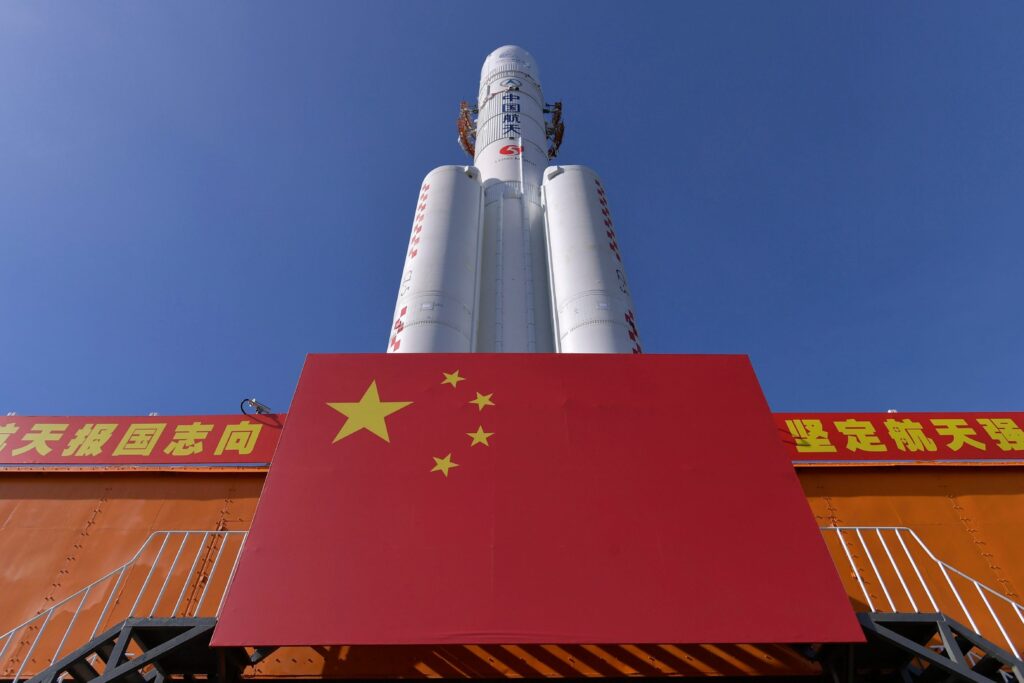
WENCHANG, July 10 — The story begins not with a roar, but with a hush. For those involved in China’s space programme, the silence that followed the landing of the Long March 10B’s first stage was the sound of a door swinging open. On a landing pad near the Wenchang launch complex, a booster that had just hurled a payload toward the heavens settled back onto Earth on four deployable legs, its titanium grid fins still warm from the friction of reentry.
China had, for the first time, recovered a liquid-propellant rocket stage intact. The China National Space Administration confirmed the landing accuracy was within 50 metres of the target point — a bullseye by any measure.
At its heart, this was a feat of controlled fury. The rocket’s first stage performed a boostback burn to reverse its trajectory, then an entry burn to slow its descent through the atmosphere, and finally a landing burn that brought the vehicle to a vertical stop. The autonomous guidance system adjusted the trajectory in real time, a capability made possible by the rocket’s choice of propellant: liquid kerosene and liquid oxygen, which can be reignited in flight.
Unlike the solid-fuel boosters China has long relied upon — which burn until they are spent and then fall away forever — the Long March 10B’s engines could be throttled and relit, making reusability a practical reality.
Technology borrowed and refined
The technologies that made this recovery possible will look familiar to anyone who has watched a Falcon 9 booster come home. The Long March 10B used grid fins — those cross-hatched control surfaces made of titanium alloy — to steer aerodynamically during reentry, and deployable landing legs to absorb the impact of touchdown. The CNSA has not hidden the lineage; the agency has described the recovery as relying on “technologies similar to those used by SpaceX’s Falcon 9.” But for China, this is not merely an imitation.
It is the first step in a domestic programme of reuse that could reshape the economics of its space launches. The significance of this test extends well beyond the landing pad.
China has flown suborbital reusable vehicles before — a reusable experimental spacecraft was tested in 2021 — but those were experimental craft, not the first stage of a heavy-lift launcher designed for orbital missions. The Long March 10B is a different class of machine. Its recovery marks the first time China has brought back a liquid-propellant rocket stage from a full orbital-class flight, and the CNSA has made clear that the technology will be refined for future Long March 10 variants, including those destined for crewed lunar missions.
What this means for the moon
For those involved in planning China’s human spaceflight programme, the stakes are immense. A reusable first stage on a crew-rated rocket means that the most expensive part of the vehicle — the engines, the avionics, the structure — can be flown again and again. On a programme aimed at landing astronauts on the Moon, that could mean the difference between a handful of expensive, one-off missions and a sustainable cadence of flights.
The CNSA has not yet said how many times the Long March 10B’s first stage might be reused, or what the cost savings might be. But the trajectory is clear: China is building toward a lunar architecture that does not throw its hardware away.
The landing itself was a controlled burn, not a crash. The stage slowed its velocity before touching down vertically, guided by the autonomous system that adjusted its descent in real time. The grid fins, made of titanium alloy, provided aerodynamic control during the high-speed passage through the atmosphere, while the landing legs absorbed the final impact forces.
The CNSA reported the landing accuracy as within 50 metres of the designated site — a precision that suggests the guidance algorithms are already performing at a level that could support routine recovery operations.
A long road ahead
One successful landing does not make a reusable fleet. The Long March 10B’s recovery is a proof of concept, not a production system. The CNSA will need to demonstrate that the stage can be refurbished and flown again, that the engines can survive multiple cycles, and that the landing reliability is high enough to risk crewed missions.
But the path is now visible. The boostback burn, the entry burn, the landing burn — each was executed in sequence, and each worked.
For a space programme that has moved methodically from orbital stations to lunar sample returns to plans for a crewed landing, this test is a quiet milestone. It does not carry astronauts. It does not break speed records.
But it does something that no Chinese rocket has done before: it came home. And for those involved, that is the beginning of a much longer story.




